Why Beginners Overtrade, and How to Stop
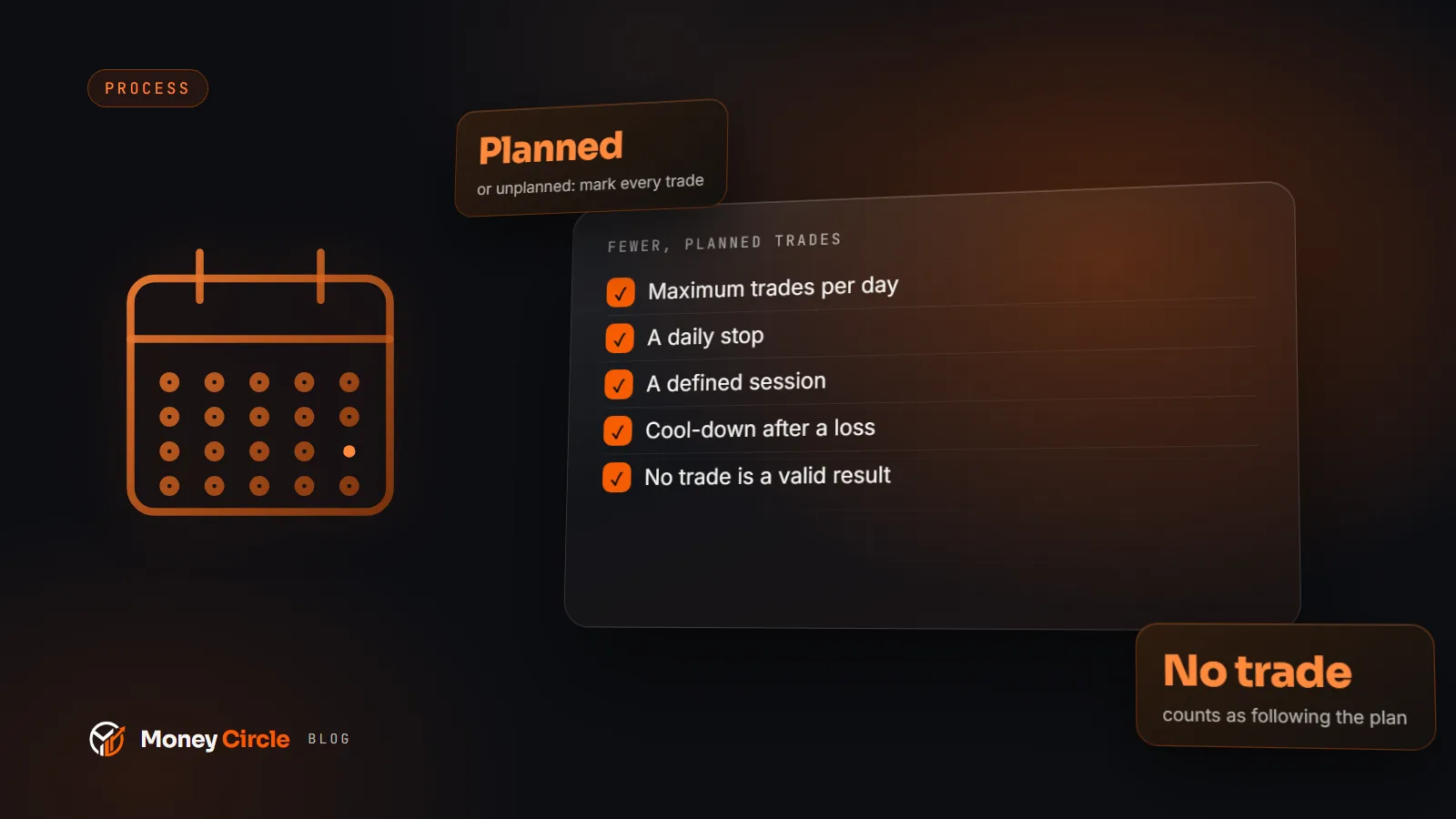
Overtrading drains accounts and focus. Learn why beginners do it and how trade caps, a daily stop and a waiting rule help.
Overtrading is one of the most common problems new traders have, and one of the least recognised. It does not feel like a mistake while it is happening. It feels like being active, seizing opportunities, learning by doing. Only later, when you look at the journal or the statement, do you see a day of twelve trades where three were planned.
This guide explains what overtrading is, why it happens, how to spot it in your own record, and what to do about it. It is educational, not advice, and it makes no claim about how many trades you should take, since that depends on your plan.
What overtrading means
Overtrading is taking more trades, or bigger trades, than your plan calls for. There are three common forms:
- Too many trades: entering setups that do not meet your rules, or splitting one idea into many small entries.
- Too much size: taking trades larger than your fixed risk allows, usually after a loss or a win.
- Too much time: sitting at the screen for hours and taking trades to fill the time.
Why beginners are especially prone
Activity feels like progress. In most jobs, doing more produces more. In trading, the best result on some days is no trade. A beginner who has not yet felt that finds waiting uncomfortable and clicking satisfying.
The market is always open somewhere. There is always a chart moving and always something that looks like a setup. Without a defined session and a trade limit, the supply of temptation is endless.
Losses create the urge to trade more. After a loss, the instinct is to get back to even. That drive pushes you to take the next signal faster, and with lower standards. Trader Reflect describes this pattern in its article on revenge trading.
Wins create overconfidence. After a few wins, rules start to feel optional, and size creeps up.
Boredom and fear of missing out. A quiet market feels like wasted time. Seeing a big move after you stayed out feels like a loss, even though no money was lost.
Small accounts want fast growth. A small account with large ambitions pushes towards more trades and more risk, which is the most reliable way to end it sooner.
The screen rewards the wrong behaviour. Platforms are built to make trading quick, with one-click orders and live profit and loss. Each trade brings a small rush, and sometimes a small win, which keeps the loop going.
How to see it in your own record
Open your journal and count. If you do not have one, start a trading journal habit before anything else. Then look for these signs:
- Days on which you took more trades than your plan allows.
- Clusters of trades within a few minutes of a loss.
- Trades with no setup label, or a label you added afterwards.
- Trades where the stop was missing or the size was larger than usual.
- Late-session trades in the last hour when nothing had happened before.
- Several small trades on the same idea, rather than one entry.
Put limits in your plan
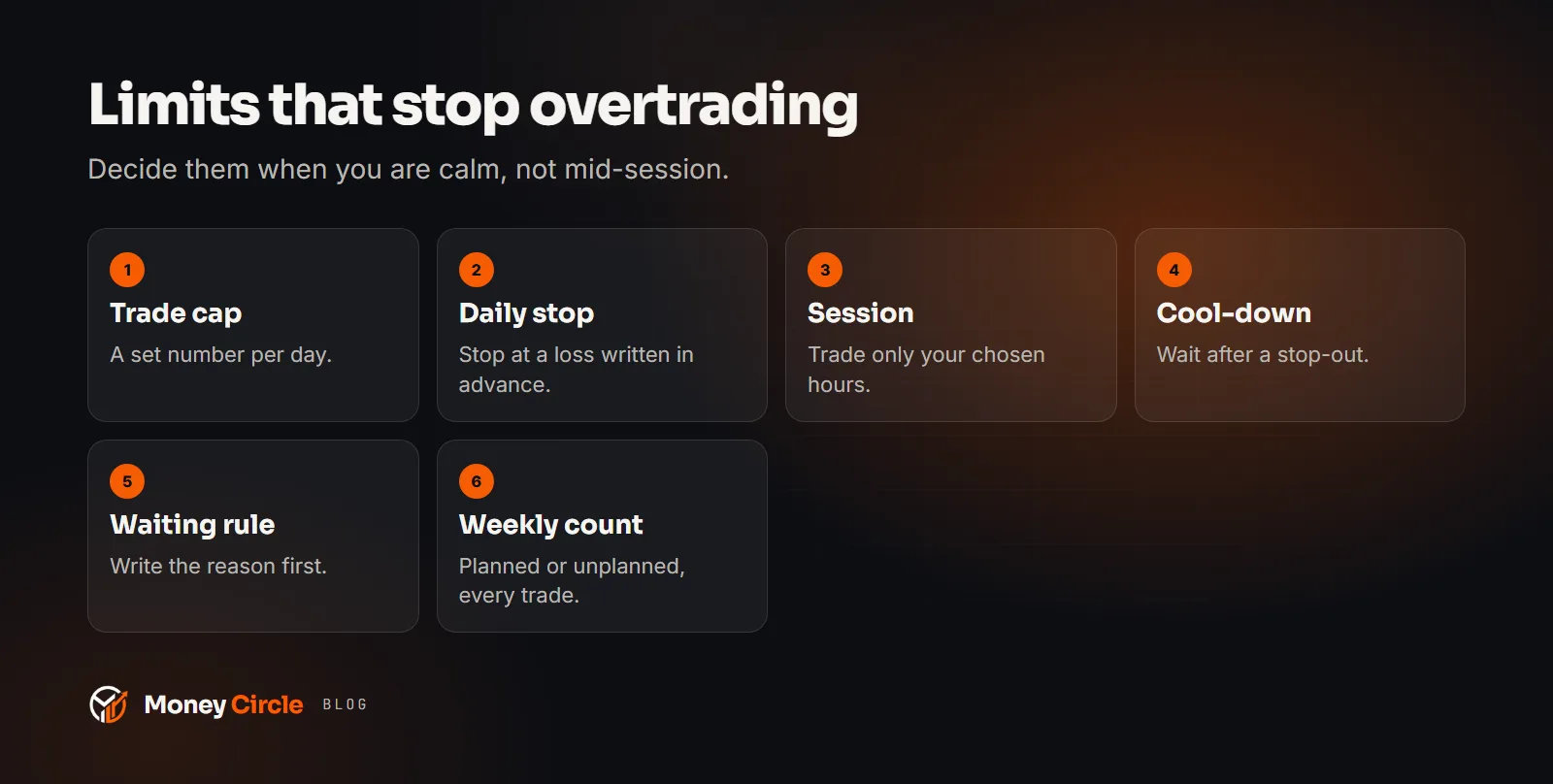
Rules beat willpower, because they are decided when you are calm. Add these to your trading plan:
A maximum number of trades per day. Choose a number that fits your plan, write it down, and stop when you reach it. Many beginners start with a small cap such as three, but the right figure is yours.
A daily stop. A loss, in units of risk, at which you stop for the day. For example, two full-risk losses. See how much to risk per trade for choosing the per-trade amount that this builds on.
A defined session. Trade only in the hours you chose, and close the platform outside them. This is simpler than it sounds, and it removes most of the idle clicking.
A cool-down after a loss. Write: "After a stop-out, I wait ten minutes and re-read my checklist before the next entry." A pause breaks the loop between the loss and the next order.
A limit on open risk. A cap on total risk across open positions stops you from stacking trades on the same idea.
Use a waiting rule
Many overtrades are impulsive. A simple filter is a waiting rule: before any entry, write the setup and the stop in one line in your journal or on a note, and wait one minute. If you cannot write the reason in a sentence that refers to your plan, you do not take the trade. It costs almost nothing, and it works because writing slows the impulse.
Another version is the checklist before entry: Does the setup match my plan? Is the stop on the chart? Is the size from the stop? Am I within my trade count? If any answer is no, there is no trade. The pre-market routine for traders gives a way to prepare before the session so these answers are mostly settled before the market moves.
Make "no trade" a valid result
Part of the cure is redefining success. A day with no trade, because nothing matched your plan, is a day you followed your rules. Write it in the journal as such. Some traders keep a tally of days on which they correctly waited, and treat it as seriously as a result. If you have been trading for a short time, this reframing may be the most useful change you can make.
Reduce what you watch, too. A plan with one or two markets and one or two setups produces fewer chances, and that is the point. A shorter list is easier to follow, and it also makes the journal easier to review.
Reduce the pull of the screen
Practical steps help more than resolve:
- Turn off price alerts you do not need.
- Close the platform when your session ends.
- Remove one-click trading, or add a confirmation step.
- Hide the open profit and loss during a trade if watching it changes your behaviour.
- Take a short break away from the screen between trades.
Review it weekly
In your weekly review, ask: how many trades did I take, how many were planned, and what triggered the unplanned ones? Choose one rule to tighten for the next week. Our weekly trading review routine shows how, and if your plan needs a stronger structure, see why trading plans fail and how to fix yours.
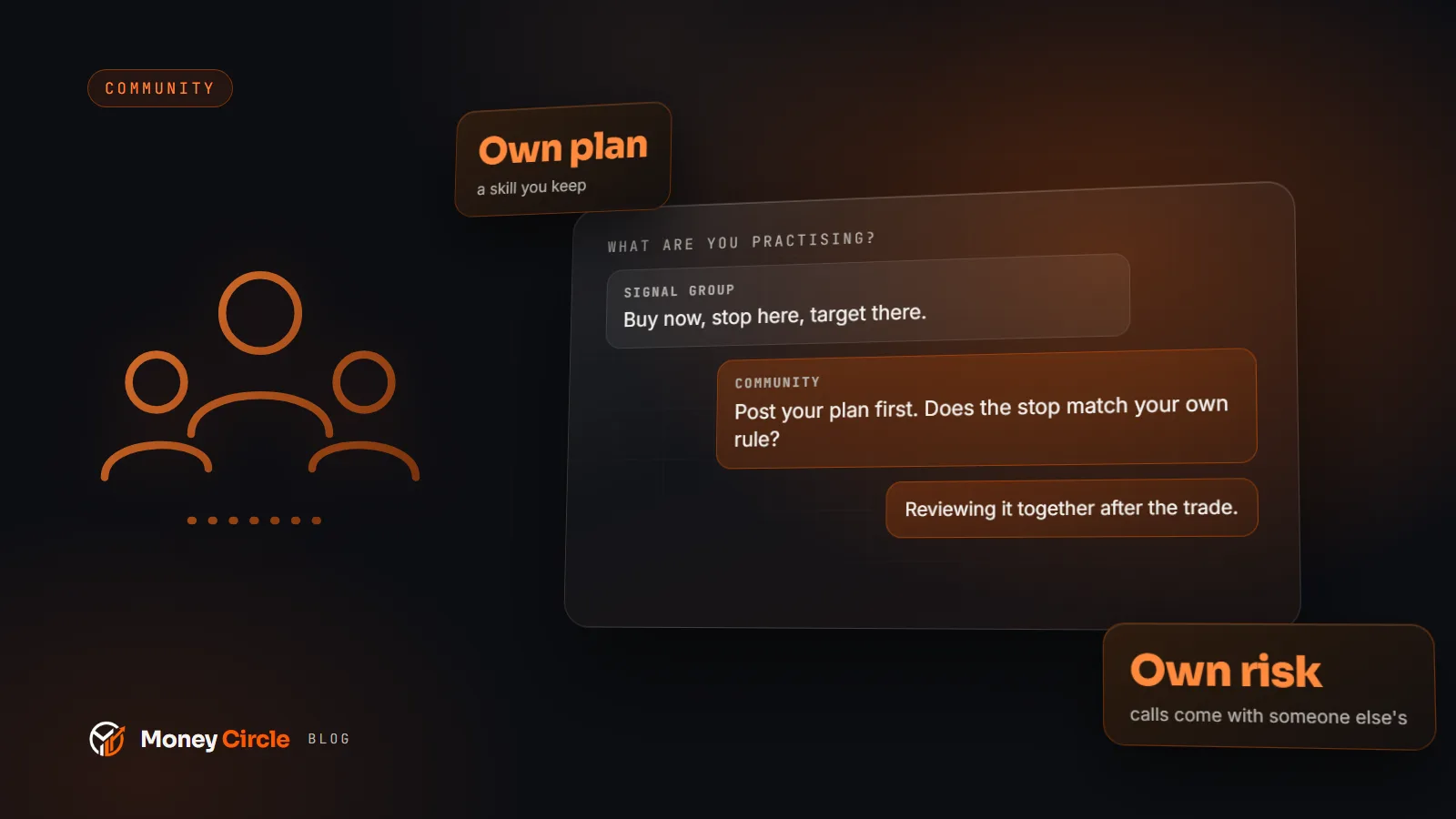
Doing this alone is hard. A small group that asks "was it in the plan?" each week makes it easier. Our article on learning to trade with a community explains how to find that kind of accountability, and the Money Circle Academy has lessons that go with this routine.
Trading involves risk of loss; fewer, planned trades do not guarantee a better result, and this is educational content, not financial advice.
Educational content, not financial advice. Trading involves risk of loss.
Learn it, log it, review it on Money Circle
Included with every paid Money Circle membership: Trader Reflect and 2 ChartViews AI analyses a day.
Guides
Continue in the ecosystem
 ChartViews AI
 Trader Reflect
More from the Money Circle Blog
Get the free Trading Plan Template
A printable plan with your rules, risk and review routine, plus the weekly market outlook by email. Unsubscribe anytime.