How to Learn Trading Step by Step: A 15-Day Structure
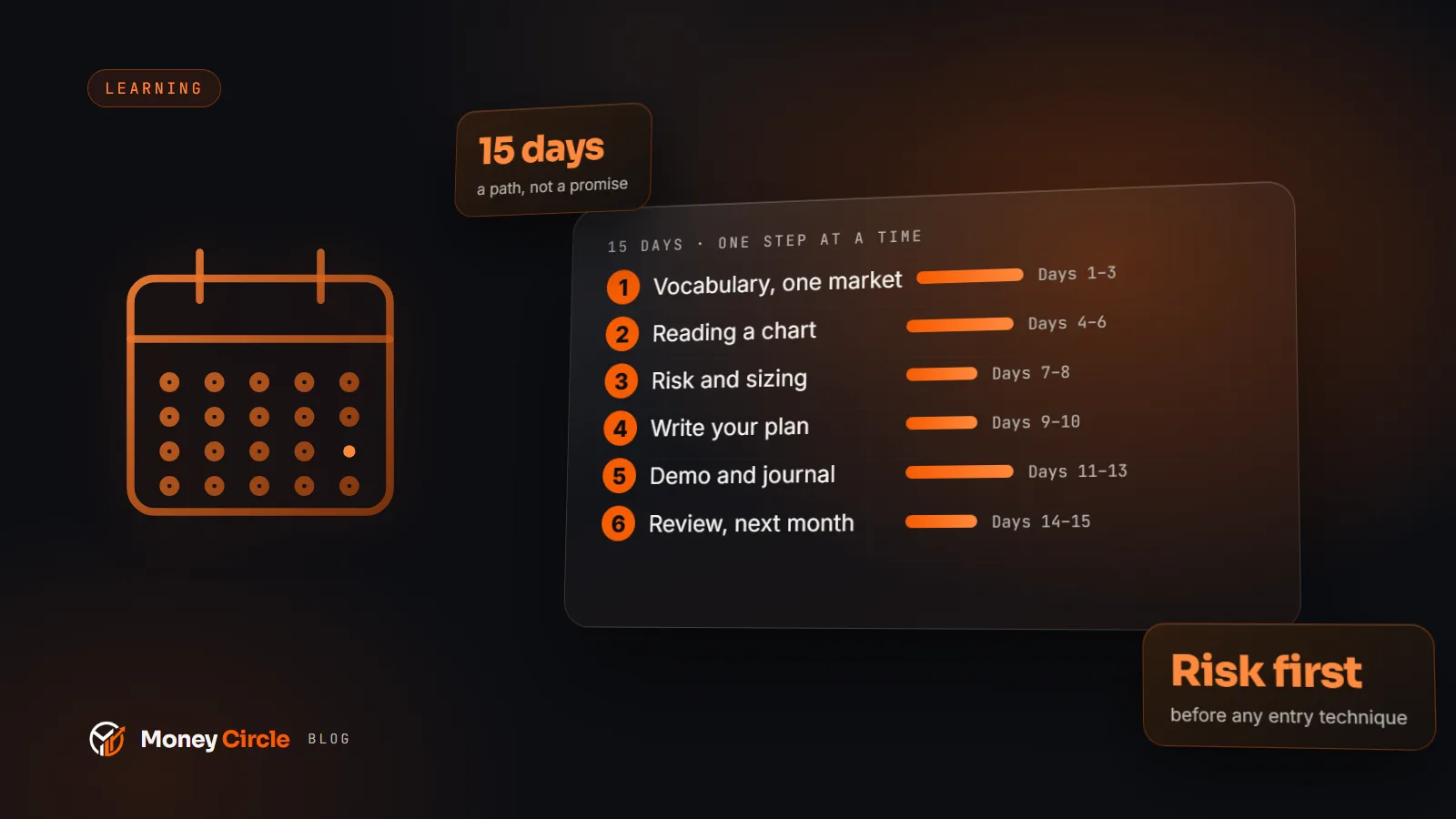
A 15-day learning path for new traders: vocabulary, charts, risk, a written plan, demo practice, a journal and your first review.
If you search for how to learn trading, you will find two kinds of advice. One promises a shortcut: a secret setup, a course that fixes everything in a weekend, a chat room that tells you what to buy. The other is a pile of free videos with no order to them. Neither helps a beginner very much, because learning to trade is less about finding the right information and more about doing a small number of things in the right sequence, and then repeating them until they are habits.
This article gives you a 15-day structure you can follow at your own pace. It is a learning path, not a promise. Fifteen days will not make you a profitable trader, and nobody honest will tell you otherwise. What fifteen days can do is take you from "I do not know where to start" to "I have a written plan, a demo account, a journal and a review habit", which is the foundation everything else rests on.
Before day one: three honest ground rules
You are learning a skill, not buying an outcome. Skills build slowly and unevenly. Plan to spend months on demo or very small size before the results mean anything.
Losses are part of the process. Trading involves risk of loss, and a method that wins often can still lose money if the losses are larger than the wins. Never trade money you cannot afford to lose, and do not borrow to trade.
Avoid anyone who sells certainty. Guaranteed returns, trades described as having no risk and countdown timers on offers are signs of a sales pitch. Real education talks about risk first.
Days 1 to 3: the vocabulary and the market you will focus on
Start by learning the words, because everything else is built on them. Spend the first three days on the basics:
- What a market, an instrument and a quote are, and what the spread is.
- What a long and a short position are, and what leverage does to both gains and losses.
- What a stop order, a limit order and a market order do.
- What a pip, a point or a tick means in the market you choose.
Then choose one market. Just one. A beginner who watches six markets learns nothing about any of them. Pick the one whose hours suit your life and whose behaviour you can follow on a chart, and put the rest aside for now.
Days 4 to 6: reading a chart, calmly
Spend these days on the chart itself. You are not looking for predictions. You are learning to describe what price has done.
- Day 4: candlesticks and timeframes. Learn what a single candle records and how the same market looks different on a daily chart and a one-hour chart.
- Day 5: support, resistance and trend. Mark the levels where price has reacted more than once and describe the trend in plain words.
- Day 6: structure across timeframes. Practise looking at a higher timeframe first, then a lower one.
Days 7 and 8: risk comes before strategy
This is the step most beginners skip, and it is the one that decides whether you are still trading in a year. Before you learn a single entry technique, learn how to limit what a trade can cost you.
- Day 7: the stop and invalidation. A stop is not where you hope to be wrong; it is the point where your idea no longer makes sense. Learn to place it from the chart.
- Day 8: position sizing. Decide a small, fixed amount of your account to risk per trade, and learn to calculate the position size from the distance to your stop.
Days 9 and 10: write your trading plan
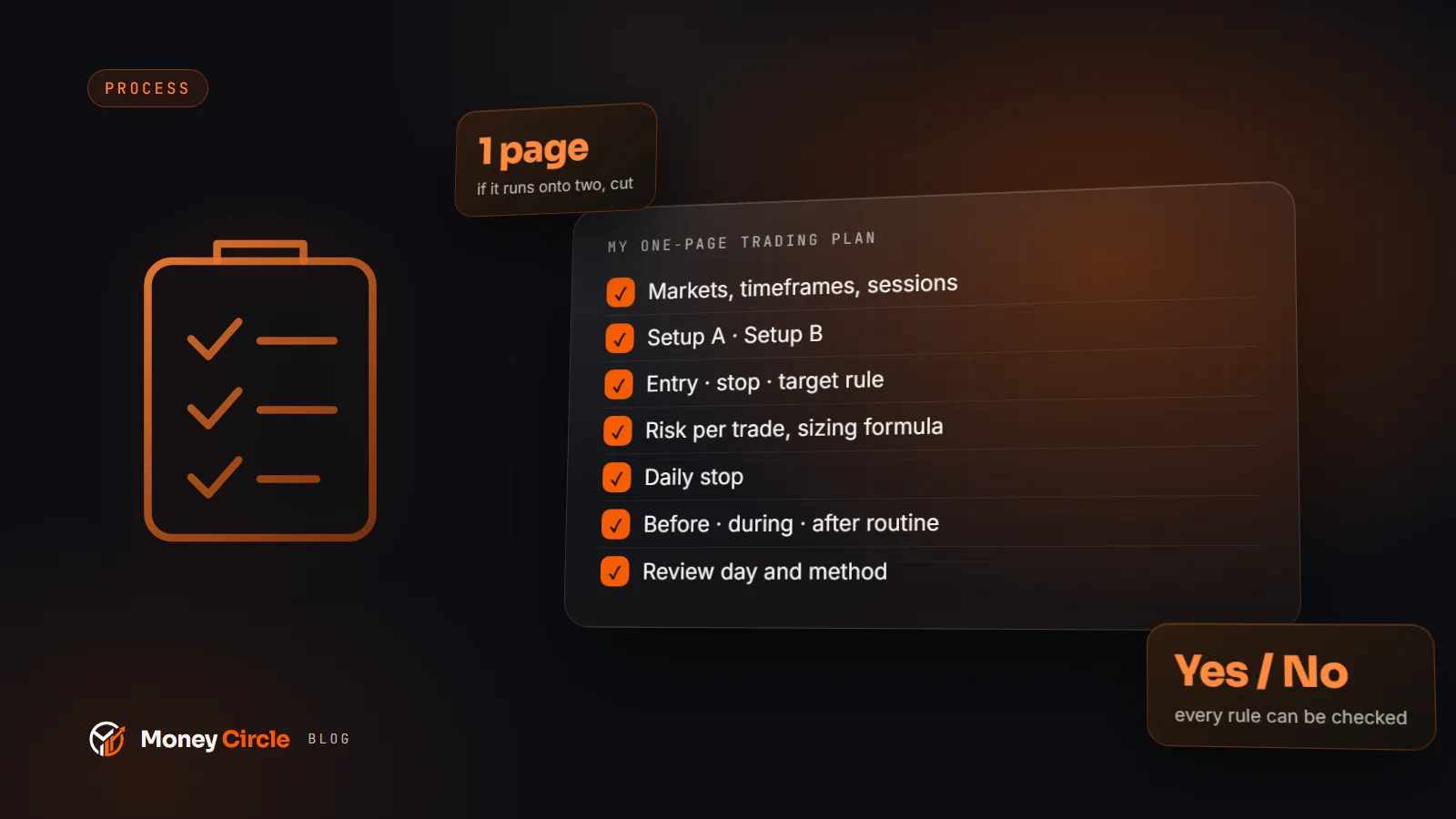
Now you have enough to write something real. A trading plan is a one-page document with rules that can be checked: which market and sessions you trade, one or two setups with their triggers, your entry, stop and target rules, your risk per trade, a daily stop, and when you will review.
Write it in plain language and make every line answerable with yes or no. Our guide on building a trading plan you will actually follow explains each part, and the free trading plan template gives you a structure to fill in. Keep it to one page. If it runs onto two, cut.
On day 10, read the plan back as if someone else had written it, and ask: could a friend look at my notes after a trade and mark it "followed" or "broken"? If not, rewrite the vague lines.
Days 11 to 13: practise on demo and start the journal
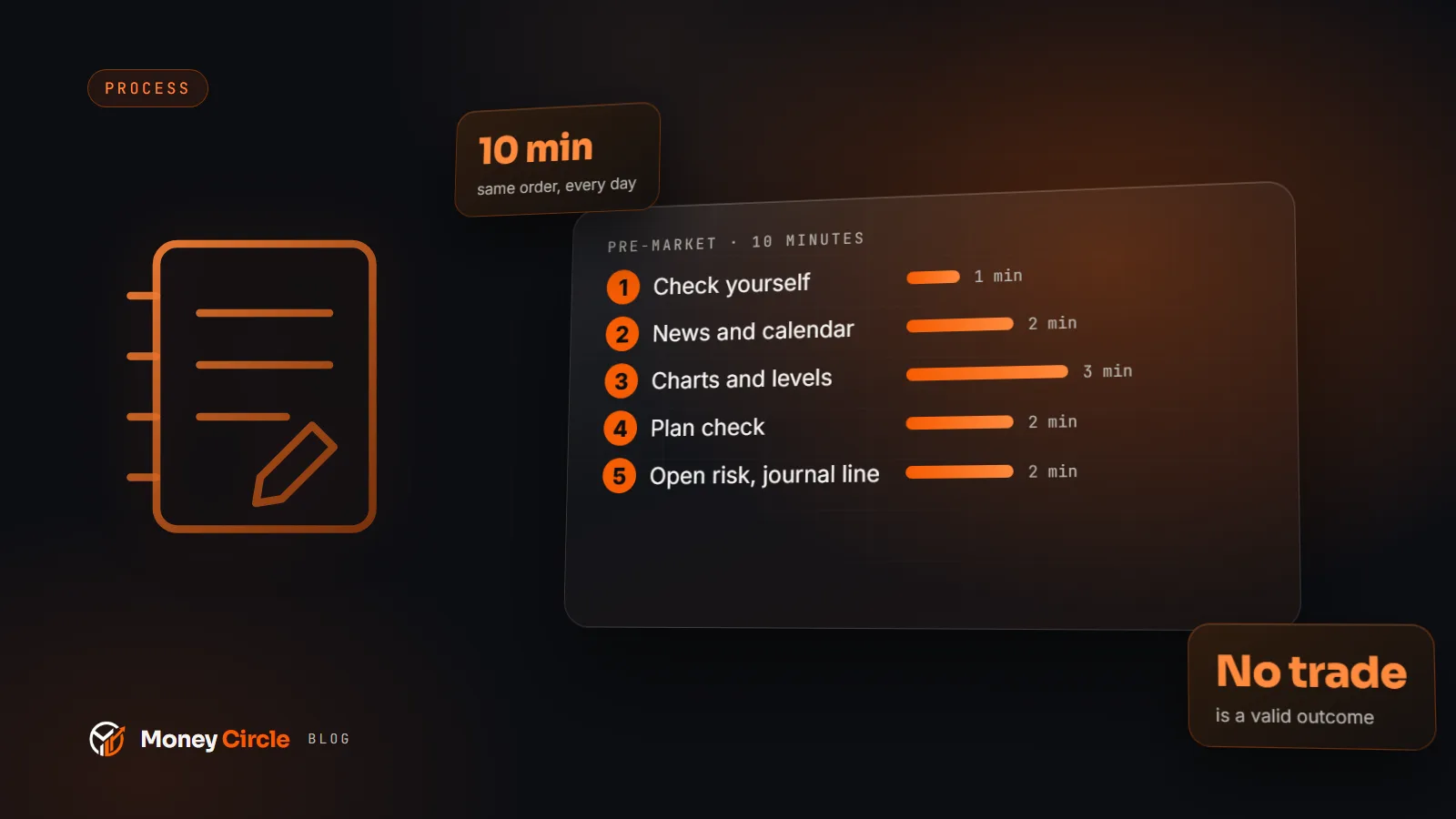
Open a demo account and trade your plan, and nothing else. The aim is not to make a lot of play money. The aim is to find out whether you can follow your own rules for several sessions in a row.
Start the journal on the first trade. For each trade, note the setup, where the stop went and why, what you did after entry, and one yes or no: did I follow my rules? Our piece on what to record in a trading journal explains which fields are worth recording and which are not. Keep it short. A journal you can finish in two minutes is one you will keep.
A word on demo trading. It is useful for mechanics and for testing whether you follow rules, but it does not test emotion in the same way, because nothing real is at stake. When you later move to real money, use the smallest size available and expect to behave differently from how you did on demo.
Day 14: your first review
On day 14, sit down with the journal and review. Count how many trades followed the plan. Look at where the rule breaks happened and what was going on just before them. Choose one change, and only one, for the next stretch. Our weekly trading review routine gives you a step-by-step format.
The review is the point where learning actually happens. Without it, you are just placing orders.
Day 15: decide what comes next
Use the last day to decide, in writing, what your next month looks like. A sensible default for a beginner is: stay on demo until you have a stretch of sessions where you followed the plan almost every time, then move to the smallest real size if you choose to, keep the journal and the weekly review going, and add only one new thing at a time.
Decide also how you will keep learning. This is where company helps. Reading other people's plans and having your own read teaches you faster than studying alone, as long as the group focuses on process and not on copying trades. We wrote about how to do this well in learning to trade with a community.
Where Money Circle fits, honestly
Money Circle has an academy, and you can register and start it free. We would rather say plainly what that means than oversell it: it is a structured set of lessons on the process described above, not a method that guarantees results, and what is included beyond the free start is described on the site, where it stays up to date. You do not need Money Circle to follow the 15 days in this article. You can do all of it with a free demo account, a spreadsheet and a notebook. If you prefer a guided path and a community to compare notes with, that is what the academy and the Trading Clans are for.
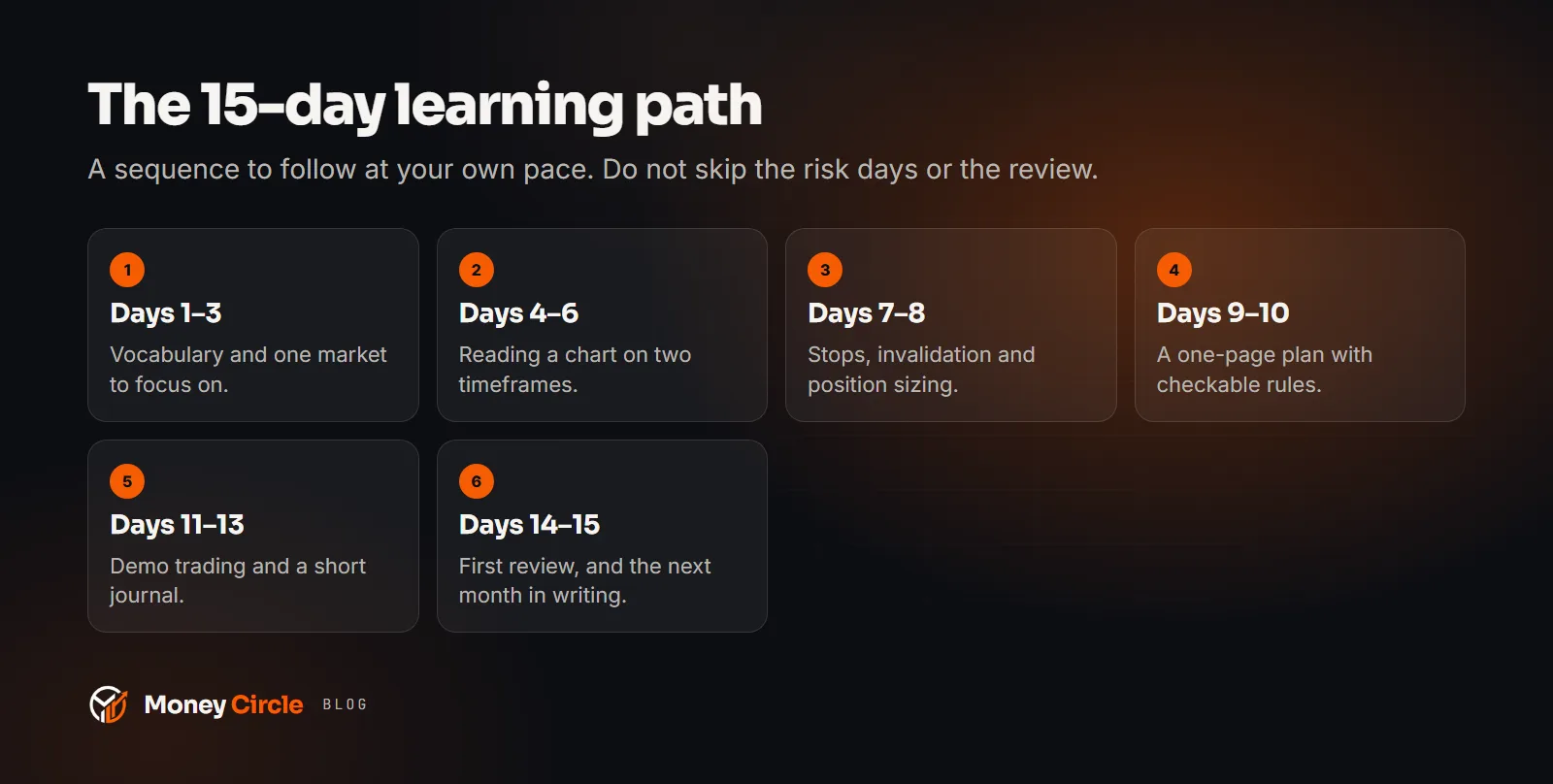
A short checklist for the 15 days
- Days 1 to 3: vocabulary learned, one market chosen.
- Days 4 to 6: I can describe a chart in plain words on two timeframes.
- Days 7 and 8: I can place a stop from the chart and size a position from it.
- Days 9 and 10: my one-page plan is written and checkable.
- Days 11 to 13: I traded the plan on demo and journaled each trade.
- Day 14: I reviewed and chose one change.
- Day 15: I wrote what the next month looks like.
What to do if you fall behind
You will. A job, a bad week or plain boredom will interrupt the schedule, and that is fine. The structure is a sequence, not a deadline. If you skip a day, resume where you stopped rather than starting over, and do not skip the risk days or the review to catch up. If you find yourself wanting to jump straight to strategies, go back to day 7. Almost every beginner who struggles is struggling with risk and consistency, not with finding a cleverer entry.
Educational content, not financial advice. Trading involves risk of loss.
Learn it, log it, review it on Money Circle
Included with every paid Money Circle membership: Trader Reflect and 2 ChartViews AI analyses a day.
Guides
Continue in the ecosystem
 ChartViews AI
 Trader Reflect
More from the Money Circle Blog

Get the free Trading Plan Template
A printable plan with your rules, risk and review routine, plus the weekly market outlook by email. Unsubscribe anytime.