How to Build a Trading Plan You Will Actually Follow
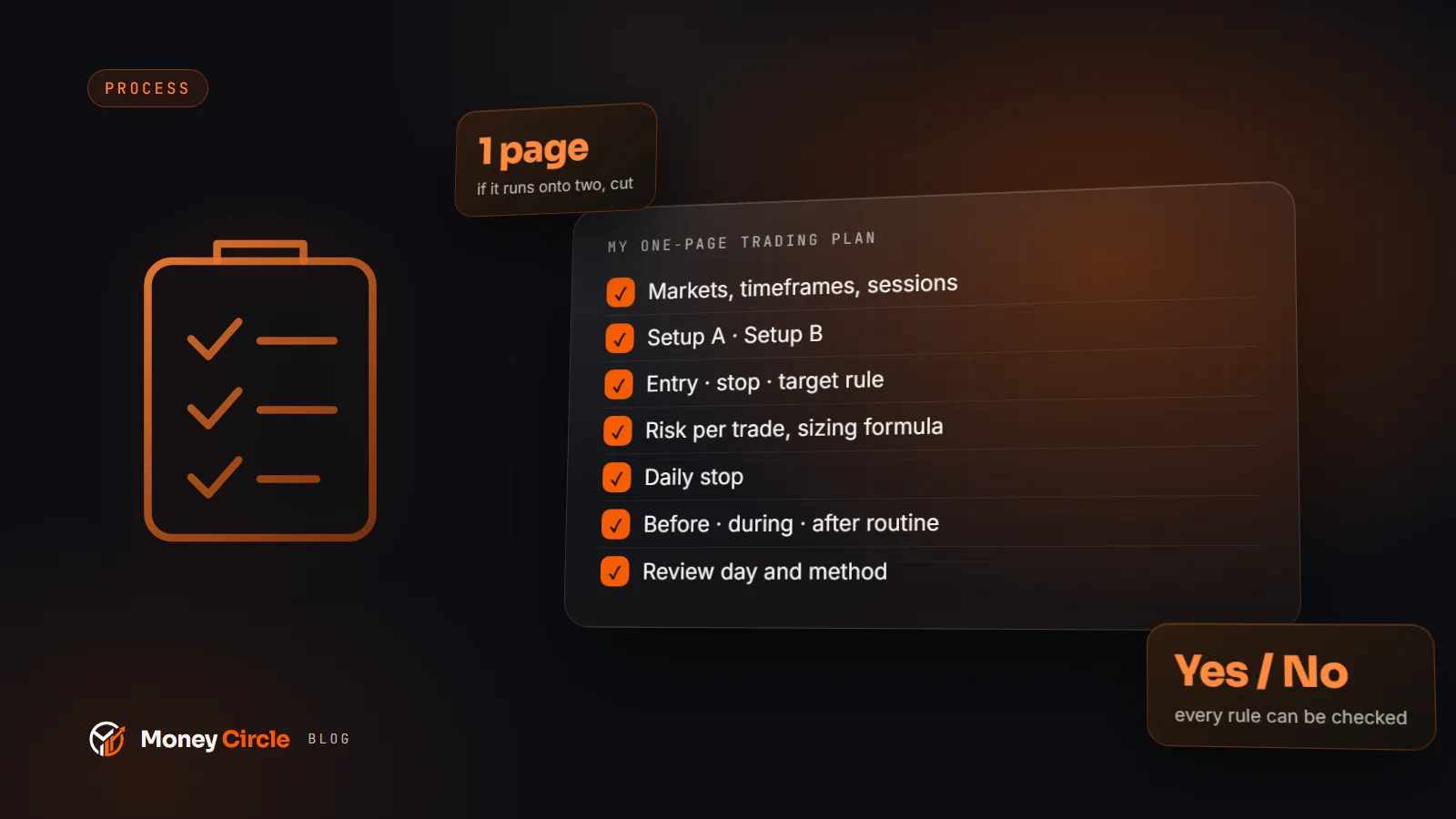
A one-page trading plan with checkable rules for markets, setups, entries, exits, risk and review, written so you can follow it.
Most people who say they have a trading plan have an intention. "I trade trends", "I only take good setups", "I manage my risk" are all pleasant sentences, but none of them can be checked. When you are looking at a live chart and your attention is split between price, a news feed and your own impatience, an intention gives you very little to hold on to.
A plan that works is shorter and more boring than you might expect. It fits on one page, it uses plain language, and every line in it can be answered with yes or no. This guide walks through what goes on that page and how to write each part so that you can follow it on an ordinary Tuesday, not only on the days you feel sharp.
Why rules must be checkable
Consider the rule "enter when the trend looks strong". Two people can look at the same chart and disagree, and you can disagree with yourself an hour later. Now consider "enter only when price closes above the previous swing high on the four-hour chart, and the stop can sit below the last higher low". Either that happened or it did not.
A checkable rule has three properties. It refers to something visible on the chart or in your account. It does not depend on how you feel. And after the trade, someone else reading your journal could tell whether you followed it. That last test is the most useful one. If a friend could not mark your trade as "followed" or "broken" from your notes, the rule is still too vague.
This matters because a plan is only valuable if you can measure your adherence to it. If you cannot tell whether you followed the plan, you cannot tell whether the plan is any good or whether you simply never ran it.
Part 1: What you trade and when
Start with scope. Write down the markets you will trade, and be restrictive. A short list that you actually know beats a long list that you skim. For each market, note the timeframe you analyse and the hours you are available to act on it.
Be honest about your life. If you work during the London session, a plan built around the London open is a plan you will break. Write the sessions you can genuinely sit through, and treat everything outside them as closed.
Part 2: Your setups
A setup is a specific, repeatable pattern that you have a reason to take. Limit yourself to one or two while you are learning. For each setup, write:
- The market condition it needs (for example, a clear range, or a trend with a pullback).
- The trigger that makes it a trade (a close beyond a level, a reversal candle at a defined zone).
- The reason you think it has an edge, in one sentence. If you cannot write the reason, you may be trading a habit.
- A short list of conditions that disqualify it, such as major news within the next hour or a spread that is unusually wide.
Part 3: Entry and exit rules
Entry rules say exactly what you need to see before you place an order, and what kind of order you use. Exit rules come in two kinds, and you need both before you enter.
The invalidation exit is where the idea is wrong. This is your stop, and it should come from the chart, not from how much you would like to lose. If you want to see how invalidation thinking works in practice, the ChartViews AI article on trade invalidation is a good companion read.
The target exit is where you take the trade off if it works. It might be a level, a multiple of the risk, or a trailing rule. What matters is that it is decided before the trade, not negotiated while the trade is open.
Also write what you will not do. Common entries on that list: moving a stop further away, adding to a losing position, and re-entering immediately after a stop-out without a fresh signal.
Part 4: Risk per trade and the daily stop
Risk rules protect you from your own worst day. There are two numbers to set, and you should choose them yourself rather than copy anyone else's.
First, how much of your account you are willing to lose on a single trade. Most educators teach a small fixed fraction, because it keeps any one outcome from mattering too much. The method for turning that fraction into a position size is covered in the ChartViews AI guide to fixed-percentage position sizing. Write the fraction in your plan, and write the formula you use to size the trade, so that you calculate rather than guess.
Second, a daily stop: the point at which you close the platform for the day. It can be a maximum loss, a maximum number of losing trades in a row, or both. The daily stop exists because decisions made after a string of losses tend to be worse than decisions made before them. Writing the limit down in advance means you are not deciding it while you are frustrated.
If you trade a funded or challenge account, add the account's own rules to the plan, such as its daily and overall loss limits, and set your personal limits comfortably inside them.
Part 5: Your routine
A plan is not only about the trade. Write the small routine around it:
- Before the session: check the calendar for scheduled news, mark your levels, and note which setups are possible today.
- During the session: one line per trade in your journal as you take it, covering the setup, the stop, the target and the planned risk.
- After the session: close the charts, record the outcome, and tick off whether each rule was followed.
Part 6: Review
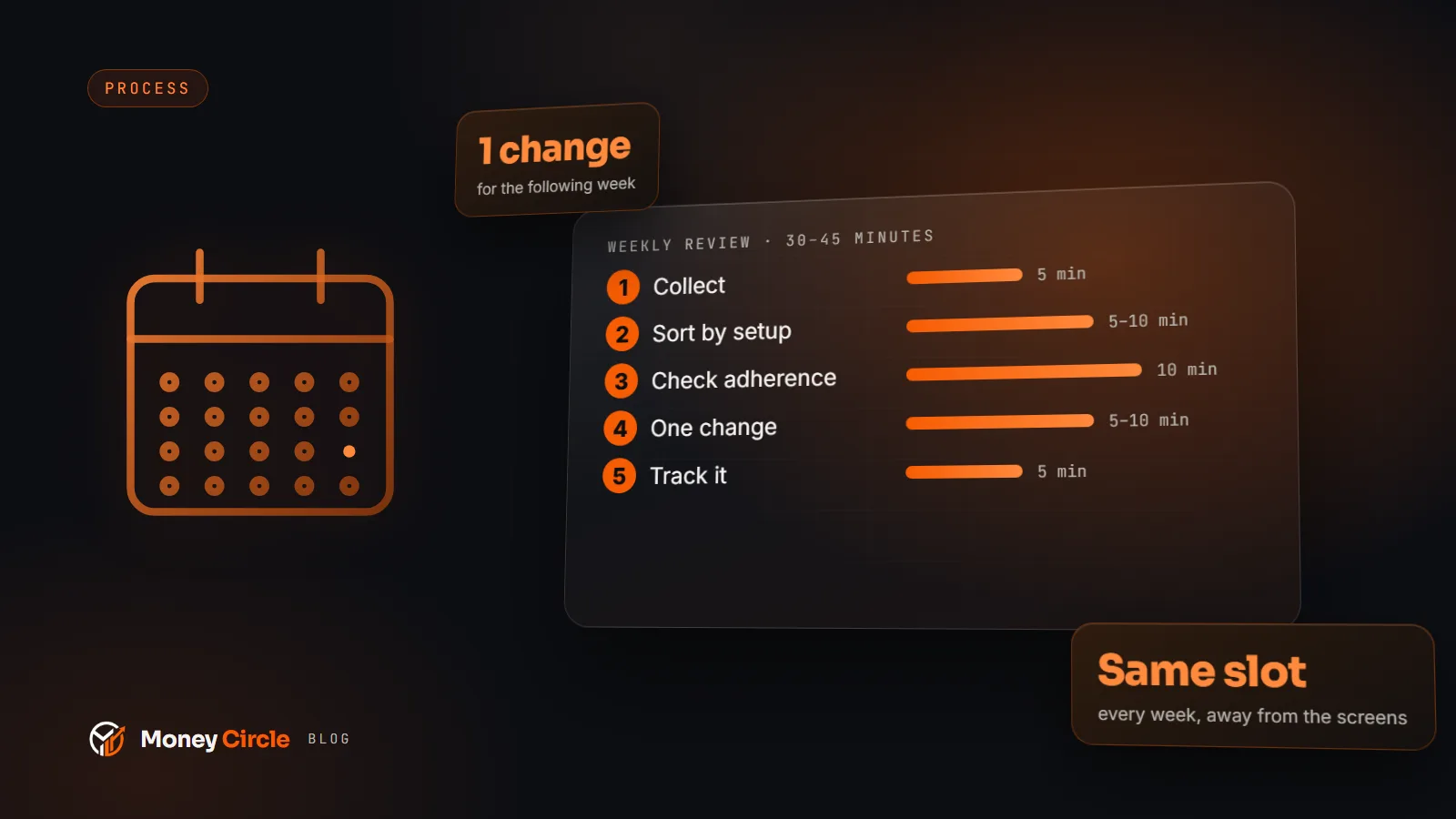
The last section says when and how you will review. A weekly review is a sensible rhythm for most people, with a lighter look at the end of each day. Write the day and time you will do it, what you will look at, and what decision it should end with. The point of review is to change one thing at a time, not to rewrite the plan after every loss.
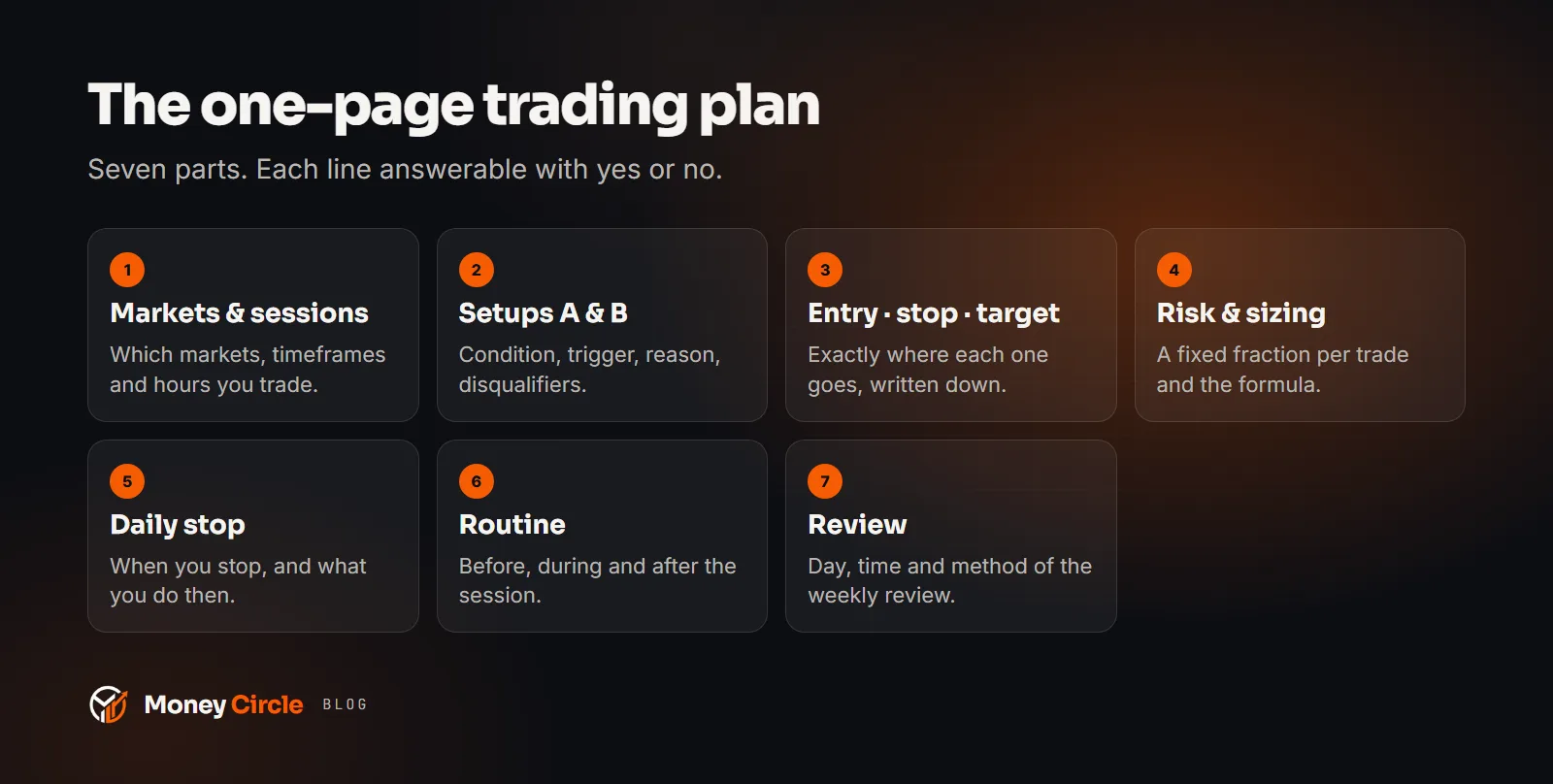
Putting it on one page
Here is a compact structure you can copy into a document:
- Markets, timeframes and the sessions I trade.
- Setup A and Setup B: conditions, trigger, disqualifiers.
- Entry rule, stop rule, target rule.
- Risk per trade and my sizing formula.
- Daily stop and what I do when it is hit.
- Before, during and after routine.
- Review day, time and method.
Test the plan before you trust it
Run the plan on a demo account or at the smallest size you can for a set period, and track only one thing at first: did you follow it? A plan you followed and that did not perform can be improved. A plan you did not follow tells you nothing about the plan. The Money Circle academy walks through this process step by step if you would like a structured way to do it.
Next step
Open a blank document today and write only the entry rule, the stop rule and the daily stop. Make each one a sentence a stranger could mark as followed or broken. Use those three lines on your next session, and note after each trade whether you kept them. Add the rest of the page once those three are holding.
Educational content, not financial advice. Trading involves risk of loss.
Learn it, log it, review it on Money Circle
Included with every paid Money Circle membership: Trader Reflect and 2 ChartViews AI analyses a day.
Continue in the ecosystem
 ChartViews AI
 Trader Reflect
More from the Money Circle Blog
Weekly Gold & Nasdaq outlook
Every Sunday: the week's key events, how gold, the Nasdaq, the Dow, the S&P 500 and EUR/USD moved, and our signal record. Free. Unsubscribe anytime.