A 30-Minute Weekly Trading Review That Leads to Decisions
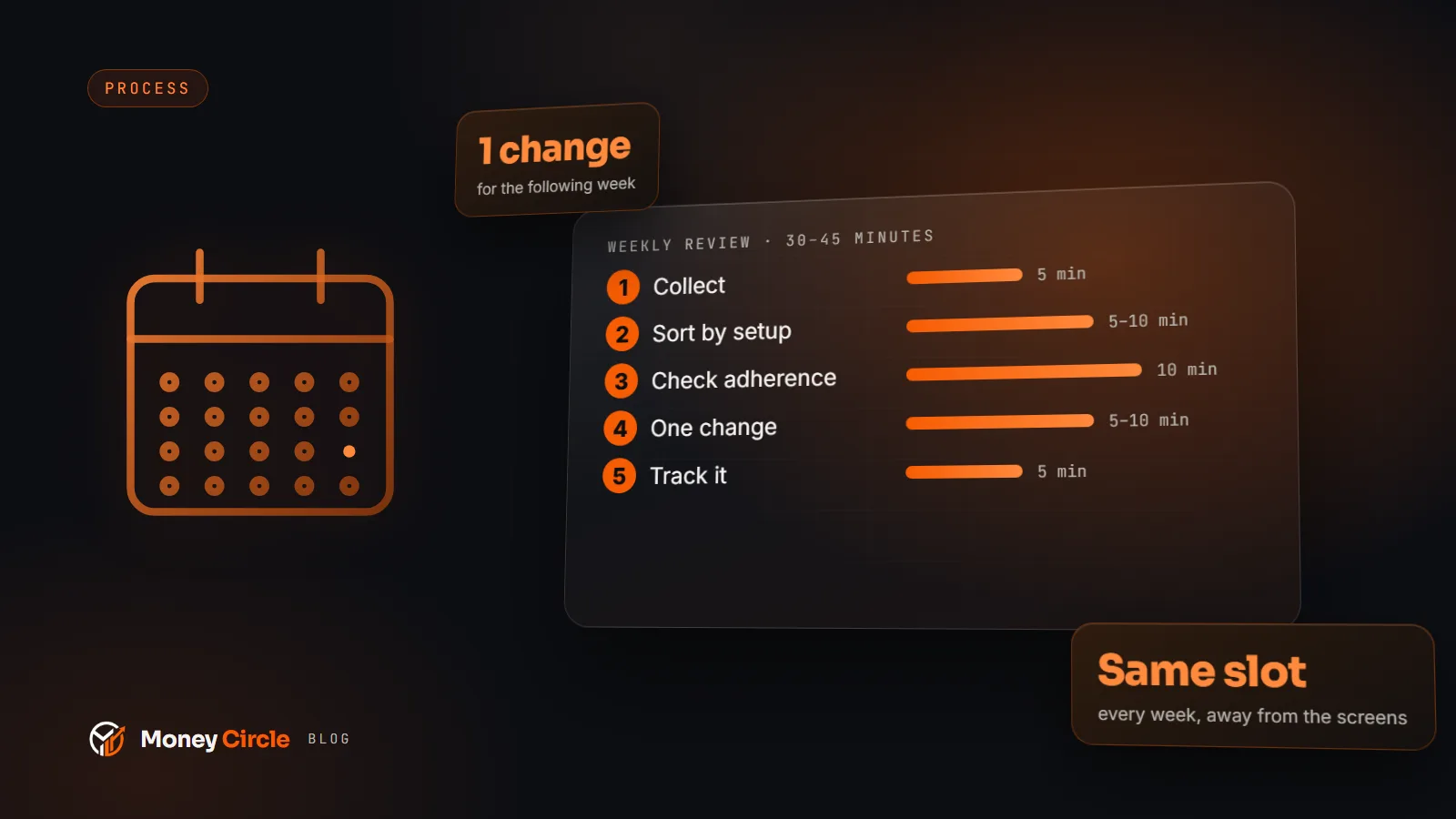
Turn your trading journal into one clear decision each week: collect, sort by setup, check rule adherence, change one thing, track it.
Many traders keep a journal and never open it again. The entries pile up, the screenshots stay in a folder, and each week begins with the same habits as the last. A journal only becomes useful when it feeds a decision, and the simplest way to make that happen is a short, fixed weekly review.
This routine takes thirty to forty-five minutes. It is built around the data you already have, and it ends with exactly one change for the following week. It is not about how you felt during the week, and it is not an exercise in self-criticism. It is bookkeeping with a purpose: finding out what your process actually did.
Why weekly, and why short
A day is too short a window to learn from, because a single day is dominated by chance. A month is too long, because mistakes repeat for weeks before anyone notices. A week gives you enough trades to see a pattern in how you behaved, and it is recent enough that you still remember the context.
Keep the session short on purpose. A review that takes two hours will be skipped. One that takes half an hour, on the same day at the same time, becomes a habit. Put it in your calendar as an appointment, away from the trading screens, ideally on a weekend or after the close on Friday.
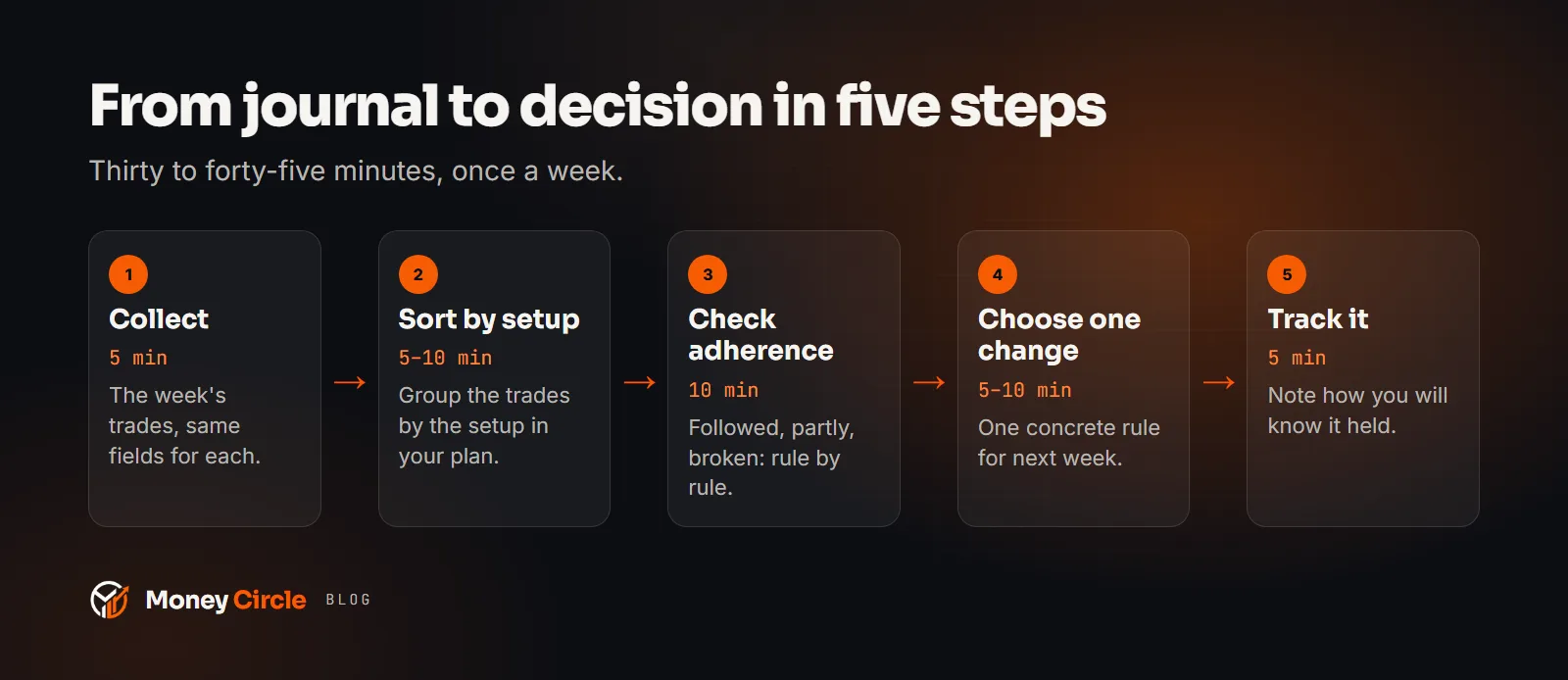
Step 1: Collect (5 minutes)
Before analysing anything, gather the week's records into one place. For each trade you want the same fields:
- Date, market and direction.
- Which setup from your plan it was meant to be.
- Planned entry, stop and target, and the planned risk.
- Actual entry and exit, and the result in money and in risk multiples.
- A screenshot or note of the chart at entry.
- Whether you followed your rules (more on this below).
Note any trades you considered and did not take, too. Skipped trades that matched your rules are data, and so are skipped trades that did not.
Step 2: Sort by setup (5 to 10 minutes)
Group the week's trades by setup. If your plan names two setups, you now have two piles, plus one for anything that did not fit either. That third pile is often the most informative.
For each pile, write down only a few facts: how many trades, the total result in risk multiples, and the typical entry quality. Resist the urge to draw a firm conclusion from a handful of trades. One week is a small sample, and the aim here is to spot where your attention should go, not to declare a setup good or bad.
If you want a refresher on measuring results in risk multiples and why the ratio of reward to risk matters, the ChartViews AI article on the risk-reward ratio covers the basics.
Step 3: Check rule adherence (10 minutes)
This is the heart of the review, and it is where a journal turns into a decision tool. For every trade, answer a short list of yes-or-no questions based on your plan:
- Was this one of my defined setups?
- Did all the entry conditions exist before I clicked?
- Was the stop where the plan said, and did I leave it alone?
- Was the position size calculated from my risk rule?
- Did I respect the daily stop and my session hours?
- Did I exit according to the plan, or by improvising?
Three patterns are common. A losing trade where every rule was followed is a normal cost of operating a plan, and nothing needs to change. A winning trade where rules were broken is a quiet warning, because it rewards the behaviour you are trying to remove. A cluster of broken rules around the same item, such as moving stops or entering before the trigger, points directly at what to work on.
Keep this step factual. You are not grading your character, you are counting events.
Step 4: Choose one change (5 to 10 minutes)
Now decide. The discipline is to pick one change for the next week, not five. Several simultaneous changes make it impossible to tell which one helped, and they are also harder to remember during a session.
Good changes are small, specific and checkable. Some examples:
- "I will not enter any trade until the candle has closed beyond the level."
- "I will place my stop order at the same moment as my entry order."
- "I will skip the first fifteen minutes after the open."
- "I will remove the third market from my watchlist for two weeks."
Before changing the plan itself, check the evidence. Altering a setup after one losing week is usually a reaction. Changing how you execute the plan after seeing repeated rule breaks is usually a correction. Tweak the plan only after enough trades have accumulated to say something, and write down the reason for the edit and the date.
Step 5: Track it (5 minutes)
A decision without a follow-up is just a wish. Add a tracking line to your journal template for the coming week: a tick box for the chosen change on every trade. Place a reminder somewhere you will see it before you open the charts, such as a sticky note or the first line of your pre-session checklist.
Next week, the review begins with that line. Did you apply the change on every trade? If yes, keep it or retire it. If no, ask what got in the way, and make the change easier to apply instead of adding a new one.
A simple weekly template
You can copy this into any note-taking tool:
- Week of: date range.
- Trades taken, trades skipped.
- Result by setup (in risk multiples).
- Adherence: followed, partly, broken, with the rules affected.
- What the data says in one or two sentences.
- One change for next week.
- How I will track it.
Keep the habit alive
Some practical points make the routine easier to sustain. Do it at the same time each week. Keep the template to one page. Review honestly even in a week with no trades, since "I followed my plan by staying out" is a useful finding. And store the weekly notes in order, so that after a couple of months you can scroll back and see which changes held and which faded.
Over time the reviews also build a record of your own process, separate from any single outcome. That record is worth more than the individual results, because it shows how you improve.
Next step
Schedule thirty minutes in your calendar for the end of this week. Before then, make sure each trade you take has the setup, planned risk and a "rules followed" tick recorded as you go. When the time arrives, run the five steps above and write down one change, no more.
Educational content, not financial advice. Trading involves risk of loss.
Learn it, log it, review it on Money Circle
Included with every paid Money Circle membership: Trader Reflect and 2 ChartViews AI analyses a day.
Continue in the ecosystem
 ChartViews AI
 Trader Reflect
More from the Money Circle Blog
Weekly Gold & Nasdaq outlook
Every Sunday: the week's key events, how gold, the Nasdaq, the Dow, the S&P 500 and EUR/USD moved, and our signal record. Free. Unsubscribe anytime.