A Pre-Market Routine for Traders: A 10-Minute Checklist
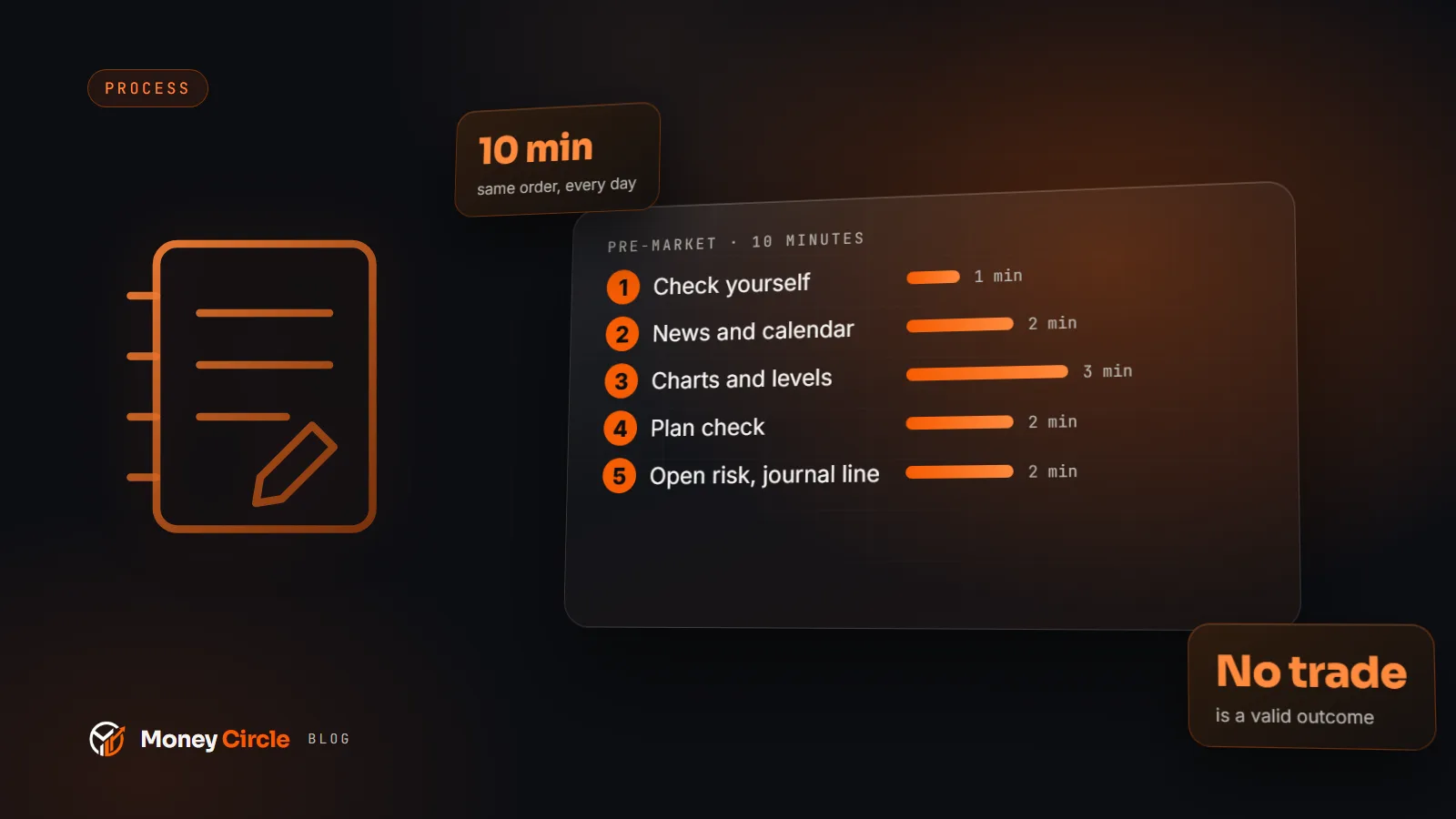
A 10-minute pre-market checklist: a self check, the news calendar, charts and levels, and a plan check before you trade.
Most trading mistakes are made before the first order is placed. They are made when a trader sits down already behind: unsure what the day's news calendar holds, unclear which levels matter, half aware of a limit they set last week and fuzzy about what they are allowed to do today. A pre-market routine fixes that. It takes about ten minutes, it costs nothing, and it replaces improvisation with a short set of checks that you do the same way every day.
This article gives you a ten-minute checklist you can adapt to any market and any session. It is a process guide, not a strategy: it does not tell you what to trade, and it does not predict anything. Its job is to make sure that when you do trade, you do it deliberately, under your own rules.
Why a routine, and why short
A routine works because it removes decisions. When you do the same checks in the same order, you do not have to remember them, negotiate with yourself or skip them on a day you feel confident. Confidence, in fact, is when most people skip them.
Keep it short on purpose. A routine that takes forty minutes will be skipped on busy mornings, and a skipped routine is worth nothing. Ten minutes is enough to cover what matters, and anything longer can go in your weekly review instead. If you want that longer view, see our weekly trading review routine.
Do it at roughly the same time each day, before the session you trade, away from open orders where possible. If you trade after work, do it before you start, not once you are already looking at a moving chart.
The ten-minute checklist
Minute 0 to 1: Check yourself
Before the market, check the trader. Ask three honest questions:
- Did I sleep reasonably and eat?
- Is anything outside trading weighing on my mind?
- How did yesterday end, and am I carrying a loss or a win into today?
Trader Reflect writes about this territory in depth. Its article on naming the feeling is a good short read on why labelling your state before you trade changes what you do next.
Minute 1 to 3: The news and calendar check
Open the economic calendar for the day and look for scheduled events that affect the markets you trade. You are looking for three things:
1. What is scheduled, and when. Note the time in your own time zone. Mistaking time zones is a surprisingly common error. 2. How relevant it is to your market. Not every release matters to every instrument. Mark only the ones that do. 3. What your plan says to do. Your trading plan should already state how you handle scheduled events: stand aside before and after, reduce size, or trade through them. Apply the rule; do not invent a new one.
Then scan for unscheduled news: a headline that has moved your market overnight, a central bank comment, a political event. A quick look is enough. The purpose is awareness of what could cause unusual movement, not forecasting what will happen. If there is a major event, say so in your journal line for the day.
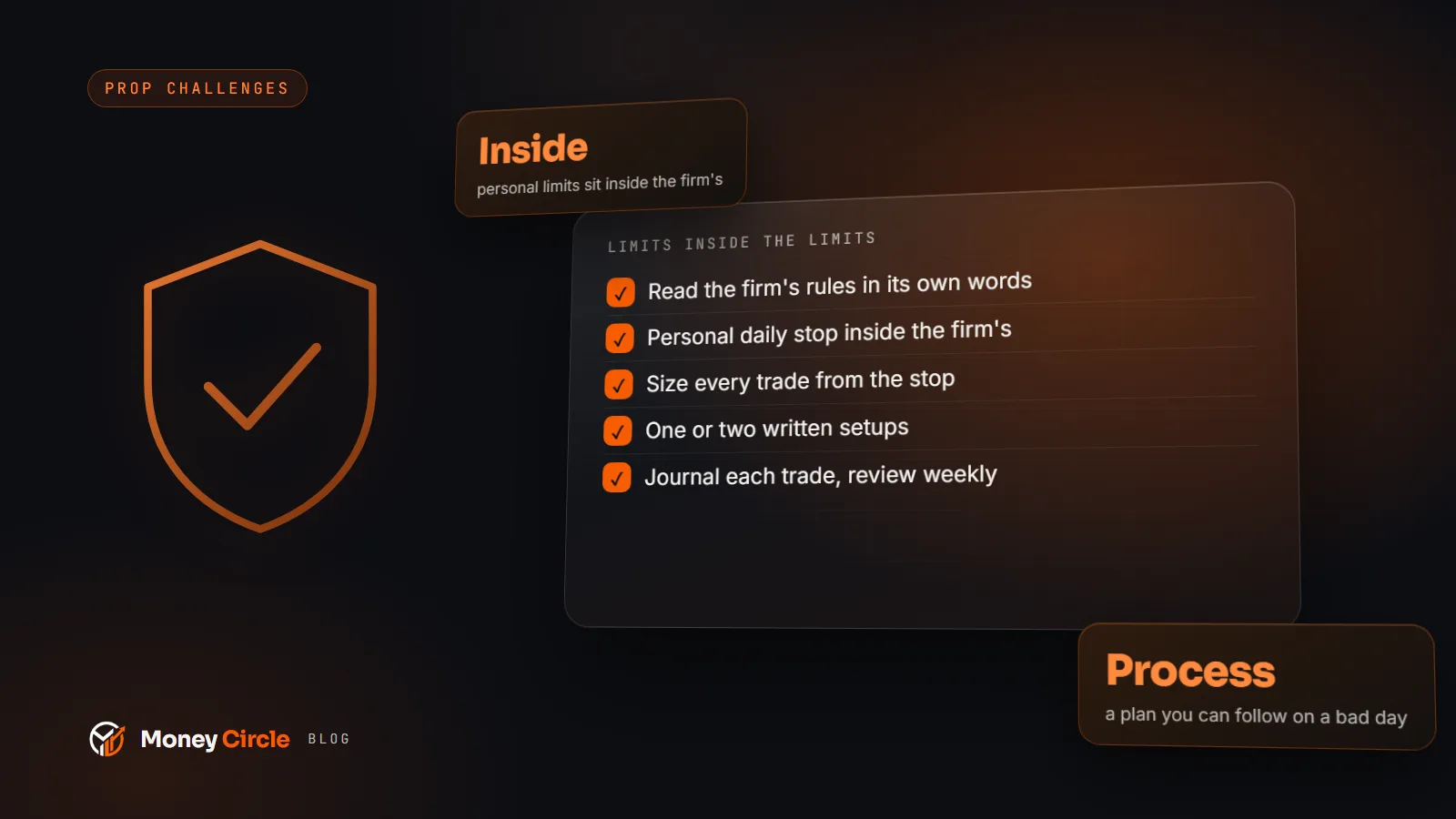
If the firm or broker you use publishes its own notices about trading hours, holidays or changes to conditions, check them now. A shortened session or a changed margin requirement is better found before the open than during it.
Minute 3 to 6: The chart and levels check
Open your charts for the one or two markets in your plan, and do a calm, structured read. Start on the higher timeframe and work down:
- Trend or range? Describe it in a sentence. If you cannot, note that it is unclear.
- Key levels. Mark the levels where price has reacted more than once, the previous session's high and low, and any level your setups rely on. Remove clutter from earlier days.
- Where is price relative to those levels? Close to one, in the middle of nowhere, or just through one.
For reading charts clearly, ChartViews AI has helpful material, including its guide to reading trading charts clearly and its article on multi-timeframe analysis. Keep your own routine simple and do not add new tools every week.
Also write the sentence "No trade is a valid outcome today." It sounds obvious, but many traders feel obliged to find something. A day with no qualifying setup is a day you protected your account.
Minute 6 to 8: The plan check
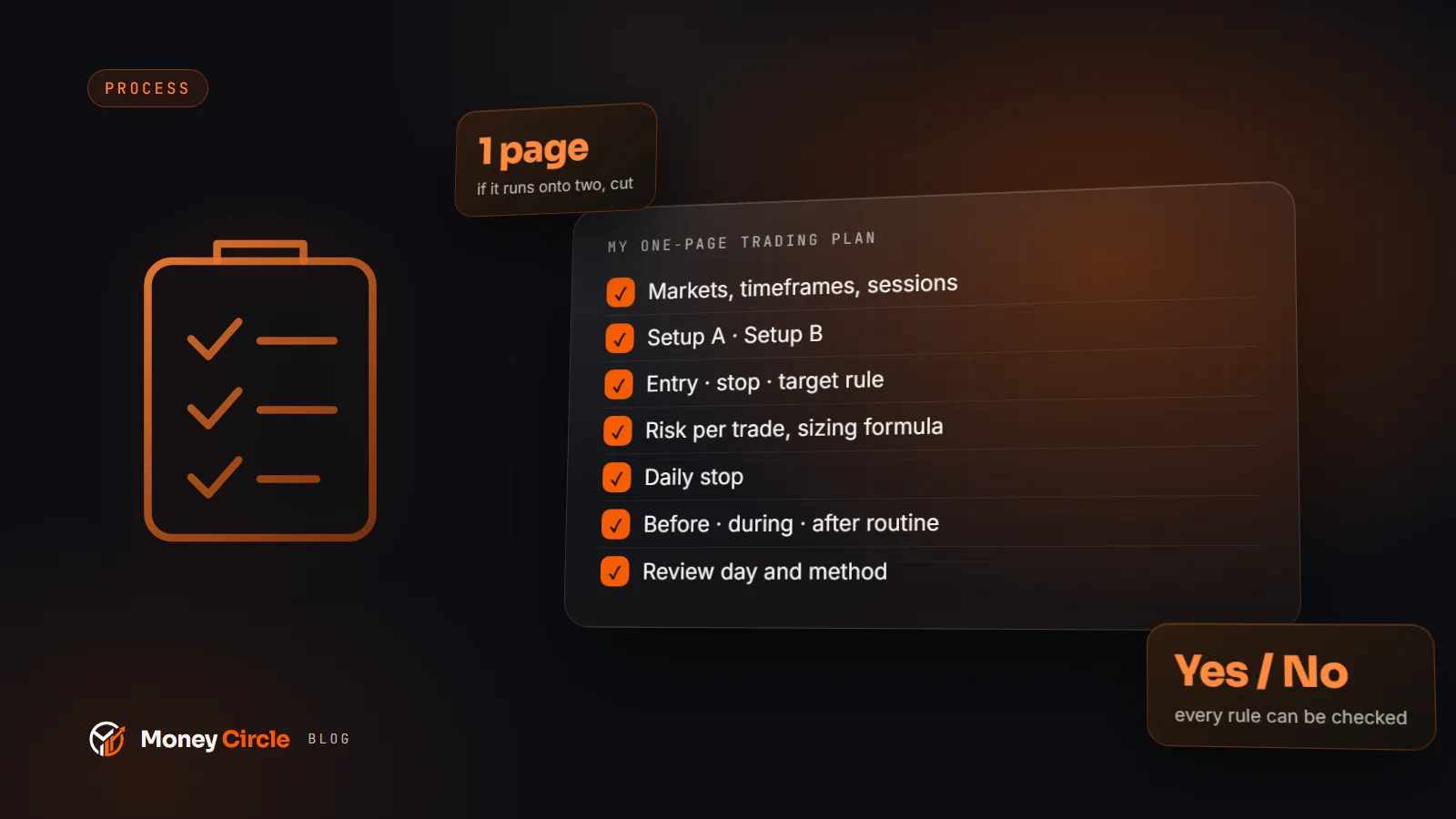
Now open your trading plan and read it through, all of it, in about two minutes. This is the step that stops rule drift, because it reminds you of what you committed to when you were calm. Check these items against the day:
- Risk per trade. What is my fixed risk amount, and how do I calculate the size? (Our guide to position sizing covers the arithmetic.)
- Daily stop. What is my limit for today, in account currency? At what point do I close the platform?
- Maximum trades. How many trades am I allowed today?
- Sessions. Which hours am I trading, and when am I done?
- What I do not do. Moving stops further away, adding to a loser, re-entering immediately after a stop-out without a new signal.
Minute 8 to 9: Look at your open risk
If you hold positions from earlier days, review them as if you were deciding to enter them now. Is the stop where the idea is invalid? What is the combined risk across positions, including correlated ones? Is any position in the way of a scheduled event from the calendar check? Make decisions now, calmly, rather than when the event arrives.
Minute 9 to 10: Write the day's line
Finish by writing three things in your journal, in a single short entry:
1. My state: one word. 2. The main risk today: for example, a central bank statement at a given time. 3. My intention: one sentence, such as "Trade setup A only, stop trading at my daily limit, no trades in the news window".
Then close the preparation, and begin only when the session you planned actually opens. Our piece on what to record in a trading journal shows how this fits with your per-trade notes.
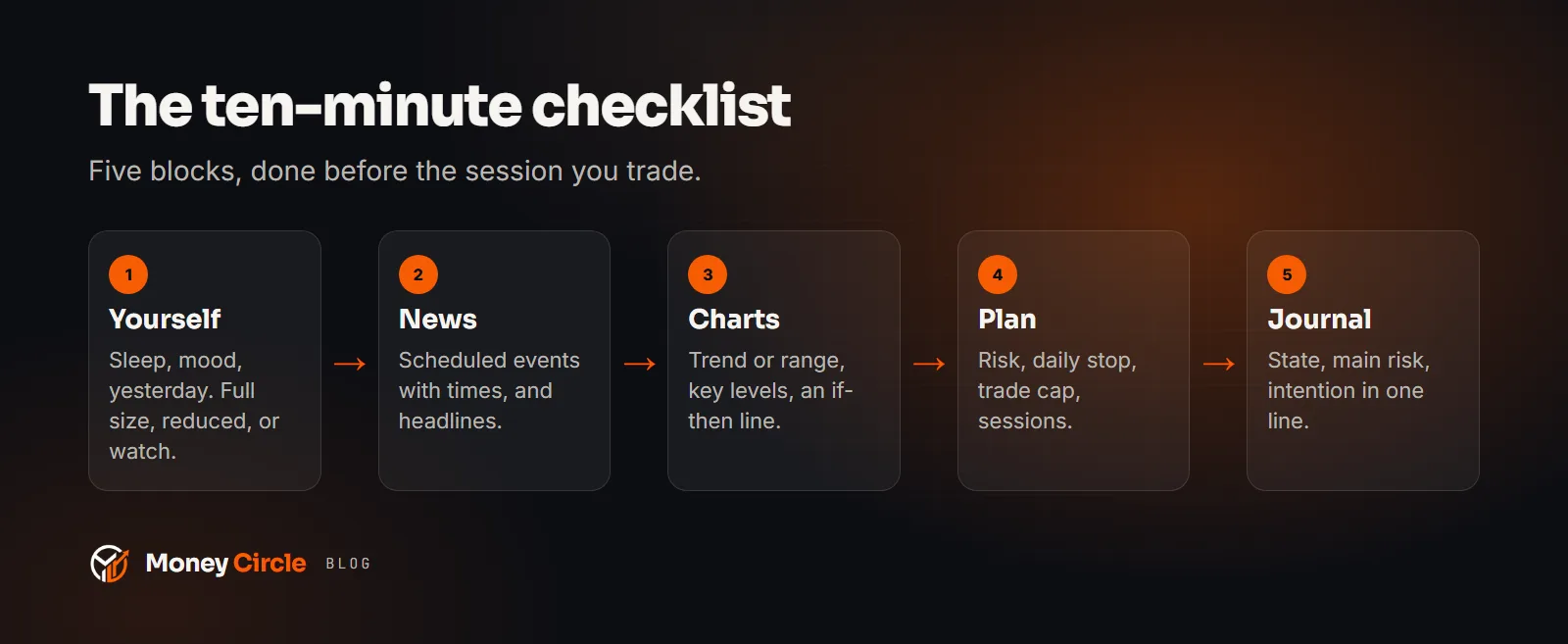
A printable version
- Check myself: sleep, mood, yesterday. Full size, reduced, or watch only.
- News: scheduled events with times, unscheduled headlines, any notices.
- Charts: trend or range, key levels, which setup is possible, if-then line.
- Plan: risk per trade, daily stop, maximum trades, sessions, what I do not do.
- Open risk: stops, combined exposure, events ahead.
- Journal line: state, main risk, intention.
Common problems and fixes
It drifts to thirty minutes. Set a timer. If a task keeps running over, move it to the weekly review.
You skip it on days you feel fine. Tick it in the journal as part of the day's record, so a skipped routine is visible when you review. Skipping often shows up as a pattern on the days you broke other rules too.
You turn it into prediction. The routine is about preparation, not forecasting. Write conditions ("if this, then that"), not forecasts ("it will go up").
You change the plan during it. Reading the plan is not editing it. If you want to change a rule, note the idea and decide at your weekly review, not in the middle of a morning.
You do it and then ignore it. The routine matters only if the intention you wrote guides what you do. Look at it again before your first order.
Making it stick
Do it for ten sessions in a row and track one thing: did I do the routine before trading, yes or no? At your weekly review, compare the days you did it with the days you did not. Many traders find the rule breaks cluster on the skipped days. If that is true for you, you will not need anyone to persuade you to keep it.
Preparation does not remove the risk of losing, and no routine makes a trade profitable. What it does is make your decisions deliberate, your limits visible and your day easier to review, which is the foundation for improving over time.
Educational content, not financial advice. Trading involves risk of loss.
Learn it, log it, review it on Money Circle
Included with every paid Money Circle membership: Trader Reflect and 2 ChartViews AI analyses a day.
Guides
Continue in the ecosystem
 ChartViews AI
 Trader Reflect
More from the Money Circle Blog
Get the free Trading Plan Template
A printable plan with your rules, risk and review routine, plus the weekly market outlook by email. Unsubscribe anytime.