How to Pass a Prop Firm Challenge: A Rule-Based Plan
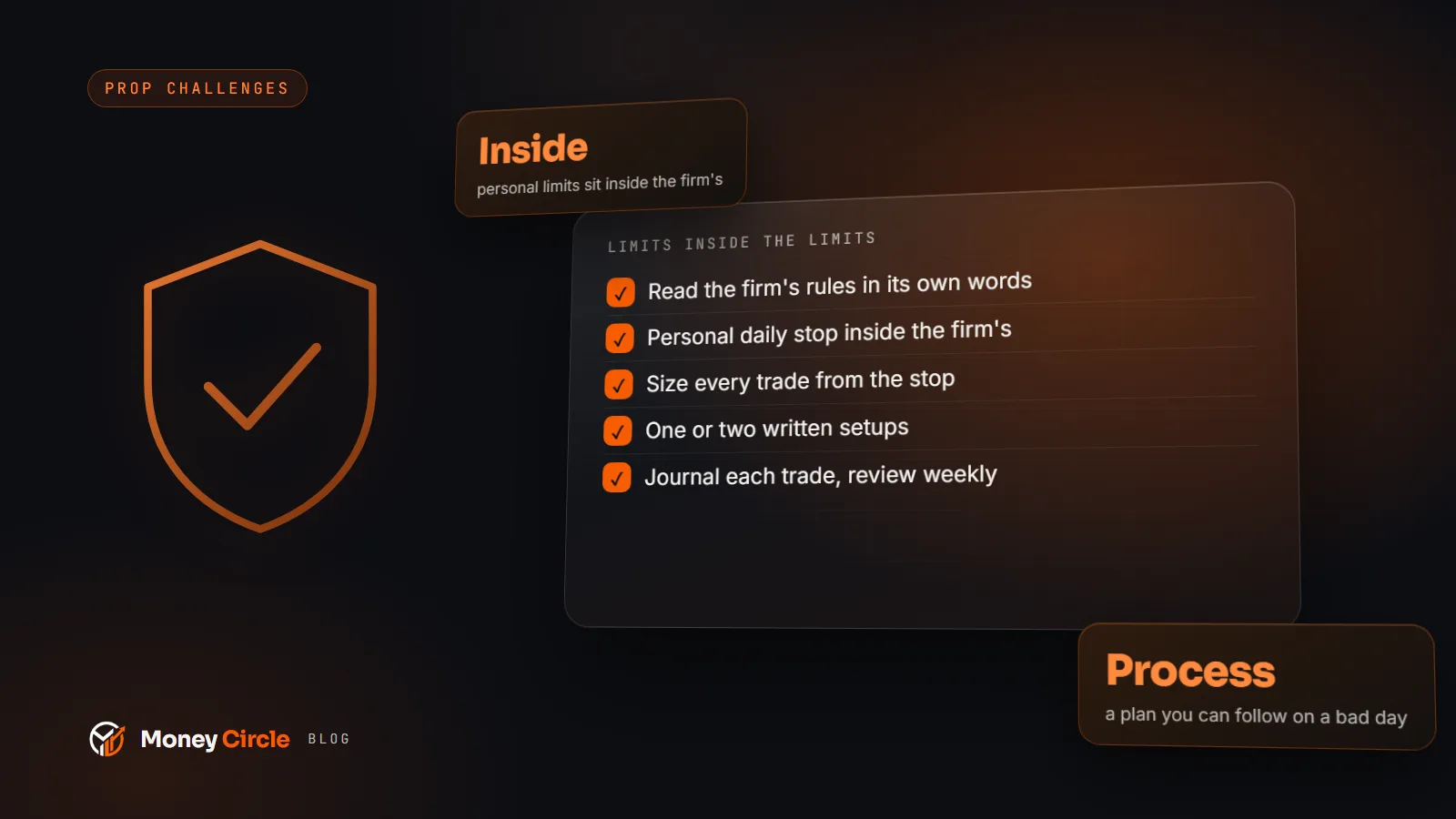
A rule-based plan for a prop firm challenge: personal loss limits, position sizing, a written trading plan and a journal.
Most people who fail a prop firm challenge do not fail because they cannot read a chart. They fail because a single bad day breaks a rule, or because a rushed trade is sized too large, or because they treat the evaluation as a sprint when it is really a test of consistency. If you are weighing up an evaluation, the useful question is not "which strategy passes?" but "what process keeps me inside the rules long enough for my plan to play out?"
This guide sets out a rule-based plan for approaching a challenge. It does not promise a pass, because nobody can, and it does not name or recommend any firm. If you are still new to the format, start with our explainer, what a prop firm challenge actually is, then come back here for the process.
Start by reading the rules like a contract
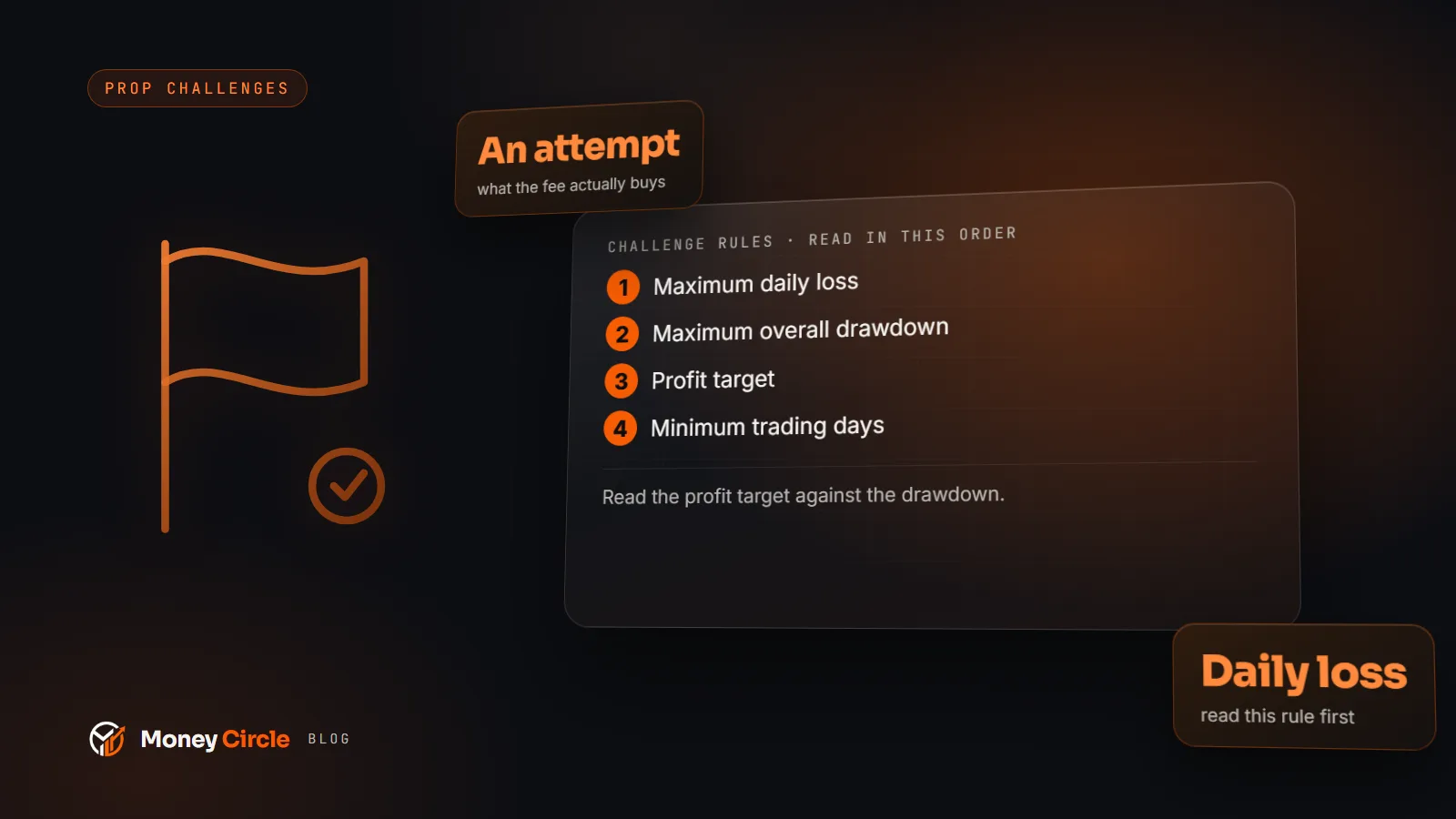
A challenge is a set of rules with a fee attached. Before you think about trading, write down the rules in your own words, because the rules decide what a sensible plan looks like. The ones that matter most:
- Maximum daily loss. How much you may lose in one day, and what counts toward it. Check whether open positions count, and whether the limit resets at a fixed time you must know in your own time zone.
- Maximum overall drawdown. The total decline you may suffer. Find out whether it is measured from the starting balance or trails your highest equity, because a trailing limit behaves very differently.
- Profit target. The gain required to move on. Read it against the drawdown, not on its own.
- Minimum trading days, time limits and restricted behaviour. Some programs restrict holding through major news, certain order types, or particular instruments.
Turn the firm's limits into smaller personal limits
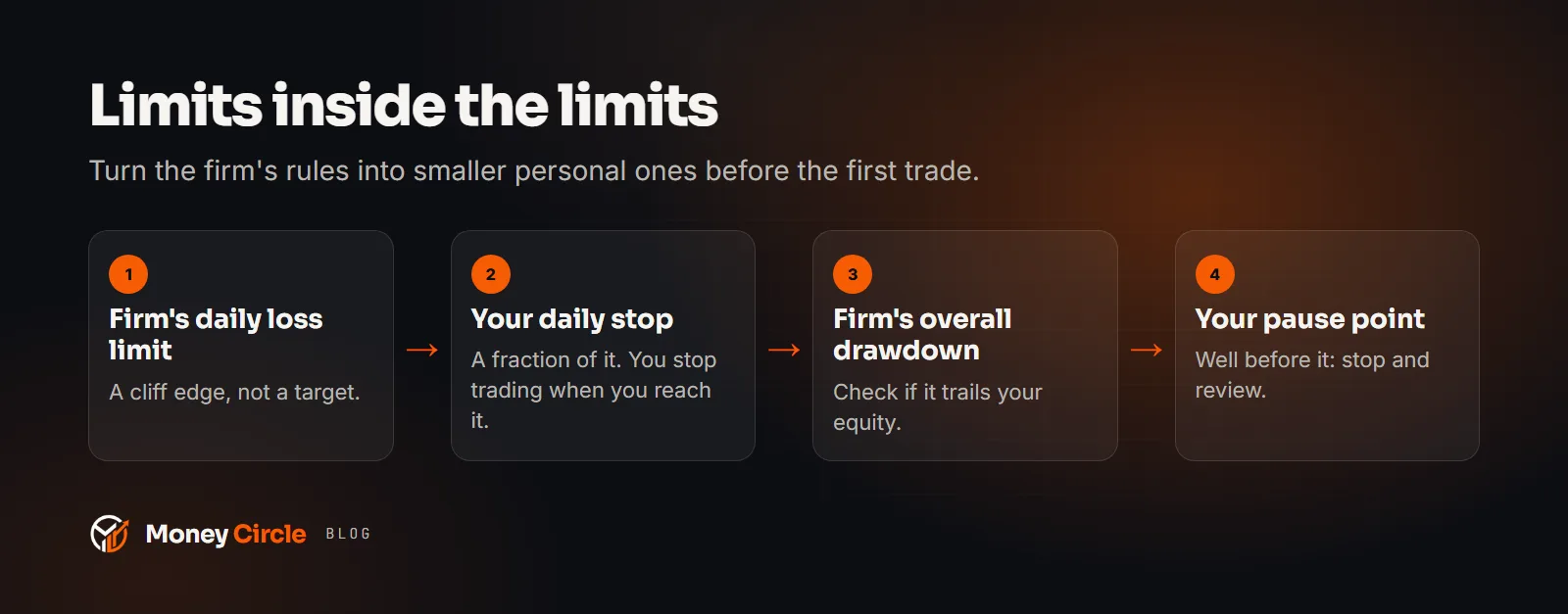
The firm's daily loss limit is a cliff edge, not a target. If you plan to lose right up to it, one slippage event or one gap can push you over. Instead, set personal limits that sit comfortably inside the firm's limits.
A simple structure:
1. Take the firm's maximum daily loss and decide on a personal daily stop that is a fraction of it, for example half. When you reach it, you stop trading for the day. No exceptions, no "one more to get back". 2. Take the overall drawdown and set a personal pause point well before it. If you reach that point, you stop trading and review before you place another order. 3. Write both numbers in your plan, in account currency, before the first trade.
The reason for the margin is practical. Losses are rarely tidy. A stop can fill worse than planned, two trades can lose at the same time because they are really the same bet, and a spread can widen at the wrong moment. A buffer turns those events into annoyances instead of disasters.
Size every trade from the stop, not from a feeling
Position sizing is where most challenge attempts are won or lost, because it controls how many losing trades you can absorb. The approach used by most educators is fixed-fractional risk: you decide a small, fixed amount to risk per trade, and you calculate the position size from the distance to your stop.
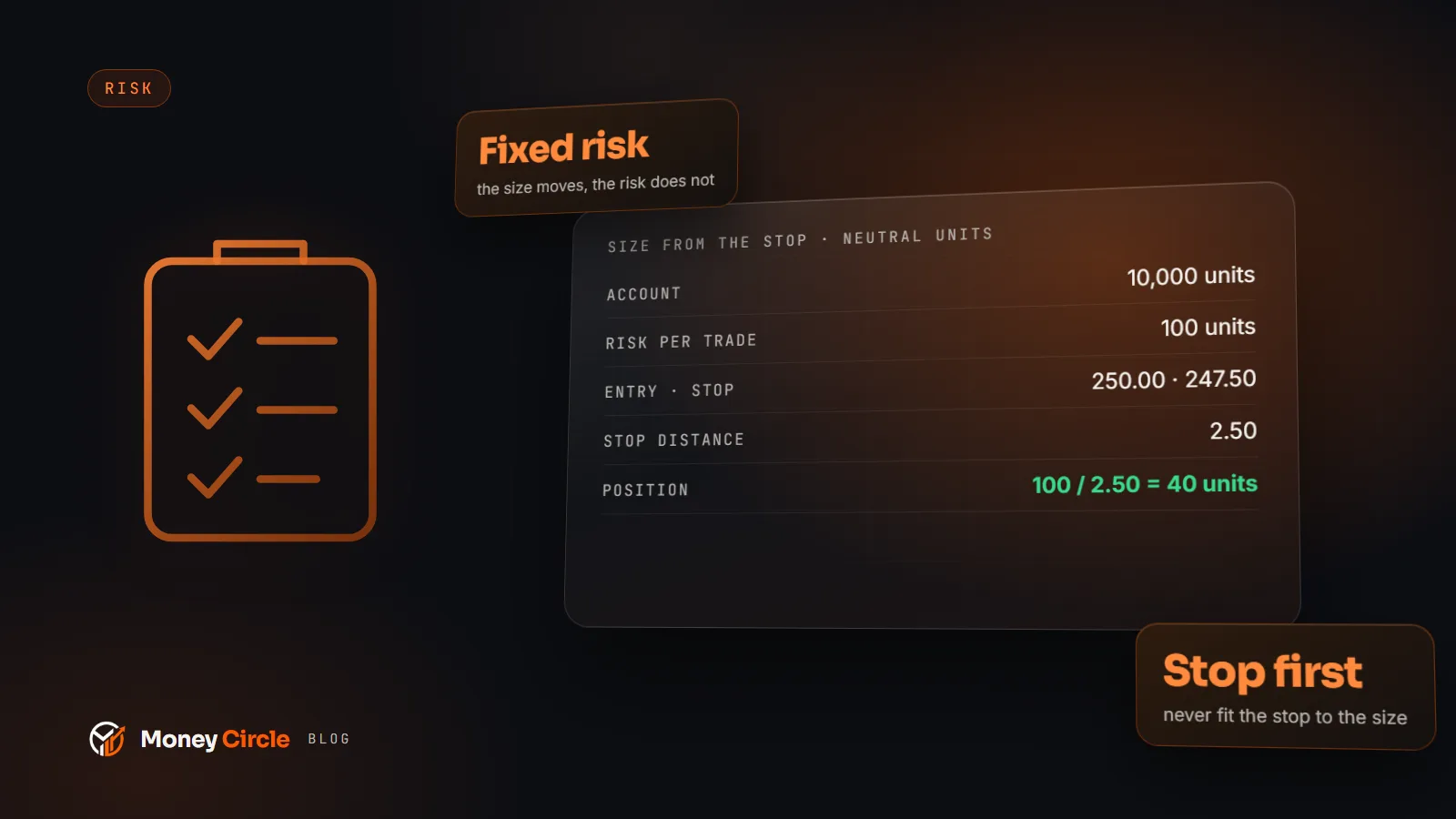
Here is the structure, in neutral units. Suppose the account is 10,000 units and you decide to risk a small, fixed amount of 50 units per trade. Your chart says the idea is invalid 2.5 price units from entry. The position is the risk amount divided by the stop distance: 50 divided by 2.5 gives 20 units of the instrument. If the stop is wider, the position is smaller. If it is tighter, the position is larger. The risk stays the same.
We cover the calculation in detail, with more examples, in our guide to position sizing and how much to risk per trade. For a second angle, ChartViews AI has a clear explainer on fixed-percentage position sizing.
Two things matter for a challenge in particular. First, your per-trade risk multiplied by the number of losses you can tolerate must fit inside your personal daily stop. If you risk a large amount per trade and your daily stop allows only one loss, you have no room for ordinary variance. Second, remember correlated trades. Two positions in related markets in the same direction can behave like one larger position, so count them together.
Write a trading plan that fits the evaluation
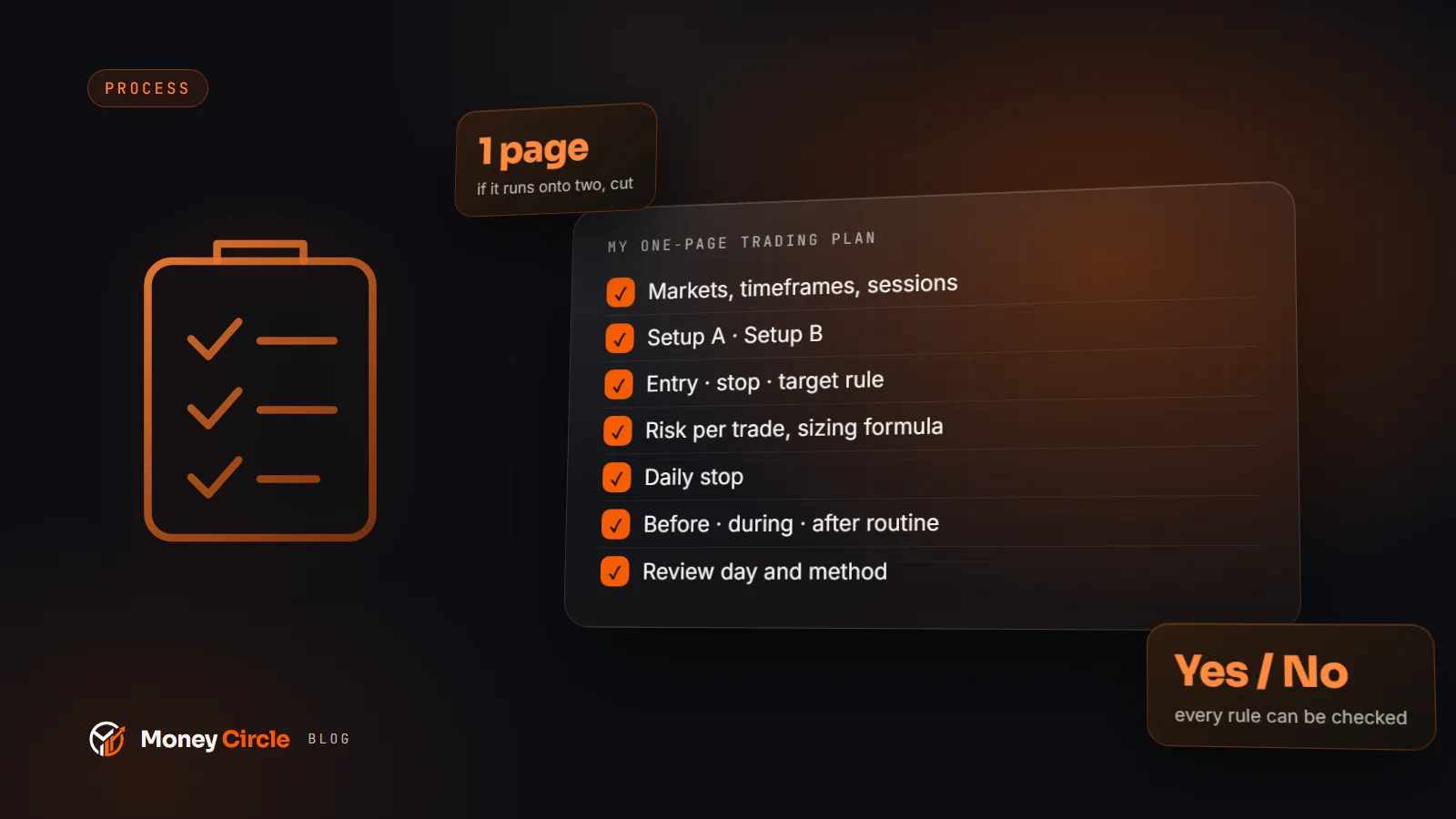
A challenge punishes improvisation. You need a written plan before you start, with rules that can be checked. If you do not have one yet, our guide on building a trading plan you will actually follow walks through each part, and the free trading plan template gives you a structure to fill in.
For a challenge, add a few lines to the usual plan:
- Which setups you will trade, and only those. One or two is enough. An evaluation is not the place to try a new idea.
- Which sessions you trade. Choose hours you can genuinely sit through, and treat the rest as closed.
- News handling. Decide in advance whether you trade through scheduled events, avoid them, or reduce size, and check whether the firm restricts it.
- A maximum number of trades per day. A cap prevents the spiral of trading to recover.
- What you do after a loss. Write the exact response, for example a short break and a note in the journal before the next order.
Keep a journal from the first trade
The journal is how you find out whether you are following the plan. In an evaluation, with limited attempts and a fee attached, noticing a drift early is worth a lot. Record for each trade the setup, where the stop went and why, what you did after entry, and a simple yes or no: did I follow my rules? Our piece on what to record in a trading journal explains which fields are worth the effort and which are noise.
Keep a short daily line as well: the day's risk used against your personal daily stop, and your state of mind. Patterns show up quickly. Many traders discover that their rule breaks cluster at the same time of day, after the same kind of loss, or when they are close to the target and start pressing.
That last pattern deserves a note. Getting near the profit target can be as dangerous as being near the drawdown limit. The temptation is to size up to finish faster. Trader Reflect has a thoughtful article on sizing up after a winning streak that is worth reading before you start. Your plan should say that size does not change near the target.
Review weekly and change one thing
At the end of each week, sit down for half an hour and look at your journal. Did you stay inside your personal limits? Which setups were taken as written? Where did you break a rule, and what was happening just before? Choose one concrete change for the following week, not five. Our weekly trading review routine gives a step-by-step format you can copy.
Decide in advance what a pass, a fail and a pause look like
Before you pay, write three short statements:
- What you will do if you pass: how you will approach the next stage so that nothing about your plan changes just because the account is different.
- What you will do if you fail: whether you will try again, and what you must change in the process before you do. A failed attempt with a clear lesson is information. A quick second attempt without one is usually a second fee for the same mistake.
- What would make you stop: for example, a set number of rule breaks, or a sign that the fee is affecting your decisions.
A short checklist
- I have read the firm's current rules on its own site and written them in my words.
- My personal daily stop and pause point sit inside the firm's limits.
- Every trade is sized from the stop distance with a fixed risk amount.
- My plan is written, with one or two setups, set sessions and a daily trade cap.
- I tested it on a demo account under the same limits.
- I journal each trade and review once a week.
- My size does not change near the target.
Where to go next
Spend one evening turning the firm's rules into your personal limits and write them at the top of your plan. If you want help doing that with other people, a small accountability group built around process and review, rather than copying trades, is a good place to do it. Either way, the aim is the same: a process you can follow on an ordinary day, which is the only kind of day an evaluation really tests.
Educational content, not financial advice. Trading involves risk of loss.
Learn it, log it, review it on Money Circle
Included with every paid Money Circle membership: Trader Reflect and 2 ChartViews AI analyses a day.
Guides
Continue in the ecosystem
 ChartViews AI
 Trader Reflect
More from the Money Circle Blog
Get the free Trading Plan Template
A printable plan with your rules, risk and review routine, plus the weekly market outlook by email. Unsubscribe anytime.