Learning to Trade With a Community: What Helps and What Misleads
How accountability, feedback on reasoning and shared process can speed learning, and the traps to avoid: copying calls, herding, survivorship bias.
Trading looks like a solitary activity: one person, one screen, one account. That picture is part of why many beginners struggle. Learning almost any skill is faster when other people can see what you are doing, and trading is unusual in how easily it can be hidden. Nobody sees your hesitation, your broken rules or your rationalisations unless you choose to show them.
A community can fix some of that. It can also make things worse if you use it badly. This article looks at what a good trading community offers, how to get real value from one, and the specific traps to watch for.
What a community can genuinely give you
Accountability
It is easy to break a rule when nobody will ever know. It is harder when you have told a few people what you plan to do. Accountability does not require anyone to police you. The simple knowledge that you will report what happened changes the moment of decision, because you are now writing for an audience that will ask "did you follow your plan?"
Research on goal-setting, such as the work of Edwin Locke and Gary Latham on specific goals and feedback, has long suggested that specific commitments combined with feedback support follow-through better than vague intentions. That is a general finding about human goal pursuit, not a claim about markets, but it fits the problem: a specific rule, stated aloud, with someone to check in against.
Feedback on your reasoning
When you review your own trade, you see it through the memory of how it felt. Another person sees only what you wrote. If they ask "why did you put the stop there?" and your answer is weak, you have learned something that months of solo screen time might not have shown you.
This is the most valuable kind of feedback: critique of the reasoning, not a verdict on the outcome. A sound decision can lose and a poor one can win. Good peers discuss the decision.
Seeing other people's process
Reading how others prepare, journal, size positions and review gives you a menu of methods to try. You will notice that capable people differ widely in style but share habits such as predefined risk, written plans and regular reviews. Seeing that spread is reassuring, and it stops you from assuming your own approach is the only one.
Company during the dull parts
Learning to trade has a lot of repetition: journaling, reviewing, waiting for setups that do not arrive. A group makes the quiet stretches easier to sustain, and it normalises the fact that a good week often means taking few trades.
How to use a community well
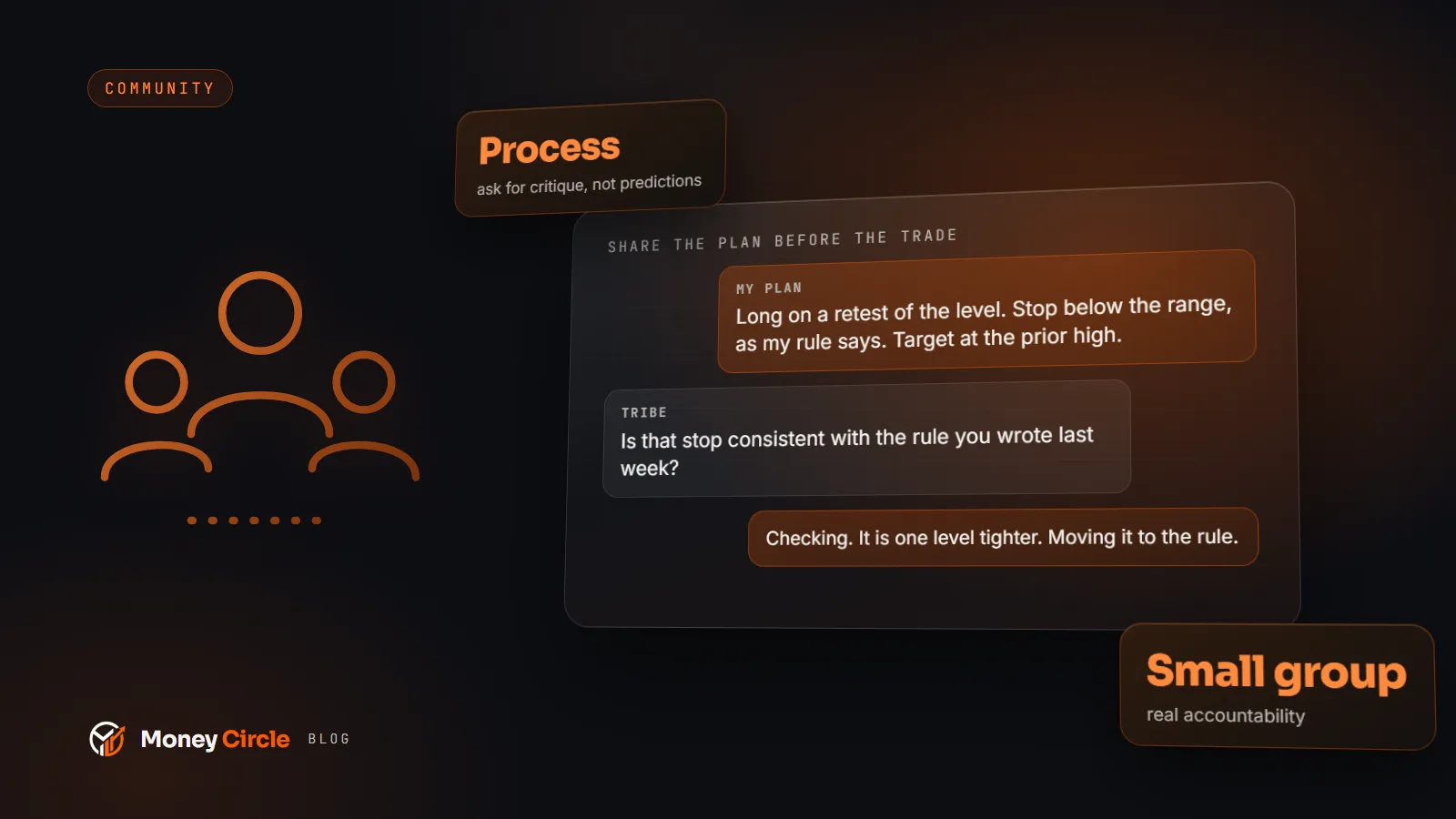
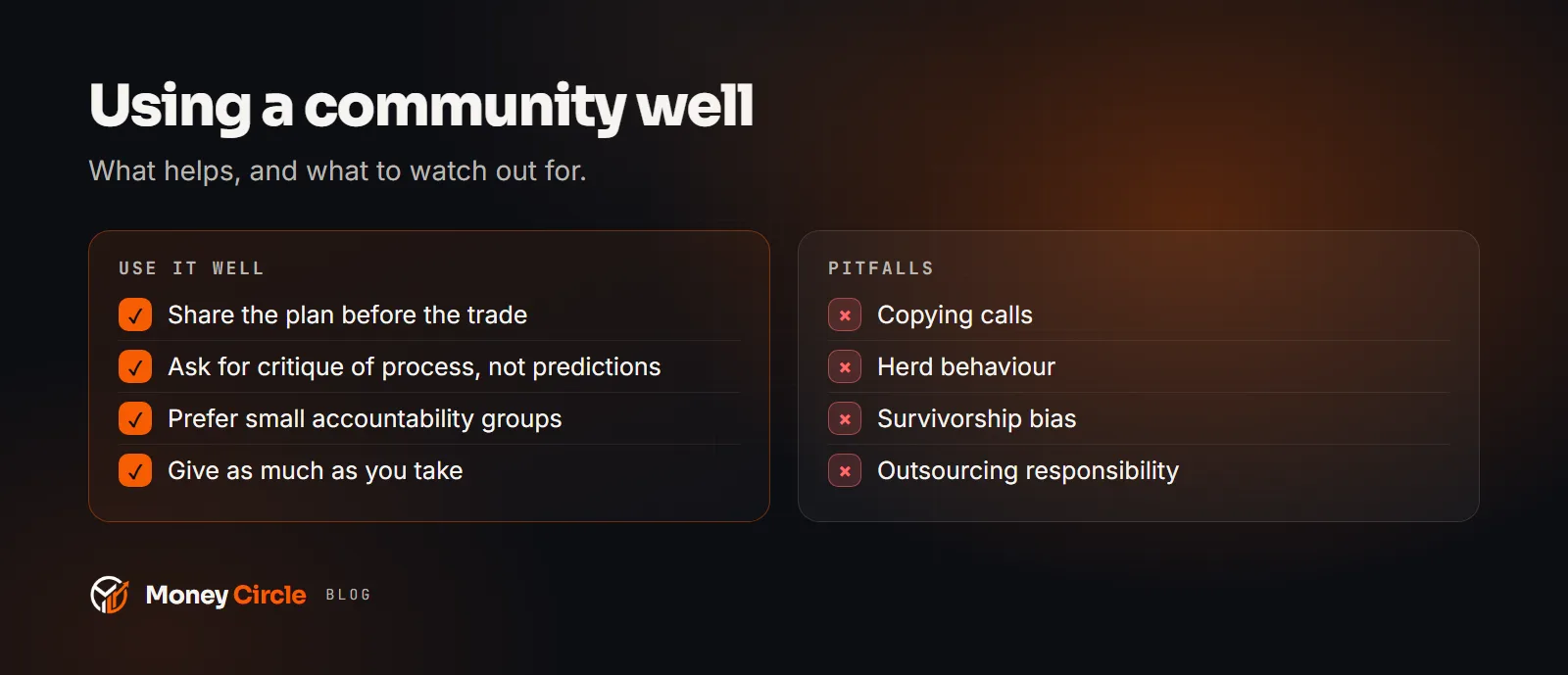
Share the plan before the trade
The most useful thing you can post is not a result but an intention: the market, the setup, the entry condition, the stop, the target and the risk you plan to take, written before you enter. This does three things. It commits you to the plan. It gives others something concrete to critique. And it leaves a timestamped record that cannot be quietly rewritten after the outcome is known.
A short, consistent format helps. Something like: setup, why now, where I am wrong, where I take profit, how much I risk. Keep it to a few lines.
Ask for critique of process, not predictions
Questions like "will gold go up?" invite guessing, and the answers are worth little. Better questions look at your method:
- "Is my stop placement consistent with my own rule?"
- "Does this setup match the definition I wrote last week?"
- "What did I miss in how I handled this exit?"
- "Is my daily stop too loose given how I have been trading?"
Prefer small accountability groups
A large chat is good for atmosphere and quick questions, but individuals get lost in it. A small group, perhaps a handful of people who check in on a regular rhythm, creates real accountability because everyone's absence is noticed and everyone's trades get read. Money Circle's Trade Tribes are built on this idea, but you can form the same thing yourself anywhere: agree on a check-in format, a weekly review call, and a rule that members post their plan before they trade.
Set the ground rules early. State that feedback is about process, that nobody is expected to follow anybody else's trades, and that missing a check-in without notice gets a gentle question. Groups with clear norms last longer than groups that rely on enthusiasm.
Give as much as you take
Reviewing someone else's plan is itself good practice. Spotting a missing stop in another person's idea trains your eye to spot it in your own. Explaining why you think a rule is checkable sharpens your understanding of the rule. Contributing feedback is not charity, it is part of the learning.
The pitfalls
Copying calls
The most tempting misuse of a community is to treat it as a source of trades. Following someone's entry without understanding the reasoning leaves you without the plan, the stop logic or the sizing. You do not know when the idea is invalidated, and you will not know what to do when it goes against you. You also inherit their decision about risk, which may not fit your account or your tolerance.
A useful test: if the person who posted the idea disappeared right now, would you know what to do with the position? If not, you are not trading your own plan.
Herd behaviour
Groups can reinforce themselves. When several people in a chat are excited about the same move, it feels like confirmation, though it may only be that everyone is looking at the same chart and reading the same headlines. Agreement is not evidence. Treat a crowded view as a reason to re-check your own rules, not as a reason to relax them.
Be especially wary of urgency. Phrases like "last chance" or "everyone's in" are signs that pressure, not analysis, is steering the conversation.
Survivorship bias
In any community, the loudest posts tend to come from people who had a good week. The people who quietly stopped, who had a rough run or who simply never posted are not part of the picture you see. This makes outcomes look more common and more repeatable than they are. Remember that screenshots are selected, and judge people by the quality of their process and the honesty of their records, not by their best results.
The same applies to anyone who presents themselves as an authority. Ask how they manage risk, what they do when they are wrong, and whether their records are complete. Be cautious about anyone who focuses on outcomes and avoids discussing losses.
Outsourcing responsibility
A community can inform your decisions, but it cannot make them for you. The account, the risk and the consequences are yours. If you notice yourself using the group to avoid owning a decision, such as waiting to be told when to exit, step back and return to your written plan.
Signs you have found a good one
- People post plans and reviews, not only winners.
- Losses and mistakes are discussed openly and without mockery.
- Feedback is about reasoning and risk.
- Nobody sells urgency or guarantees.
- You leave conversations with a clearer process, not just stronger opinions.
Next step
Write your next trade idea in five lines before you place it: setup, why now, where you are wrong, where you take profit, and how much you risk. Share it with one trusted person or a small group, and ask a single process question about it. After the trade, report back on whether you followed the plan, whatever the result. If you want a structured place to practise this, look for a small accountability group, or simply find two or three people who will commit to a weekly check-in.
Educational content, not financial advice. Trading involves risk of loss.
Learn it, log it, review it on Money Circle
Included with every paid Money Circle membership: Trader Reflect and 2 ChartViews AI analyses a day.
Continue in the ecosystem
 ChartViews AI
 Trader Reflect
More from the Money Circle Blog
Weekly Gold & Nasdaq outlook
Every Sunday: the week's key events, how gold, the Nasdaq, the Dow, the S&P 500 and EUR/USD moved, and our signal record. Free. Unsubscribe anytime.