Trading Community vs Signal Groups: What Actually Helps You Improve
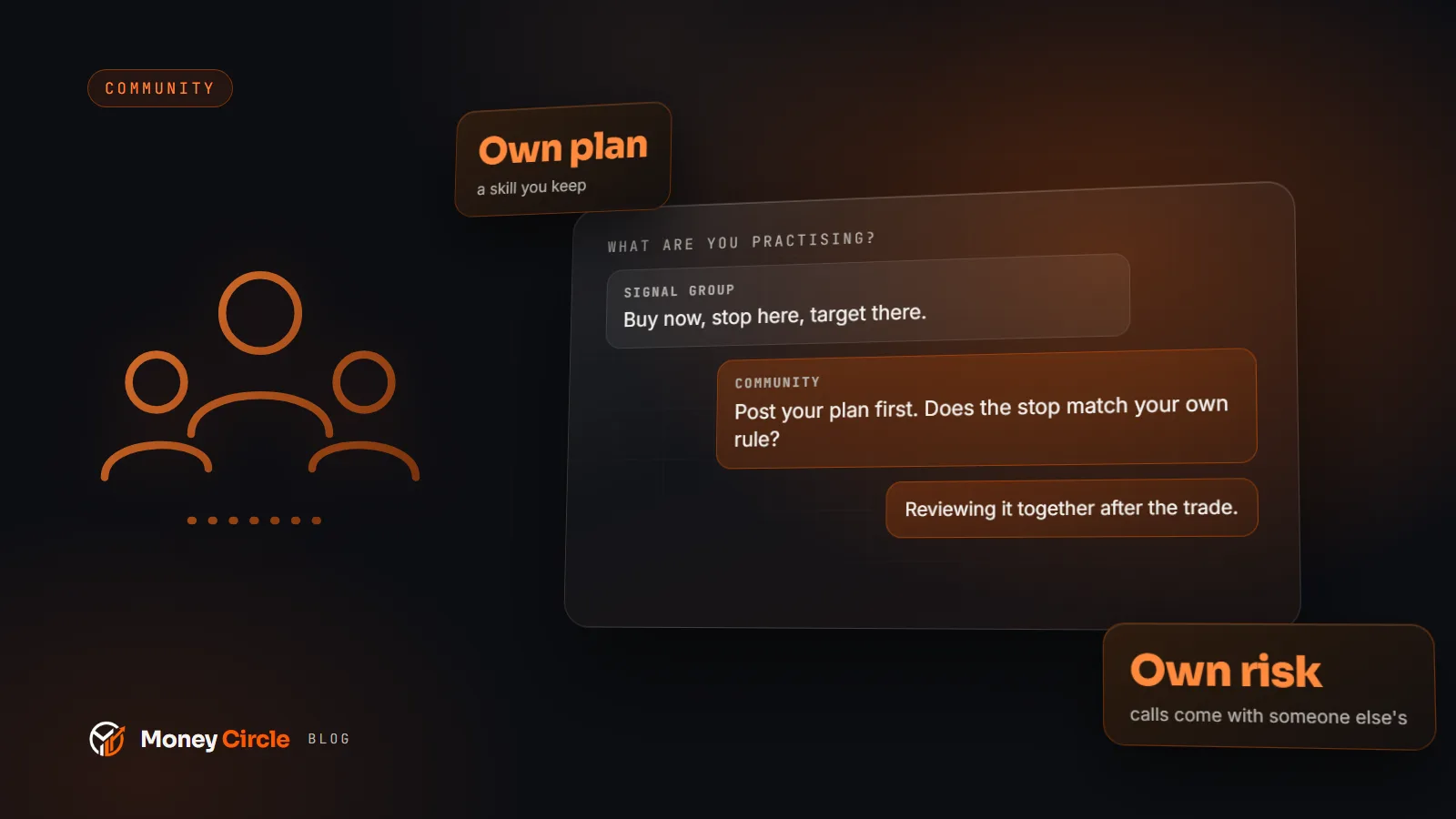
An honest comparison of trading communities and signal groups: accountability, process and feedback versus copying calls.
If you are about to join something to help you trade better, you will probably meet two very different offers. One is a trading community: a place where people discuss markets, share plans, review each other's work and learn together. The other is a signal group: a channel where someone posts trade calls, usually an instrument, an entry, a stop and a target, and members act on them.
They can look similar from the outside, since both are chats full of charts, but they are built to do different jobs. Choosing between them is easier when you are clear about what you actually want. If your goal is to become a trader who can make your own decisions, the useful question is not "which one shows me more winning trades?" but "which one makes me better at the parts of trading I control?"
This article compares the two honestly, including where each one is strong, where each one falls short, and what to ask before you join. It is educational, not advice. Money Circle runs a community, so we have a stake in this topic, and we have tried to be fair about the limits of both models.
What each model is built to do
A signal group is built to deliver trade ideas. The value proposition is simple: someone else does the analysis and you receive the result. The measure of success is the quality of the calls.
A trading community is built to improve its members. The value is in discussion, feedback and accountability: reading other people's plans, having yours read, reviewing mistakes and building habits. The measure of success is whether members become more consistent in how they trade.
Neither model is automatically good or bad. What matters is whether the model matches your goal, and whether the particular group behaves the way it says it does.
Where a signal group can be useful
Being fair to the model, signals can serve some purposes.
- Examples to study. A trade idea with a stated entry, stop and target is a worked example. If you read the reasoning and compare it with your own analysis, it can teach you something.
- A sense of tempo. Seeing how often setups appear and how they play out can calibrate your expectations.
- Time saving. Some people simply do not have time to scan markets and want ideas to evaluate.
Where signal groups fall short
You inherit someone else's risk. A call comes with a stop and a size implied by someone else's account and temperament. Your account may be smaller, your tolerance lower, your costs higher. If you copy the entry but size the position by feel, you are no longer taking the trade that was posted.
You do not know when the idea is invalid. When a copied trade goes against you, the original reasoning is not yours. You cannot tell whether this is normal noise or a broken thesis, and the temptation is to freeze, move the stop or wait for the next message.
Timing and execution differ. By the time a call is posted, read and acted on, the price may have moved, the spread may have widened, and the planned risk to reward no longer holds. Different members get different fills on the same call.
Nothing is learned from the result. A win teaches you only that you followed the call. A loss teaches you only that the call failed. Neither improves your own process, because you had none involved.
The record may not be what it seems. Ask whether results are complete, whether losing calls stay visible, whether they are measured the same way throughout, and whether anyone independent can check them. Selective screenshots tell you very little. Be cautious of any group that emphasises its best weeks and is quiet about the rest.
Urgency is a warning sign. "Last chance", "everyone is in" and countdowns are sales tactics, not analysis.
Where a trading community is strong
Accountability. When you post your plan before a trade and report back afterwards, you are more likely to follow it. People notice when you go quiet. That social friction is surprisingly effective against rule-breaking.
Feedback on process. Others can spot a missing stop, a vague rule or a trade that contradicts your own plan. It is much easier to see someone else's blind spots than your own, and you will start seeing yours by doing it for others.
Shared review habits. Weekly reviews, journaling formats and checklists spread through a community. Doing them alongside other people makes them stick.
Different perspectives. Seeing how others handle the same market, the same drawdown or the same temptation widens your range of responses.
Honest company during bad runs. Everyone who trades has a rough stretch. Having people who are open about theirs makes yours easier to bear and less likely to turn into a destructive reaction.
We wrote more about this in learning to trade with a community.
Where communities fall short
Being a community does not make a group good. The weaknesses are real.
It can turn into a signal group by drift. If the most active members post calls and others copy them, the group has become a signal group with extra steps. Check what the daily conversation actually consists of.
Herd behaviour. When many people are excited about the same move, it feels like confirmation. It is usually just a shared view of the same chart. Agreement is not evidence.
Survivorship bias. The loudest voices tend to be those who had a good week. Quiet members and those who left do not appear in the picture.
Too large to give feedback. In a chat with thousands of members, individuals get lost. Feedback is rare and accountability is thin.
No substance behind the friendliness. A pleasant atmosphere is not the same as improvement. If nobody ever shares a plan, a review or a mistake, there is nothing to learn from.
Small groups tend to work better
The most reliable format is a small group, perhaps a handful of people who check in regularly. Everyone's absence is noticed, everyone's trades get read, and the norms can be set clearly: feedback is about process, nobody has to follow anybody else's trades, and a missed check-in gets a gentle question. Money Circle's Trading Clans are built around this idea, and you can create the same thing anywhere with two or three people willing to commit to a weekly review. The format matters more than the brand.
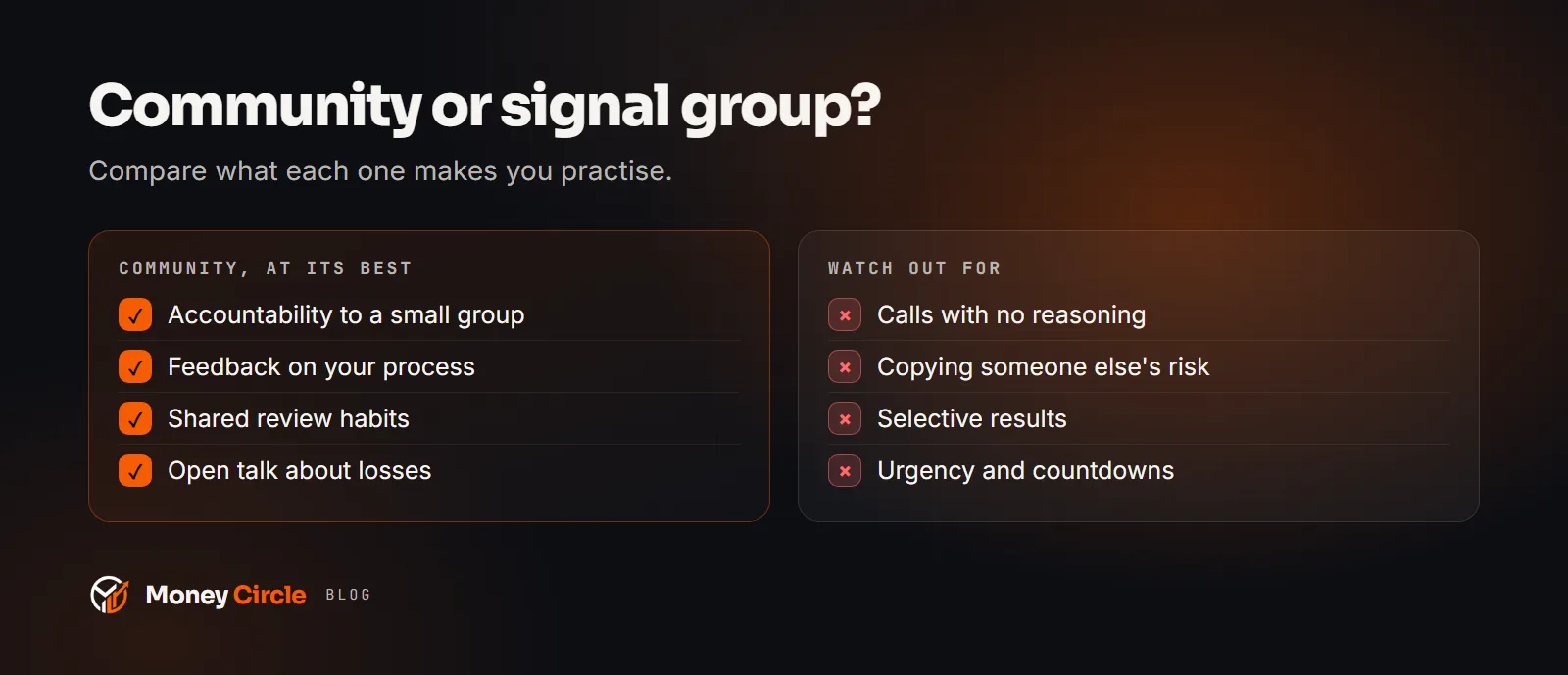
A side-by-side comparison
- Main product. Signal group: trade calls. Community: feedback and accountability.
- What you practise. Signal group: following instructions. Community: building and checking your own plan.
- Risk handling. Signal group: someone else's. Community: yours, discussed openly.
- When a trade goes wrong. Signal group: you wait for a message. Community: you review against your own rules.
- Skill left after a year. Signal group: little that transfers. Community: habits that go with you to any account.
- Main danger. Signal group: dependence, and unverified records. Community: herd behaviour, and drift into copying.
Questions to ask before you join either
1. What exactly will I receive, and how is it different from a free resource? 2. Is the full record, including losing trades, visible and checkable by someone independent? 3. Is risk discussed before entries? Is a stop and the reasoning given with every idea? 4. Are members expected to post plans and reviews, or only to react to calls? 5. Does anyone promise returns or guarantee outcomes? If so, leave. 6. Can I leave easily, and is it clear what I am paying for? 7. Does the group have rules against pressure, hype and unrequested trade copying?
If you still want signals
Some people want trade ideas as part of the mix, and that is a reasonable choice if you handle them properly. Treat each call as an idea to evaluate. Do your own stop and size calculation from your own account, using a fixed amount at risk (our guide to position sizing shows how). Journal every idea you take or skip, with a yes or no for "did I follow my plan?". ChartViews AI has a useful article on the difference between chart interpretation and a signal service that explains why a decision-support approach differs from a call service. Never let an idea's source override your own risk rules.
A simple way to test any group
Join for a short, defined period and ask one question: after two weeks, am I a more consistent trader or just a busier one? Write down your plan adherence in your journal before and after. If you are following your rules more often, the group is helping. If you are making more trades, with less certainty about why, it is not.
Whichever you choose, the account, the risk and the consequences are yours. The best groups, in either category, are the ones that make that obvious and help you carry it well.
Educational content, not financial advice. Trading involves risk of loss.
Learn it, log it, review it on Money Circle
Included with every paid Money Circle membership: Trader Reflect and 2 ChartViews AI analyses a day.
Guides
Continue in the ecosystem
 ChartViews AI
 Trader Reflect
More from the Money Circle Blog
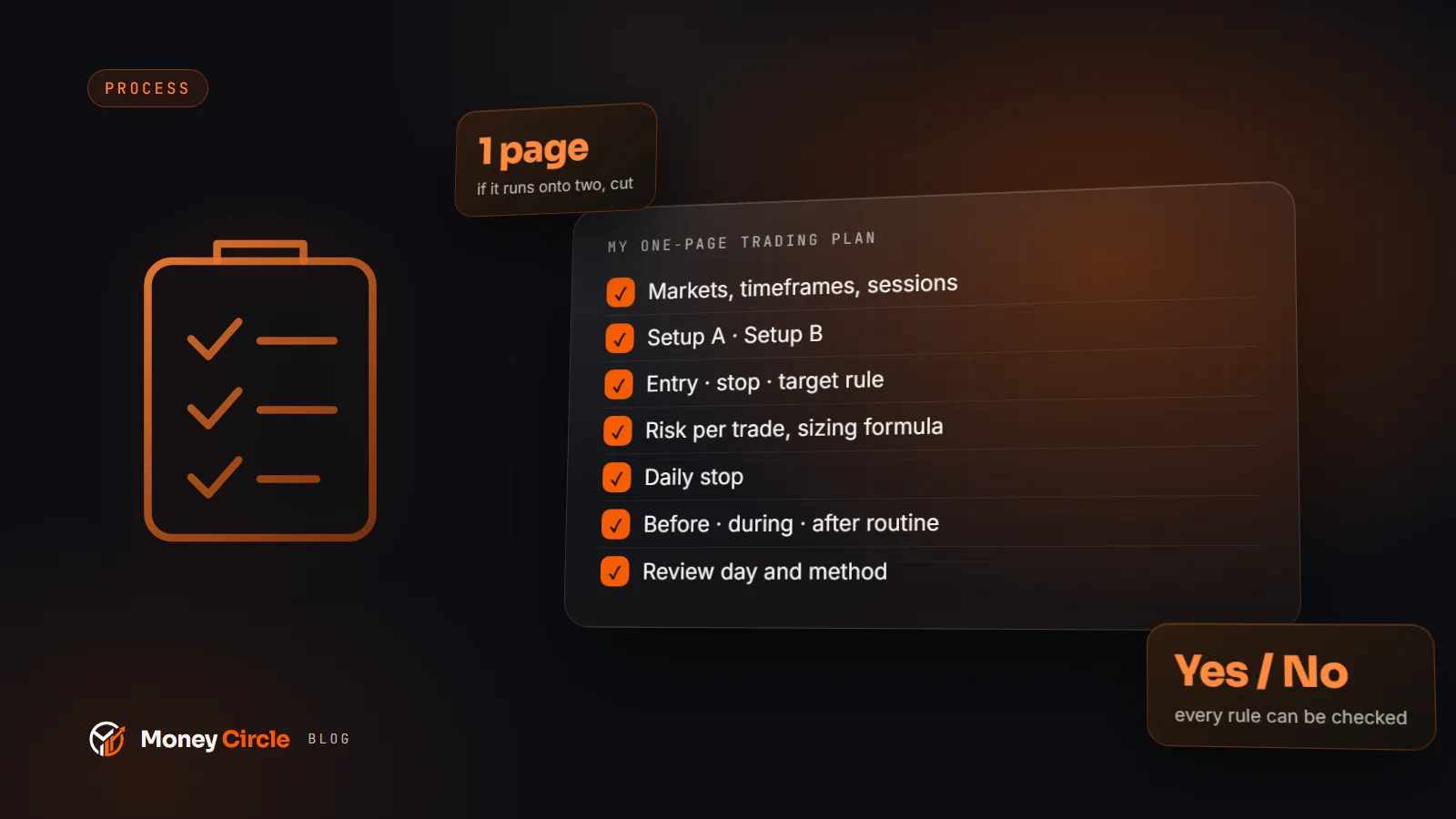
Get the free Trading Plan Template
A printable plan with your rules, risk and review routine, plus the weekly market outlook by email. Unsubscribe anytime.