The Trading Journal Habit: How to Keep One for 90 Days
How to build a trading journal habit that lasts: a three-minute entry, a weekly review and what to do when you fall behind.
Most traders know they should keep a journal. Far fewer keep one for more than a few weeks. The first entries are detailed, the middle ones get shorter, and then a busy week happens and the notebook goes quiet. The journal itself is not the problem. The habit around it is.
This guide is about making the habit stick. If you want to know which fields to record, read trading journal: what to record first. Here we cover when to write, how short the entry can be, how to run a weekly review, and how to recover when you miss days. It is educational, not advice.
Why the habit matters more than the format
A journal works only if it is read, and it can only be read if it exists. A simple record of forty trades is worth far more than a beautiful template used six times. Your journal is the one source of data about how you actually trade, as opposed to how you remember trading. Memory is edited by mood: wins feel earned and losses feel unlucky. The page does not know your mood.
So the first goal is not insight. The first goal is consistency. Insight comes later, from the pile of entries you have kept.
Make the entry small enough to always finish
The most common reason for abandoning a journal is that each entry takes too long. If it takes fifteen minutes to log a trade, you will skip it on the days you are tired, and those are the days you most need it.
Aim for a three-minute entry. A workable minimum is:
- The date, the market and the direction.
- The setup, in a few words from your plan.
- Where the stop was and why there.
- What you did after entry: held, moved the stop, closed early.
- Did I follow my rules: yes, partly or no.
- One word for how you felt.
- The result, in units of risk or in money.
Attach it to something that already happens
Habits stick when they follow an existing routine. Choose a trigger and write it down: "When I close a trade, I log it before I look at another chart." Or: "When I shut the platform for the day, I spend five minutes on the journal." Pick one trigger and do not negotiate.
Many people prefer logging each trade straight after it closes, because the details are fresh. Others prefer a single end-of-session batch. Either works. What does not work is "later", because later becomes tomorrow and then never.
If you use a digital tool, put it where you already are. The trading journal app page describes a simple one. A paper notebook is also fine, as long as it is on your desk and not in a drawer.
Journal the trades you did not take
Some of the most useful entries are the non-trades. If you saw a setup and skipped it, write one line: what it was and why you passed. If you took nothing all day because nothing matched your plan, say so. That is a valid and often disciplined outcome, and recording it normalises it. It also stops the journal from becoming a record of only the days you were active, which pushes you to trade more.
The weekly review is what turns notes into change
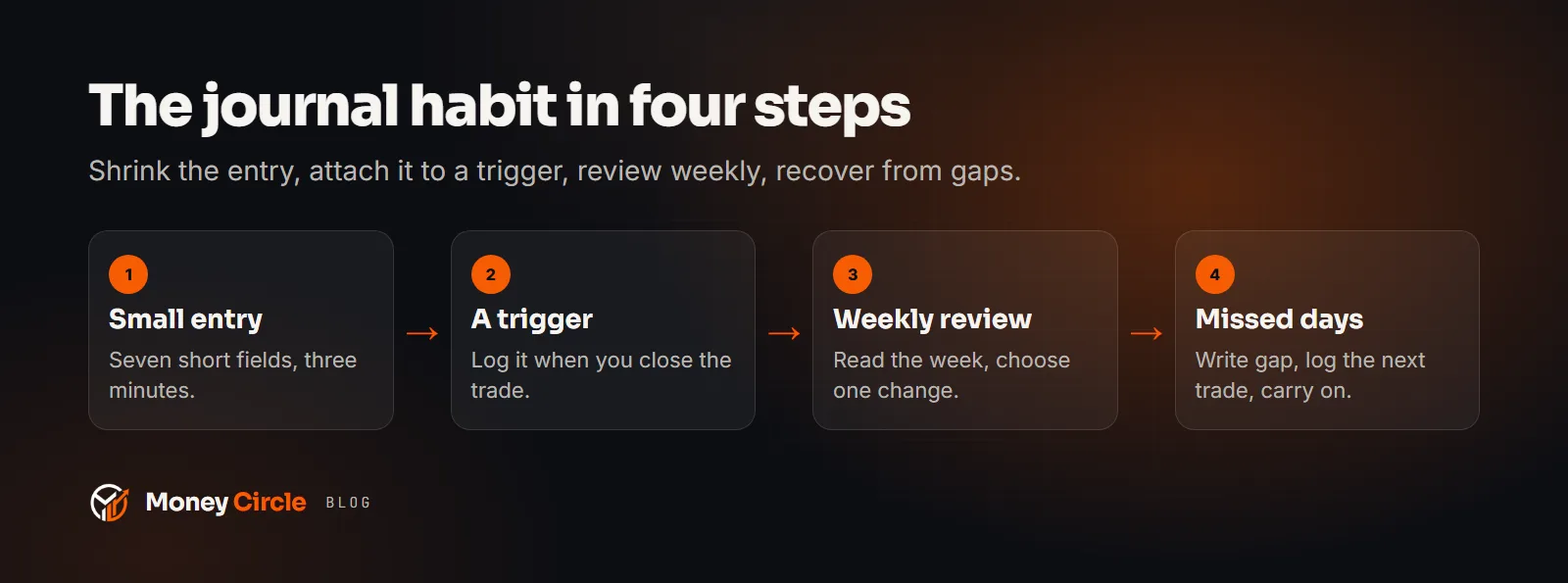
Entries on their own are a diary. The review makes them a tool. Once a week, at a fixed time, away from the charts, read the week's entries and answer a few questions:
- How many trades did I follow the plan on, and how many not?
- Which setup had the most trades, and how did it go in terms of risk?
- What was the most common mistake?
- What is the one change I will make next week?
What to look for after a month
After thirty days, resist the urge to judge your results. A month of trades is a small sample, and the aim is to find patterns in behaviour, not to prove a method. Look for things you can act on:
- Times of day when your rule-following drops.
- Setups where you move the stop more than your plan allows.
- Moods that precede broken rules, such as "bored" or "revenge".
- Trades that were bigger than your plan allowed.
When you miss days
You will miss days. The mistake is to treat a gap as failure and quit. Use a simple recovery rule: if you miss a day, log the missed trades briefly from your platform history when you next sit down, then carry on. If you have missed a week, do not try to reconstruct it in detail. Write "gap" for those days, log the next trade, and keep going.
Never make logging a punishment. A journal that you dread will be abandoned. If it has become a chore, shrink it: go back to the five-field minimum for a week.
A 90-day plan
Ninety days is long enough to build a habit and short enough to be a clear goal.
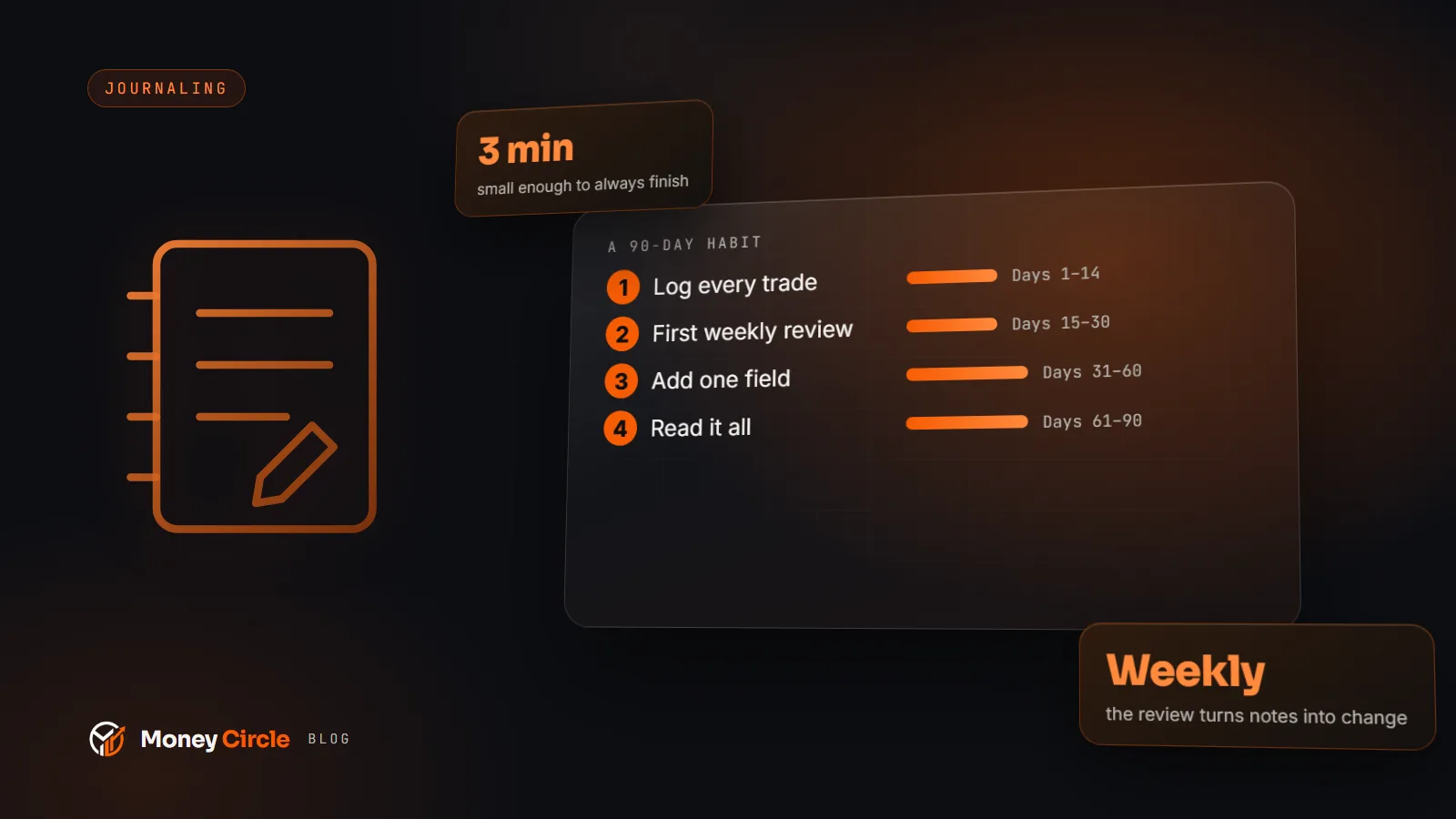
Days 1 to 14: log every trade with the minimum fields, straight after it closes. Do not analyse anything yet.
Days 15 to 30: keep logging. Hold your first weekly review at the end of each week, and pick one change.
Days 31 to 60: add one field if you have a real question that needs it, for example the time of day. Keep the rest unchanged.
Days 61 to 90: read the whole log from the start. Count how often you followed the plan, and which mistake is the most common. Write a short summary of what you have learned about your own behaviour, and decide what to change in your trading plan.
At day ninety, you have a record that is more useful than any course, because it is about you. If your plan still needs work, our guide to why trading plans fail shows how to use that record to tighten it.
Keep it honest
A journal only helps if it is truthful. Record the trades in which you broke a rule, especially those that made money. A rule broken with a lucky result is still a broken rule, and it will cost you eventually. Do not edit old entries, and do not record only the setups you are proud of.
It can also help to share a short weekly summary with an accountability partner. Our article on learning to trade with a community explains how to do this without turning it into a chat about trade calls, and the Money Circle Academy includes a lesson on journaling that pairs with this routine.
Trading involves risk of loss, and a journal improves your process but does not guarantee any result; this is educational content, not financial advice.
Educational content, not financial advice. Trading involves risk of loss.
Learn it, log it, review it on Money Circle
Included with every paid Money Circle membership: Trader Reflect and 2 ChartViews AI analyses a day.
Guides
Continue in the ecosystem
 ChartViews AI
 Trader Reflect
More from the Money Circle Blog

Get the free Trading Plan Template
A printable plan with your rules, risk and review routine, plus the weekly market outlook by email. Unsubscribe anytime.