Why Trading Plans Fail, and How to Make Yours Stick
Most trading plans fail in the first hard week. Here is why, and how to write rules, if-then triggers and checks you can follow.
Almost every trader has a trading plan on paper, and almost every trader has broken it. If that sounds familiar, the problem is usually not a lack of willpower. It is that the plan was written for a calm person at a desk on a quiet evening, and it has to be followed by a different person on a fast, uncomfortable afternoon.
This article is about the gap between having a plan and following it. If you do not have a plan yet, start with our guide to building a trading plan you will follow or the free trading plan template. If you have one that keeps failing, read on. It is educational, not advice.
Why plans fail
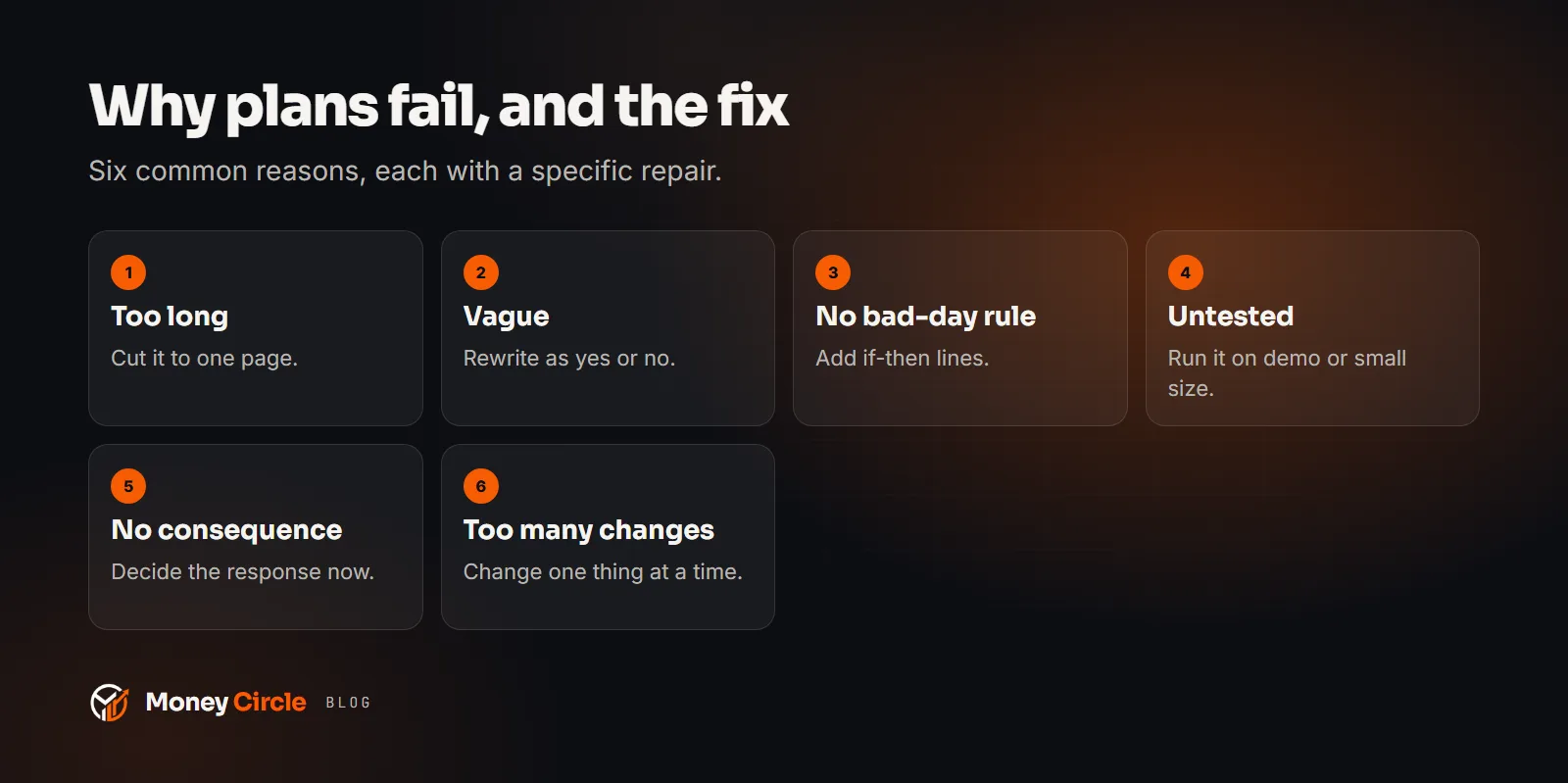
They are too long. A plan that runs to ten pages will not be read at the moment you need it. When a decision has to be made in seconds, you cannot look anything up. If the rule does not fit in your head, it does not exist.
They are vague. "Only take good setups" and "manage risk carefully" are wishes. Nobody can tell whether they were followed, including you. A rule must be checkable: yes or no, did I do it?
They have no rule for the bad moments. Plans describe entries and exits but say nothing about what to do after three losses, after missing a move, or after a big win. Those are the moments when most rules get broken.
They were never tested. A plan that has not been run on a demo account, or on small size, is a hypothesis. The first live trades are the test, and it is expensive to discover that a rule cannot be followed.
They have no consequence. If breaking a rule costs nothing, rules become suggestions. There needs to be a visible record, and a defined response.
They try to change everything at once. A new trader writes twenty rules on Sunday and abandons them all by Wednesday. Habits change one at a time.
Make every rule checkable
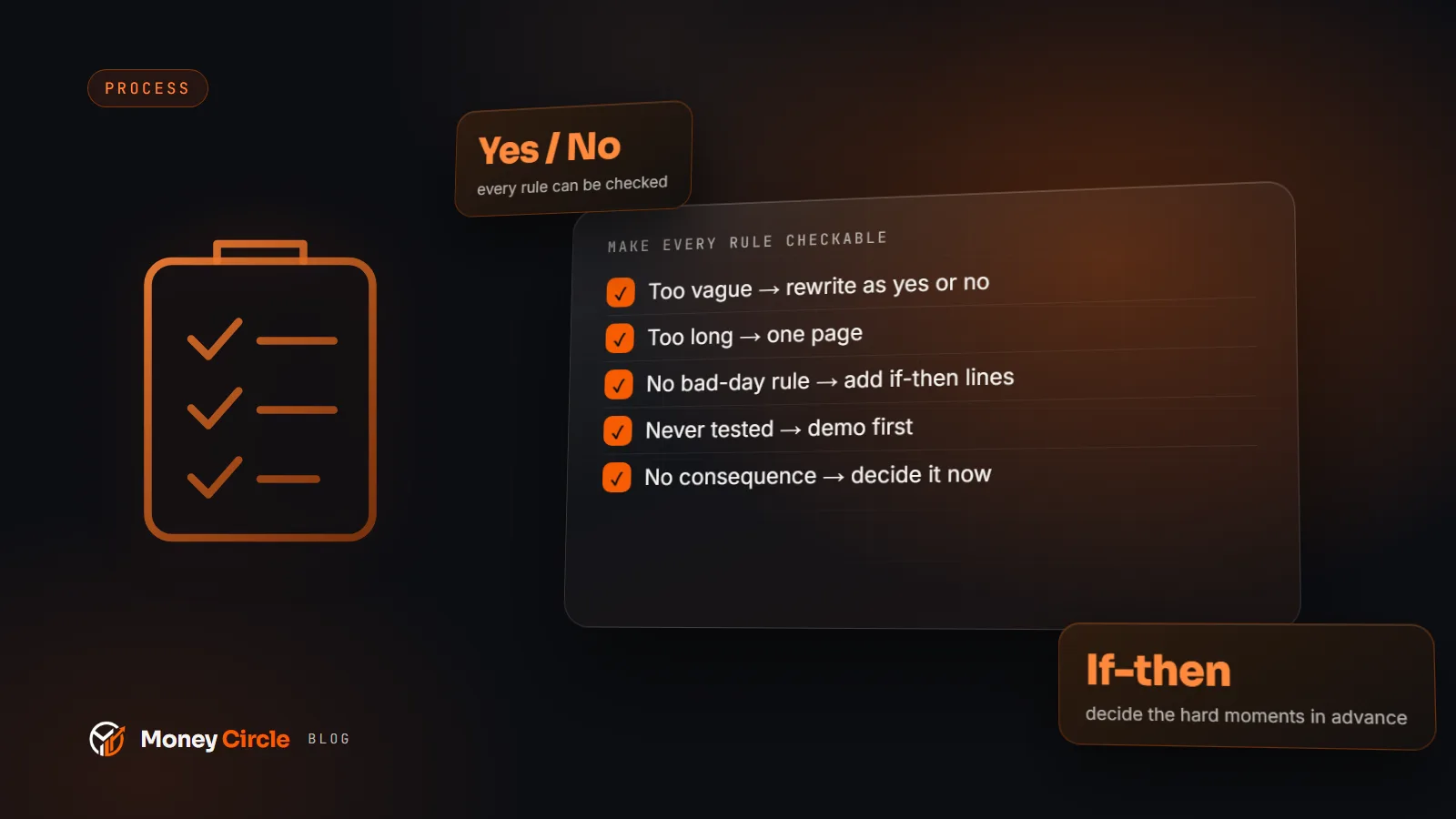
Go through your plan and rewrite each line so it can be answered with yes or no after a trade.
Weak: "Risk a small amount." Better: "My risk per trade is one fixed fraction of my account, written here, and I size every position from the stop."
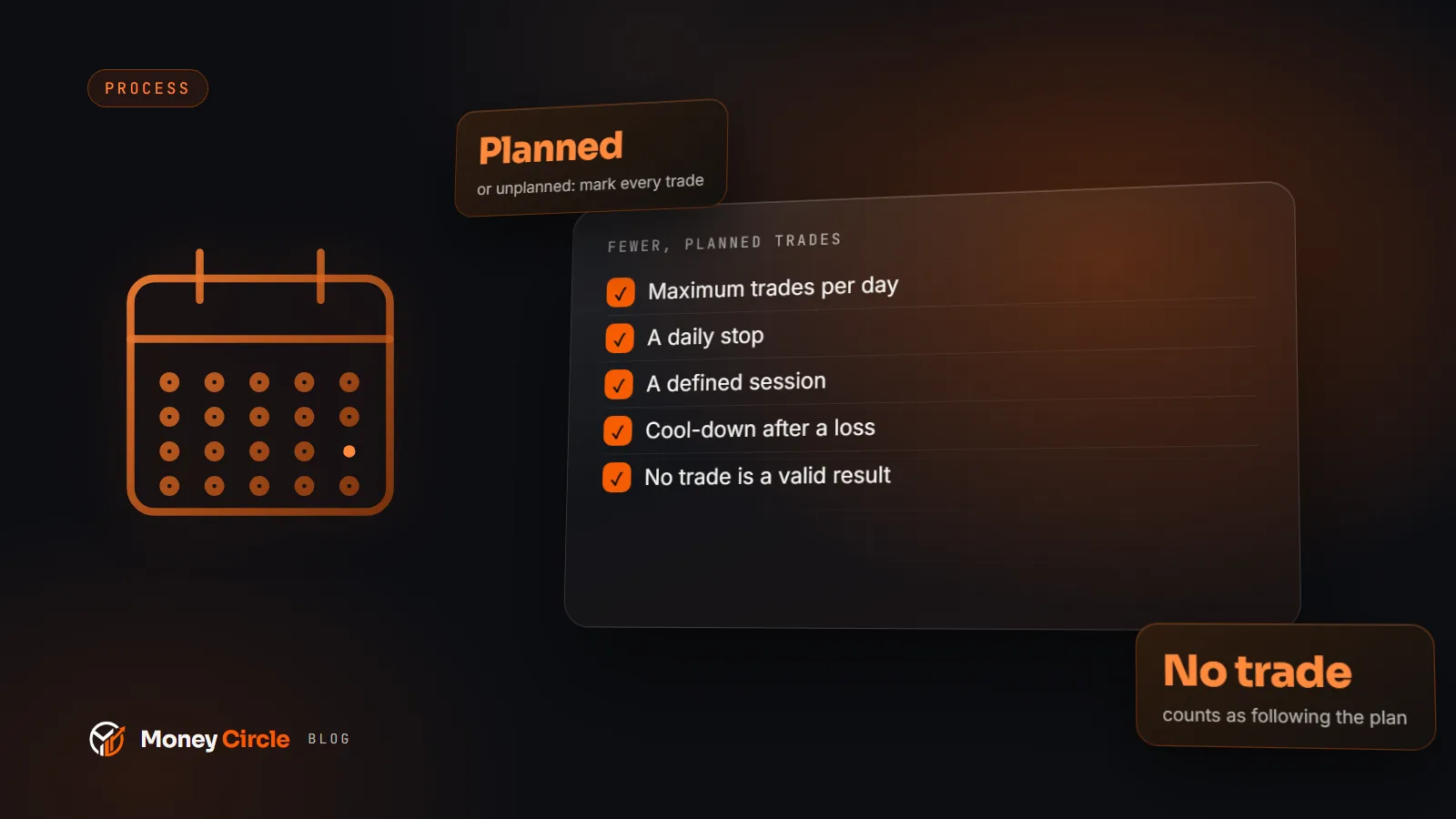
Weak: "Don't overtrade." Better: "I take a maximum of three trades per day, and I stop for the day after two losses."
Weak: "Wait for confirmation." Better: "I enter only after a candle closes beyond the level on my signal timeframe."
If a line cannot be checked, it is not yet a rule. Our guide to how much to risk per trade helps with the first example, and the pre-market routine turns the second into a habit.
Add if-then rules for the hard moments
The research-minded name for this is an implementation intention, but the idea is simple: decide in advance what you will do when a specific situation arises. "If I take a stop-out, then I take a five-minute walk before I look at another chart." "If price moves against me before my stop is hit, then I do nothing and let the stop work." "If I feel the urge to chase a move I missed, then I write down the setup I would have needed and wait for the next one."
Write at least five of these, aimed at the situations in which you have broken rules before. Look through your last month of trades for the mistakes you made more than once, and give each a pre-decided response. Trader Reflect has a good article on if-then plans that goes further.
Keep the plan to one page
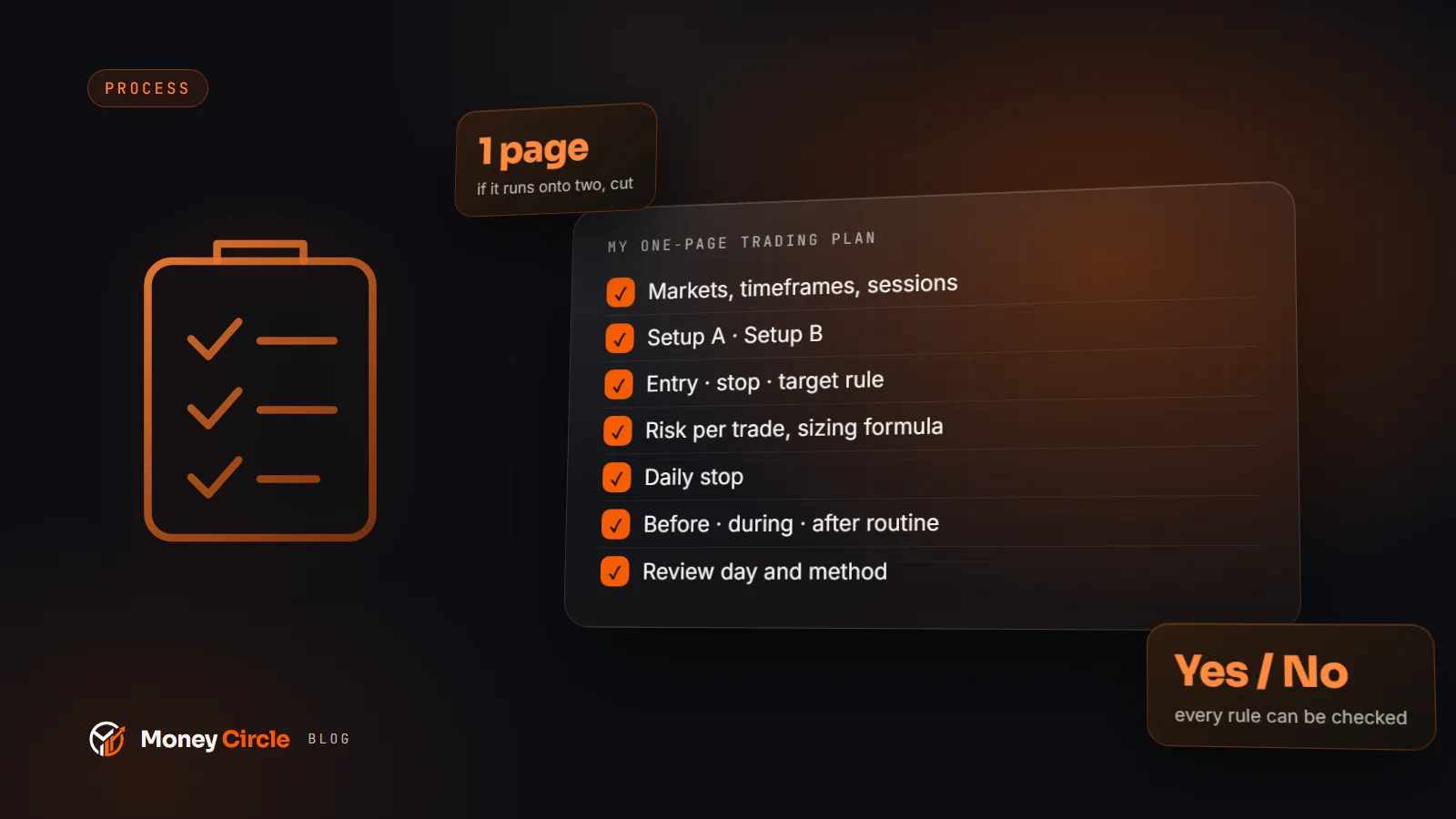
A one-page limit forces you to choose. A useful structure is seven parts: markets and sessions, one or two setups, entry-stop-target rules, risk and sizing, a daily stop, a routine, and a review slot. Everything else belongs in a notes file, not in the plan.
Fewer setups help most. Two setups that you know deeply are easier to follow than eight you half understand. If your plan lists more than two or three, cut it down for the next month and see what changes.
Build a checklist, not just a plan
A plan is the document; a checklist is how you use it. Put three short lists on a card next to your screen:
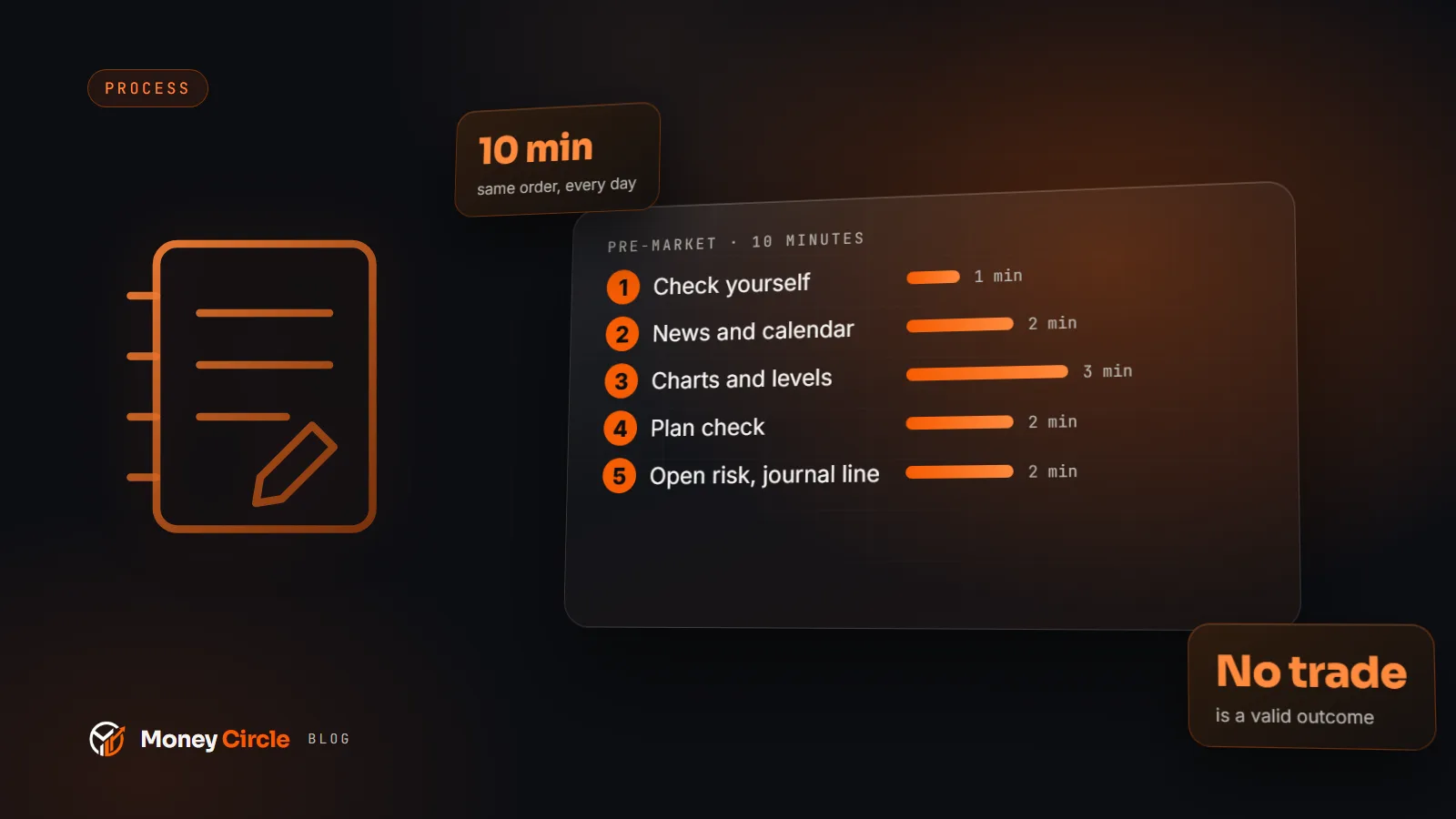
- Before the session: my state is fine, I know the scheduled news, my levels are marked, my daily stop is written.
- Before each entry: the setup matches my plan, the stop is placed on the chart, the size comes from the stop, I am within my trade count.
- After each trade: I logged it, and I marked whether I followed my rules.
Track adherence separately from results
A plan can be followed and still lose, and it can be broken and still win. If you only look at profit, you learn the wrong lesson from both. Record one extra field in your journal for each trade: followed the plan, partly, or no. At the end of the week, count them.
Adherence is the number you can control. A week in which every rule was followed and the account is slightly down is a good week, and a week of broken rules and a profit is a warning. Our weekly trading review routine gives you a way to do this in half an hour.
Test before you trade live
Run the plan on a demo account or on very small size for a set period, such as twenty trades or two weeks, whichever is longer. The aim is not to prove that it makes money; a small sample cannot do that. The aim is to find out whether you can follow it. If you cannot, change the plan, not your willpower. Maybe the setup needs a screen you cannot watch, or the daily stop is so tight that you ignore it. Find out on small size.
Decide the consequences in advance
Write down what happens when a rule is broken. It does not need to be dramatic. For example: "If I break a risk rule, I stop for the day and write two sentences about why." "If I break rules three times in a week, I trade demo only the following week." The point is that the response is already decided, so that you do not negotiate with yourself in the moment.
Avoid punishments that involve trading more, such as "I'll make it back tomorrow". The consequence should reduce risk, not add to it.
Change one thing at a time
When the plan is not working, resist the urge to rewrite it. Use your weekly review to pick one change: one rule to make clearer, one if-then to add, one setup to drop. Run it for a few weeks. If you change many things together, you will not know what helped.
Also protect the plan from the market. Do not change it in the middle of a session, after a win or after a loss. Plan changes happen in the review, with a clear head.
Share it with someone
People follow rules they have said out loud to someone else. Send your plan to a friend, or share it with a small group where you can report back weekly. Our article on learning to trade with a community explains how to use a group for accountability and not for copying calls, and the Money Circle Academy has lessons that pair well with a one-page plan.
Trading involves risk of loss, a written plan does not guarantee any result, and this is educational content, not financial advice.
Educational content, not financial advice. Trading involves risk of loss.
Learn it, log it, review it on Money Circle
Included with every paid Money Circle membership: Trader Reflect and 2 ChartViews AI analyses a day.
Guides
Continue in the ecosystem
 ChartViews AI
 Trader Reflect
More from the Money Circle Blog
Get the free Trading Plan Template
A printable plan with your rules, risk and review routine, plus the weekly market outlook by email. Unsubscribe anytime.