How Much Should You Risk Per Trade? A Beginner Guide
How to choose a risk per trade you can live with: losing-streak arithmetic, recovery maths and a simple test, in neutral units.
"How much should I risk per trade?" is one of the most searched questions in trading, and the honest answer is that nobody can give you a number that is right for everyone. What can be done is to show you how the number behaves: what a run of losses does to an account at different risk levels, why deep losses are so hard to recover from, and how to test a figure against your own behaviour before real money is involved.
This guide is about choosing the amount. If you already have the amount and want the formula that turns it into a position size, read position sizing: how much to risk per trade. All numbers below are hypothetical, in neutral units, and none of them is a recommendation. This is education, not advice.
What "risk per trade" actually means
Risk per trade is the amount you will lose if your stop is hit, written as a fixed fraction of your account. It is not the size of the position, and it is not the margin you put up. A large position with a distant stop and a small position with a tight stop can carry exactly the same risk.
You set it before the trade, you write it in your plan, and you do not change it in the middle of a session. The point of a fixed fraction is that it removes one decision from the moment when you are least able to make it well.
Losing streaks are normal, so plan for them
Every method loses sometimes, and losses tend to arrive in clusters. You do not need to believe that your next ten trades will all lose. You only need to accept that a run of five or ten losses in a row is possible, and ask what it would do to you.
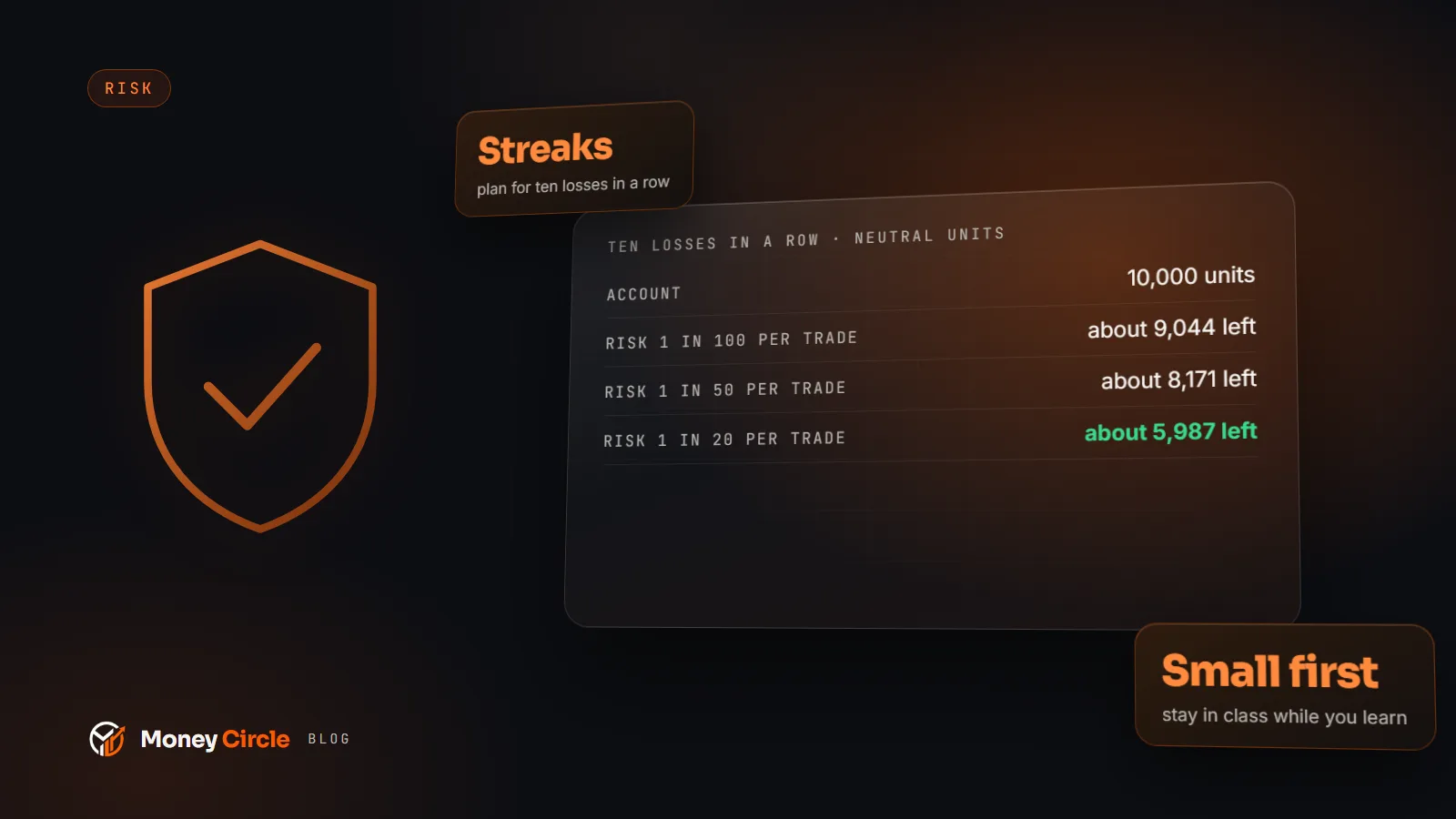
Here is the arithmetic for a hypothetical account of 10,000 units after ten losing trades in a row, with each loss equal to a fixed fraction of the account at that moment:
- Risking one percent per trade: the account falls to about 9,044 units, a loss of about 956 units.
- Risking two percent per trade: the account falls to about 8,171 units, a loss of about 1,829 units.
- Risking five percent per trade: the account falls to about 5,987 units, a loss of about 4,013 units.
Why deep losses are so hard to repair
A loss and the gain needed to undo it are not the same size. Take the same three outcomes and ask what you would need to earn to get back to 10,000 units:
- From 9,044 you need to grow the account by about a tenth.
- From 8,171 you need to grow it by a little over a fifth.
- From 5,987 you need to grow it by about two thirds.
A simple test for your number
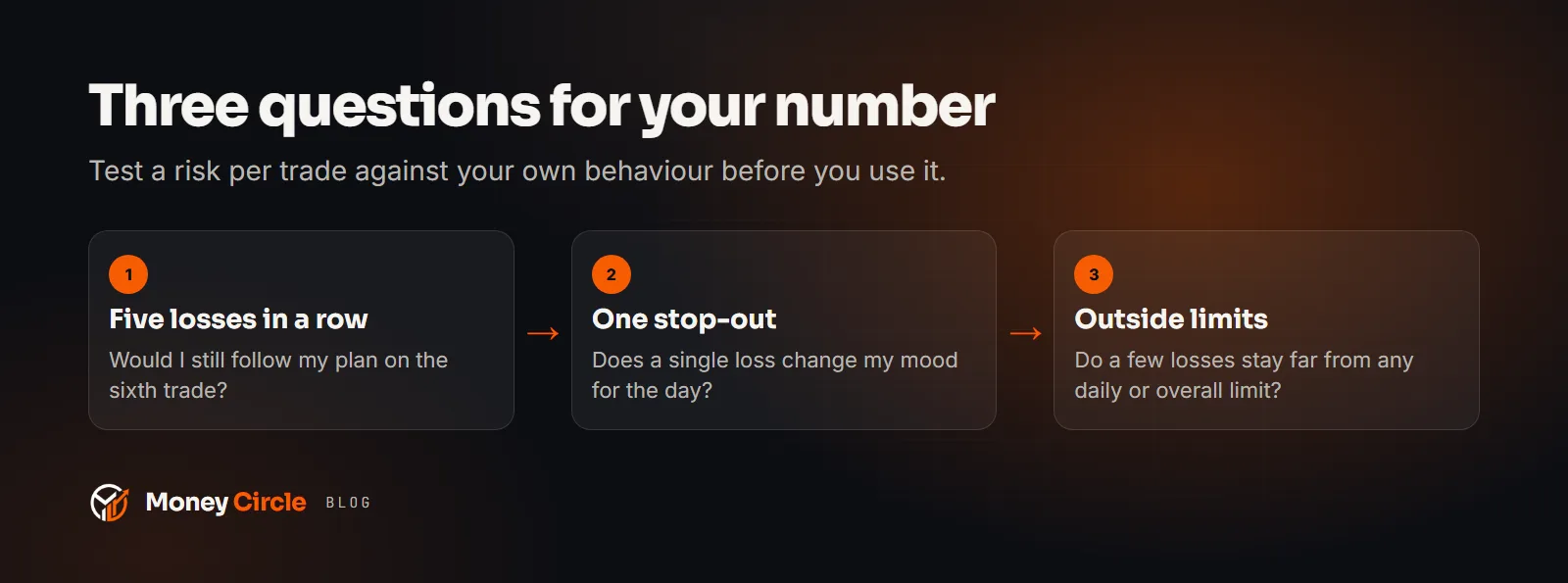
Instead of copying a figure from a video, test your own with three questions.
1. Can I take five losses in a row without changing my behaviour? Imagine them in sequence, at the size you are considering. Be honest about whether you would still follow your plan on the sixth trade, or whether you would shrink your stop, skip the next setup, or double your size to win it back. If any of those is likely, the size is too big for you at this stage.
2. Does one loss change my mood for the rest of the day? If a single stop-out leaves you irritated or anxious, the amount matters to you emotionally more than it should. Lower it until a loss feels like a normal business expense.
3. Does the number fit inside every outside limit? If you trade an evaluation or any account with a daily loss limit or a maximum drawdown, your per-trade risk has to be small enough that a few losses cannot reach those limits. Our guide to how to pass a prop firm challenge shows how to turn an outside limit into smaller personal ones.
If you cannot answer yes to the first and third questions and no to the second, lower the number. There is no prize for a larger one.
Why beginners should start small
When you are new, three things are true at once. Your edge, if you have one, is unproven. Your execution is still inconsistent. And your emotional reactions to losing money are untested. A small risk per trade gives you room to learn all three without paying for the lessons with the account.
Think of the early months as paying for a training course. The smaller your risk per trade, the longer you can stay in class, and the more examples you collect to review. A trader who risks too much can finish the course in a week and learn nothing from it.
Start with a figure that feels almost boring on a demo account, trade it for a few weeks, and review the results in your journal. Only change it deliberately, after a review, and never in reaction to a single trade.
When changing the number makes sense
Reasons to lower it: you broke your own rules after a loss, your account is below the level at which you last set the figure, or you are approaching an outside limit. Reasons to raise it slowly, if at all: you have followed your plan for a long stretch, your journal shows steady execution, and the larger amount still passes the three questions above.
Reasons never to change it: you just won three trades, you just lost three trades, you feel certain about the next setup, or a deadline is approaching. Feelings are not a signal. If you are tempted to size up after a run of wins, Trader Reflect has a useful read on that urge.
Fixed fraction or fixed amount?
Two simple methods exist. With a fixed fraction, you risk the same share of the current balance each time, so the amount falls after losses and rises after wins. With a fixed amount, you risk the same number of units each time, which is simpler but ignores the account size. For a small account that is learning, the fixed fraction has a built-in brake: losses automatically make the next position smaller. Whichever you choose, write it down and keep it for a defined period.
Risk per trade is not the whole risk
A small figure per trade does not protect you from taking too many trades, from holding several correlated positions, or from a bad day made of many small mistakes. Add two more rules to your plan:
- A daily stop: the loss at which you stop for the day.
- An open-risk limit: the most you will have at risk across all open trades at once.
Put it on paper
Write four lines at the top of your trading plan:
- My risk per trade is a fixed fraction of my account: this is the figure.
- I have tested it against five losses in a row and can follow my plan through them.
- My daily stop and my open-risk limit are written here.
- I change the figure only after a weekly review, never during a session.
Trading involves risk of loss and nothing here is financial advice; choose an amount you can afford to lose.
Educational content, not financial advice. Trading involves risk of loss.
Learn it, log it, review it on Money Circle
Included with every paid Money Circle membership: Trader Reflect and 2 ChartViews AI analyses a day.
Guides
Continue in the ecosystem
 ChartViews AI
 Trader Reflect
More from the Money Circle Blog
Get the free Trading Plan Template
A printable plan with your rules, risk and review routine, plus the weekly market outlook by email. Unsubscribe anytime.