Position Size for Forex, Gold and Indices: Worked Examples
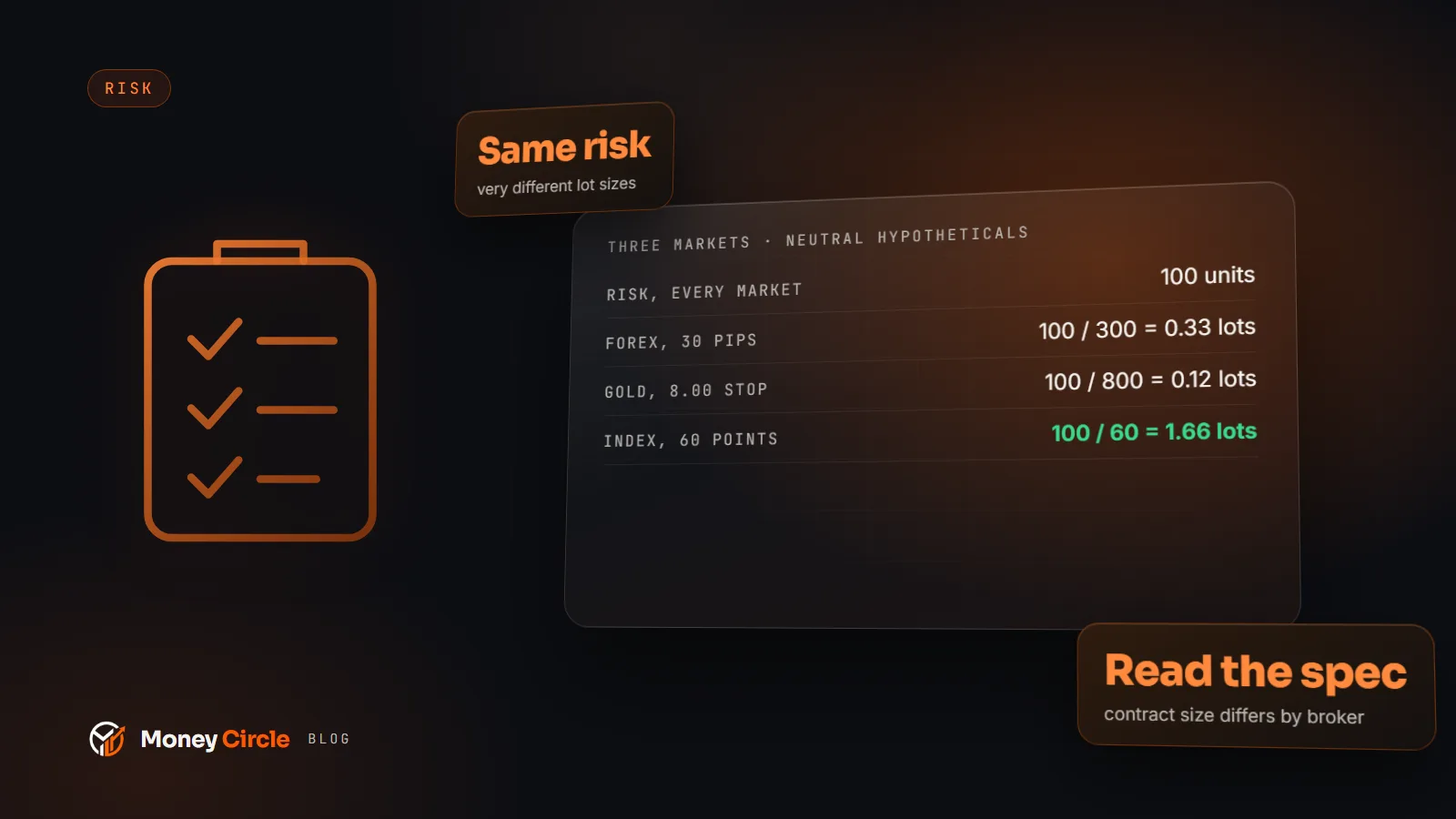
How to size a trade in forex, gold and indices: pips, points, contract size and a hypothetical worked example for each.
The formula for position size is the same in every market: the amount you are willing to lose divided by the loss per unit of size if the stop is hit. What changes from market to market is the unit. Forex uses pips and lots, gold is quoted in price units per ounce, and indices are traded in points. Many beginners get the formula right in theory and then size a trade wrongly because they misread the contract.
This guide walks through one hypothetical example for each of three popular markets. All prices, contract sizes and account values are invented for illustration. Real contract specifications differ between instruments and brokers, so treat the numbers as a method, not a reference. It is educational content, not advice. If you want the theory first, read position sizing: how much to risk per trade.
The same four steps everywhere
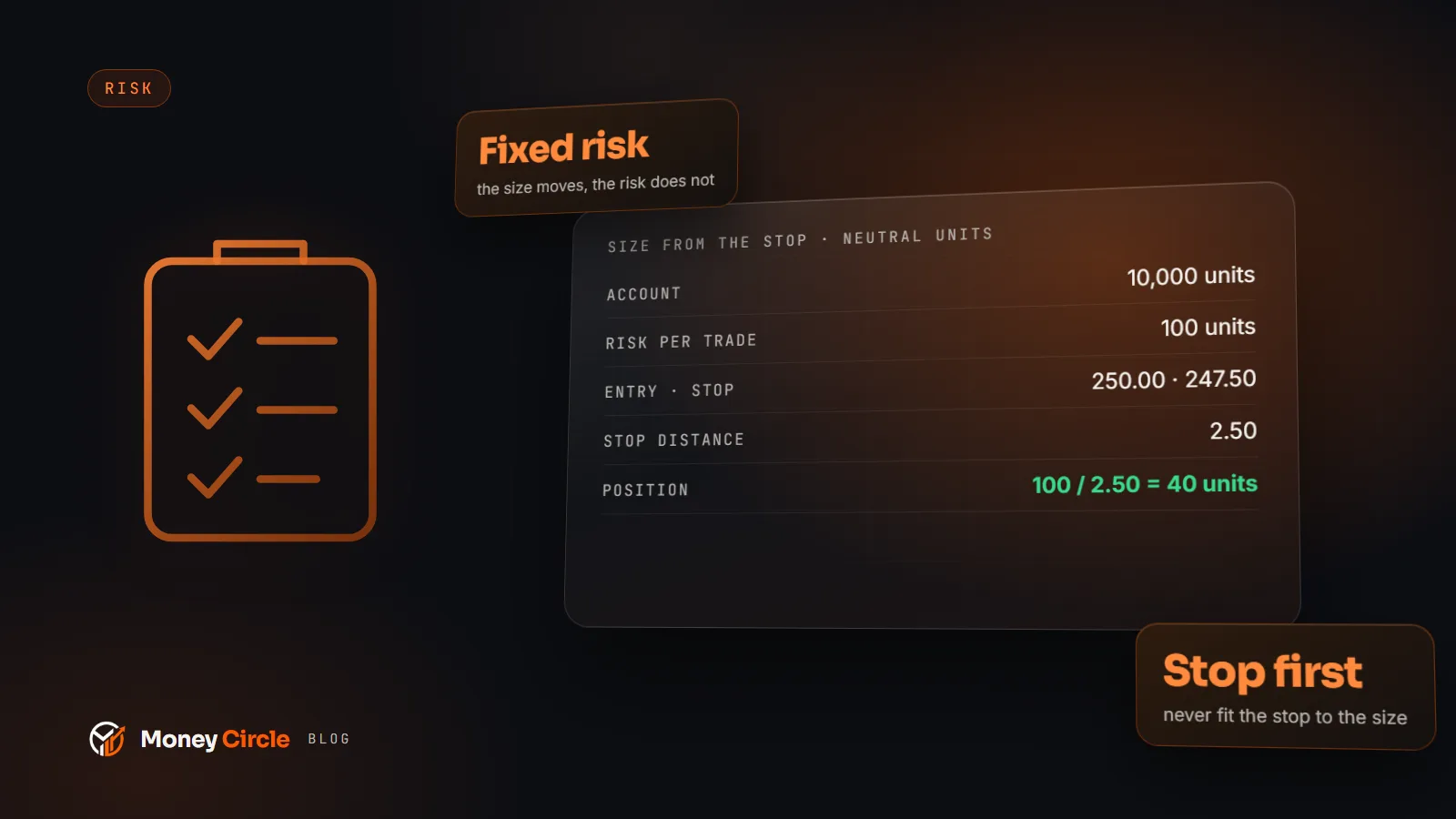
1. Decide the amount at risk, as a fixed fraction of the account. We use 100 units on a 10,000-unit account, held in the same currency in which the instrument's profit and loss is paid. 2. Find the stop distance from the chart, where the idea is invalid. 3. Convert the stop distance into money for one lot, using the instrument's contract specification. 4. Divide the amount at risk by the money per lot, and round down to the nearest tradable step.
Step three is where mistakes happen, so we look at it for each market.
Forex: pips, pip value and lots
A pip is the standard small unit of a currency pair's price. For most pairs it is the fourth decimal place, 0.0001, and for pairs involving the yen it is the second, 0.01. A standard lot is usually 100,000 units of the base currency, and for a pair where the account currency is the quote currency, one pip on one standard lot is worth about 10 units of the account currency. Mini and micro lots are a tenth and a hundredth of that.
Hypothetical example. You are looking at a long in a pair quoted at 1.0850 and your chart says the idea is invalid below 1.0820. The stop distance is 30 pips. Amount at risk: 100 units.
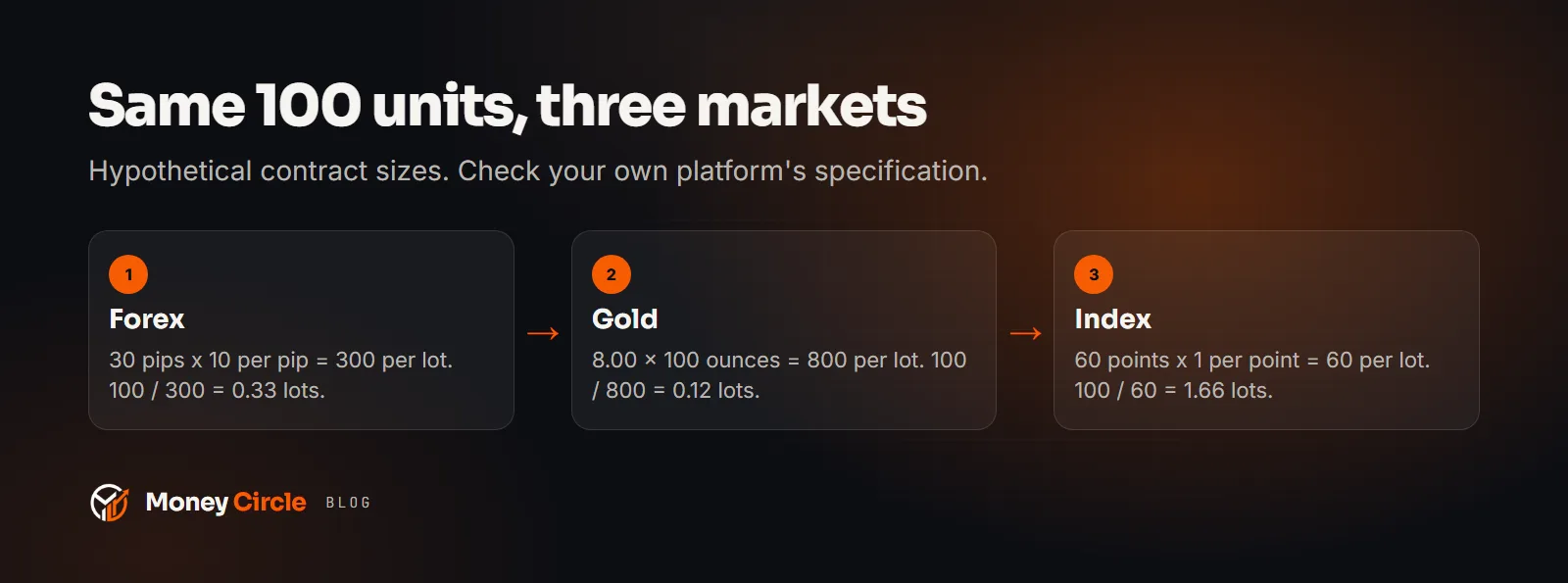
- Loss per standard lot if the stop is hit: 30 pips times 10 units per pip equals 300 units.
- Position size: 100 divided by 300 equals 0.333 lots, which you round down to 0.33 lots.
- Real risk at 0.33 lots: 0.33 times 300 equals 99 units, which is inside your limit.
Gold: price units and the size of the contract
Gold is quoted as a price per troy ounce, and many brokers define one lot as 100 ounces. In that case, a move of 1.00 in the price is worth 100 units of the account currency per lot. Some brokers use a different contract size, so read the specification, not a forum post.
Hypothetical example. The price is 2,000.00 and your chart says a long is invalid below 1,992.00. The stop distance is 8.00 price units. Amount at risk: 100 units.
- Loss per lot if the stop is hit: 8.00 times 100 ounces equals 800 units.
- Position size: 100 divided by 800 equals 0.125 lots, rounded down to 0.12 lots (assuming a step of 0.01).
- Real risk at 0.12 lots: 0.12 times 800 equals 96 units.
Indices: points and the value of a point
Index CFDs are quoted in points, such as an index trading near 18,000. The value of one point per lot depends on the provider: a common arrangement is that one lot gains or loses one unit of the account currency per point, but others use a different multiplier. Again, the specification decides.
Hypothetical example. An index is quoted at 18,000 and your chart says a long is invalid below 17,940. The stop distance is 60 points. Assume one lot is worth 1 unit per point. Amount at risk: 100 units.
- Loss per lot if the stop is hit: 60 times 1 equals 60 units.
- Position size: 100 divided by 60 equals 1.66 lots, rounded down to 1.66 lots (assuming a step of 0.01).
- Real risk at 1.66 lots: 1.66 times 60 equals 99.6 units.
Comparing the three
The three examples risk the same 100 units, but the positions look very different: about a third of a lot in forex, about an eighth of a lot in gold and a little over one and a half lots in the index. This is the point of sizing from the stop. The lot number says nothing about the risk, and the risk is what you are controlling.
Practical details that change the answer
Round down. Round the size down to the nearest tradable step, never up. Rounding up means more risk than you planned.
Include the spread. The spread widens your effective stop distance, particularly on tight stops. If it is a meaningful share of your stop, add it to the distance.
Commissions and swaps. On some accounts these add to the cost. A position held overnight may accrue a financing charge.
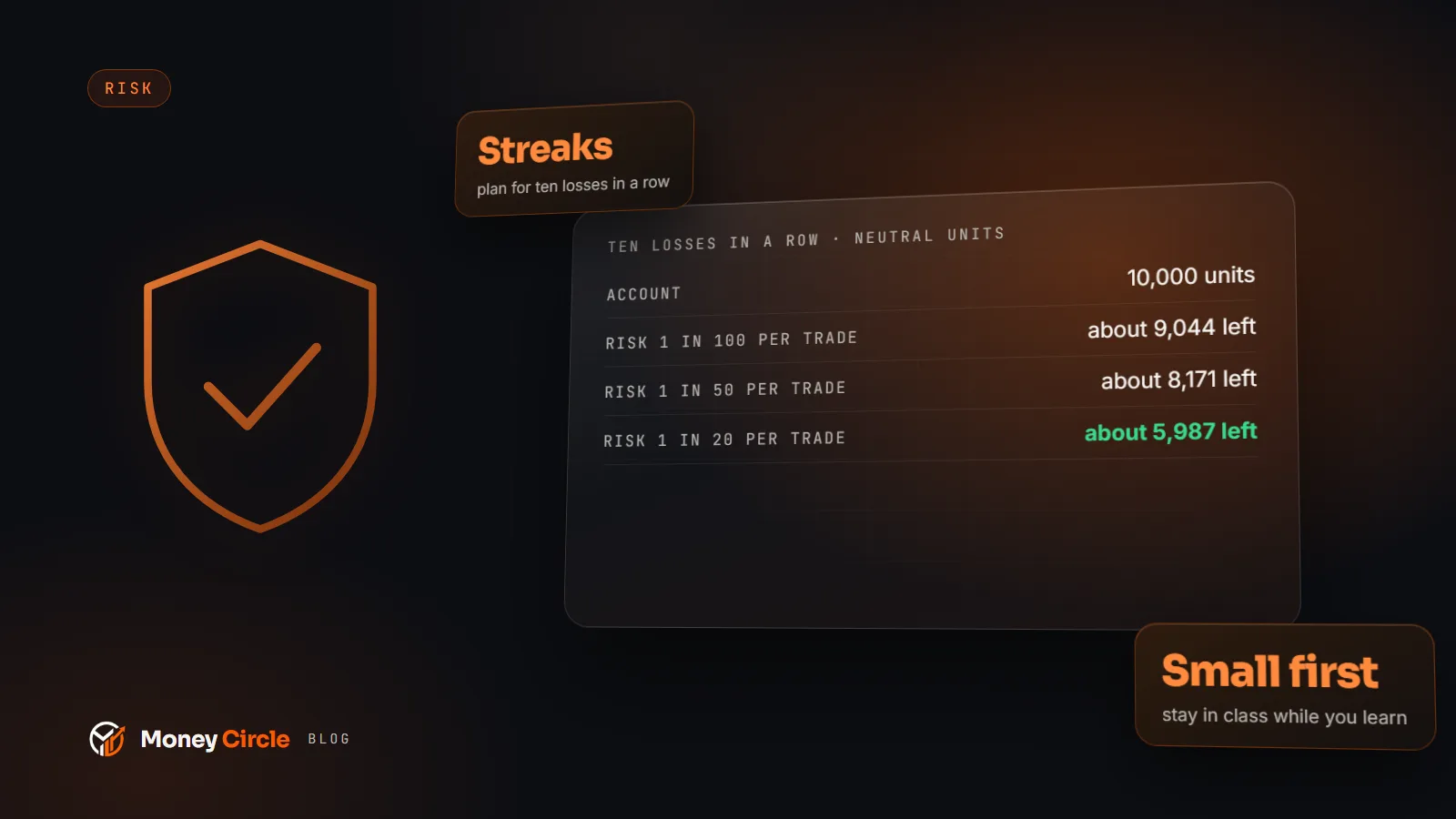
Slippage and gaps. A stop is not a guarantee of the price at which you will be filled. Around news, a fill can be far from the stop. Plan for a loss larger than the planned amount occasionally, and keep your risk per trade small enough that it is survivable.
Leverage and margin. Margin is the deposit your broker holds against the position, and leverage determines how large a position it allows. They limit how much you can open. They do not tell you how much you should risk. Do not let available margin decide your size. Our guide to how to choose a CFD broker explains the questions to ask about leverage and costs.
Correlation. Long gold and short a currency pair against the dollar can be the same bet seen twice. Add the risk of correlated positions together.
Check it with a calculator
Do the arithmetic by hand a few times so that you understand it, then use a tool to avoid mistakes. Money Circle has a free position size calculator for this. Whatever you use, confirm the contract size and the point or pip value with your own platform before you trade, because they are the inputs most often wrong.
Practice
Take any three charts, one from each market, and mark where your idea would be invalid. Write down the stop distance, look up the contract specification, and compute the size for 100 units of risk on a 10,000-unit account. Then compare your answer with your platform's own calculation. Repeat it on a demo account for a week, writing one line in your journal for each trade: "sized from the stop: yes or no". The Money Circle Academy has a lesson on this with more practice questions.
Trading leveraged products such as CFDs involves a high risk of losing money quickly; this is education, not advice, and the examples above are hypothetical.
Educational content, not financial advice. Trading involves risk of loss.
Learn it, log it, review it on Money Circle
Included with every paid Money Circle membership: Trader Reflect and 2 ChartViews AI analyses a day.
Guides
Continue in the ecosystem
 ChartViews AI
 Trader Reflect
More from the Money Circle Blog
Get the free Trading Plan Template
A printable plan with your rules, risk and review routine, plus the weekly market outlook by email. Unsubscribe anytime.