How to Choose a CFD Broker: Questions to Ask Before You Deposit
Regulation, the legal entity you sign with, client-money rules, costs and platforms: a neutral checklist for choosing a CFD broker.
Choosing a broker is one of the first practical decisions a new trader makes, and it is often made in a hurry, based on an advert or a friend's mention. Yet the broker is the counterparty to your trades and the keeper of your deposited money. It deserves at least the care you would give to choosing a bank.
This guide is educational and deliberately neutral. It does not recommend or rate any firm. It gives you a list of questions that you can ask of any broker, and a way to find the answers in the firm's own documents. Rules differ by country and change over time, so treat what follows as a framework for your own checking, not as legal or financial advice.
What you are actually buying
A CFD, or contract for difference, is an agreement with a broker to exchange the difference in the price of an asset between opening and closing the contract. You do not own the underlying asset. Most CFDs are leveraged, which means a small deposit controls a larger position, and losses as well as gains are magnified accordingly. That is why the quality and conduct of the firm matter: you are entering a contract with them, and their terms define what happens to your money.
Regulation: which regulator, and which entity
The first question is whether the firm is authorised by a financial regulator you recognise. The second question is more subtle and often missed: which legal entity will you actually contract with?
Large brokerage brands frequently operate through several separate companies in different jurisdictions. One entity may be regulated by a well-known authority in a major financial centre, while another entity under the same brand name, serving clients from other regions, may sit under a very different regime with lighter protections. The logo and website look the same. The legal protections can be quite different.
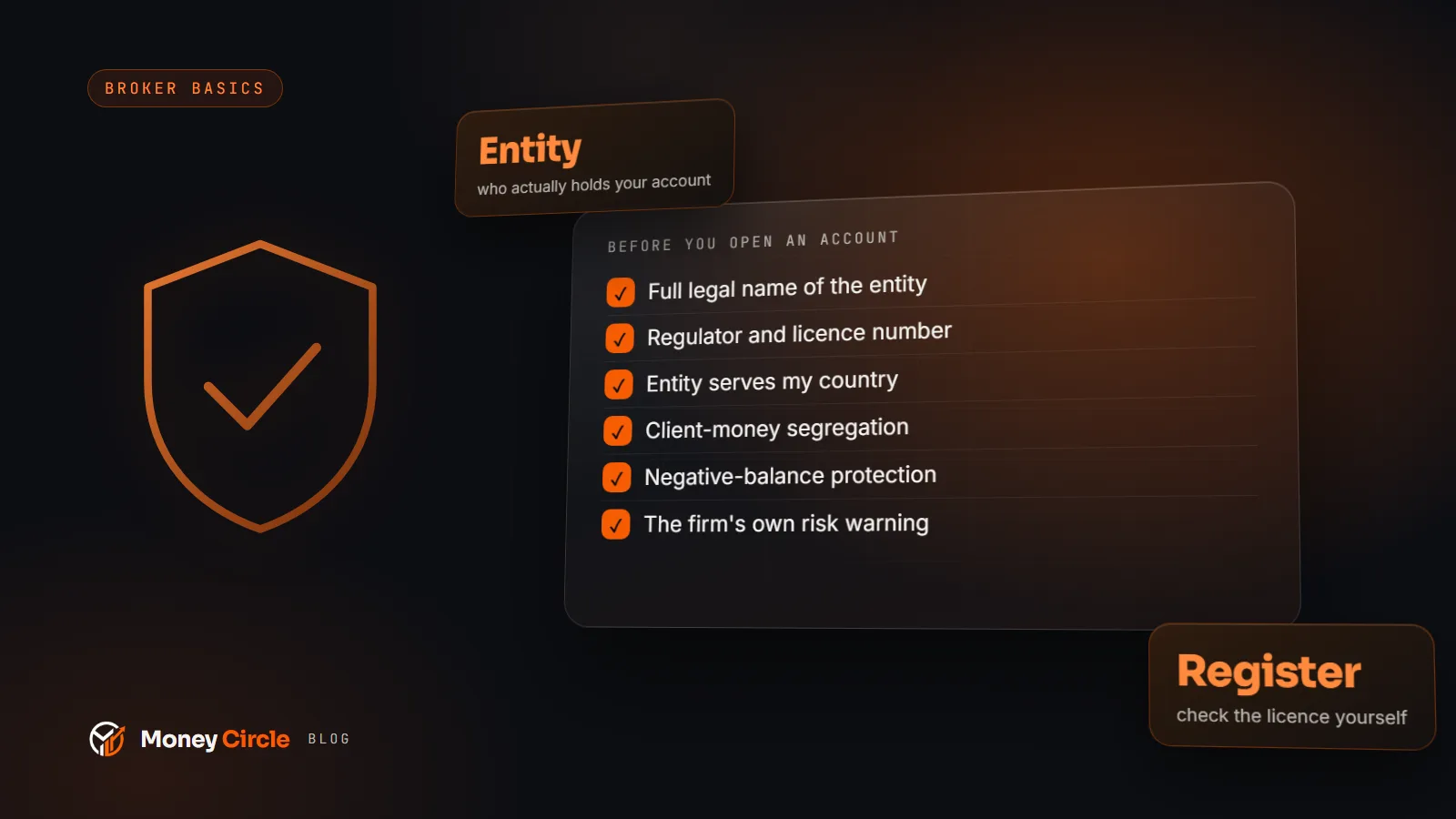
So do not stop at "they are regulated". Find these details in the firm's terms and conditions, usually in the footer or the legal documents section:
- The full legal name of the company that will hold your account.
- The regulator that authorises that specific company, and its registration or licence number.
- Which entity serves clients in your country of residence. The sign-up process may place you with an entity you did not expect.
Client money and what happens if the firm fails
Ask how client funds are held. A common standard is segregation: client money is kept in accounts separate from the firm's own money, so that it can be identified if the firm runs into trouble. Look for a plain statement that your funds are segregated and with which kind of institution they are held.
Also find out whether any compensation scheme applies to clients of that specific entity, what it covers, and what it does not. Do not assume one exists because the brand operates elsewhere. The answer depends on the entity and the country.
Negative-balance protection
With leveraged products, a fast market move can in theory take an account below zero. Some regimes require brokers to ensure retail clients cannot lose more than they deposited. Others do not. Check the terms for a clear statement on negative-balance protection for your account type, and note whether it applies to every account type or only to retail clients.
Read the risk warning
In many jurisdictions regulators require firms to display a standardised risk warning on their website and marketing, usually stating that CFDs are complex instruments and that a large share of retail accounts lose money with the provider. The exact wording and the figure it quotes come from the firm itself and vary from one entity to the next.
Do not scroll past it. Read the warning on the broker's own site, for the entity that serves your country. It is the firm's own required disclosure, and it tells you more about the product than a landing page will. If you cannot find it easily, that is information too.
Costs: spreads, commissions and swaps
Costs are where brokers differ in ways you can measure. There are three main types to understand:
- Spread: the difference between the buying and selling price. You pay it on entry in effect. It can widen sharply around news and at market open or close.
- Commission: a fee charged per trade or per volume traded, common on some account types in exchange for tighter spreads.
- Swap or overnight financing: a charge or credit for holding a leveraged position past the daily cut-off. For a swing trader this can matter more than the spread.
Platforms and execution
You will spend hours inside the platform, so test it. Does it offer the charting you need, order types such as stop and limit orders, and the ability to attach a stop at the time of entry? Does it work reliably on the devices you use? Is there a clear record of trade history you can export for your journal?
Execution quality is harder for a newcomer to judge, but a demo account helps you see how orders behave and how the price feed looks. Remember that demo conditions can be gentler than live ones, so use it for learning the interface rather than as proof of live performance.
Deposits and withdrawals
Money going in is easy for every firm. Money coming out is the better test. Before depositing, read the withdrawal section: which methods are supported, whether withdrawals must go back to the original funding source, how long processing takes, what verification is required, and whether fees apply. Check that the name on the account must match the name on your bank account, which is a normal anti-money-laundering requirement.
Be wary of anything that pressures you to deposit quickly, offers guaranteed results, or attaches conditions to withdrawing a bonus. Reasonable firms are patient about onboarding.
Start with a demo
A demo account lets you test the platform, order types and fee behaviour with no money at risk. Use it to run your trading plan for a few weeks, to place and cancel orders, and to practise attaching stops. When you move to a live account, begin with an amount you can afford to lose and keep the size small until your process has proved itself.
If any term in this article is unfamiliar, the Money Circle glossary explains the common ones in plain language.
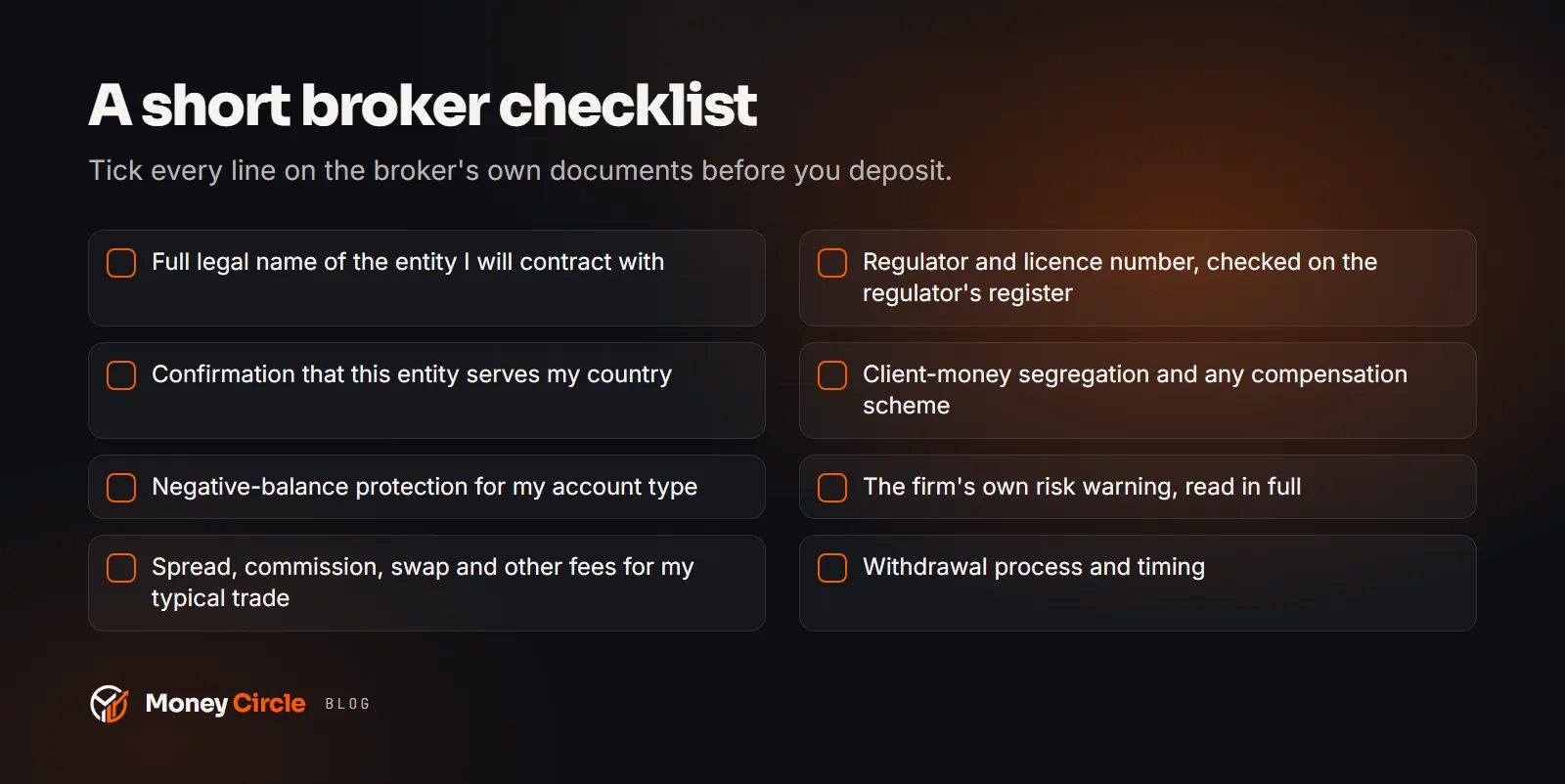
A short checklist
- Full legal name of the entity I will contract with.
- Regulator and licence number, checked on the regulator's own register.
- Confirmation that this entity serves my country.
- Statement on client-money segregation and any compensation scheme.
- Negative-balance protection terms for my account type.
- The firm's own risk warning, read in full.
- Spread, commission, swap and other fees for my typical trade.
- Withdrawal process and timing.
Next step
Pick any broker you are curious about and do the legal-entity exercise on it: open its terms, write down the company name, the regulator and the licence number for your country, and check them on the regulator's register. Then read its risk warning once, start to finish. That single exercise will teach you more than any comparison table.
Educational content, not financial advice. Trading involves risk of loss.
Learn it, log it, review it on Money Circle
Included with every paid Money Circle membership: Trader Reflect and 2 ChartViews AI analyses a day.
Continue in the ecosystem
 ChartViews AI
 Trader Reflect
More from the Money Circle Blog
Weekly Gold & Nasdaq outlook
Every Sunday: the week's key events, how gold, the Nasdaq, the Dow, the S&P 500 and EUR/USD moved, and our signal record. Free. Unsubscribe anytime.