

Forex Trading Sessions Explained: London, New York and the Overlap
Markets behave differently across the day. See how the Asian, London and New York sessions differ, and how to pick the hours that suit you.
Currency markets trade around the clock on weekdays, but they do not behave the same way at every hour. Activity builds when major financial centres open, fades when they close, and bunches up where two centres are open at once. If you have ever wondered why a chart was dead for hours and then moved sharply, the answer is often the clock.
This guide explains the main trading sessions, what the London and New York overlap is, how to find the hours in your own time zone, and how to choose a session that fits your life and your plan. It is educational only. Session times below are approximate and shift with daylight saving, so always check them for the current date.
Why sessions matter
Prices are set by buyers and sellers, and the number of participants changes through the day. When many large participants are active, there is usually more volume, spreads tend to be tighter, and moves can be faster. When few are active, the market can drift or go quiet, and spreads may widen.
For you as a trader, this changes three practical things:
- Cost. Spreads are often narrower when liquidity is high. A strategy with a tight stop is more sensitive to this.
- Behaviour. Some setups need movement to work. Others work better in calm conditions. The same plan can behave differently in different sessions.
- Your schedule. You cannot watch every hour. Choosing a session is also choosing when you will be at the screen and when you will not.
The main sessions
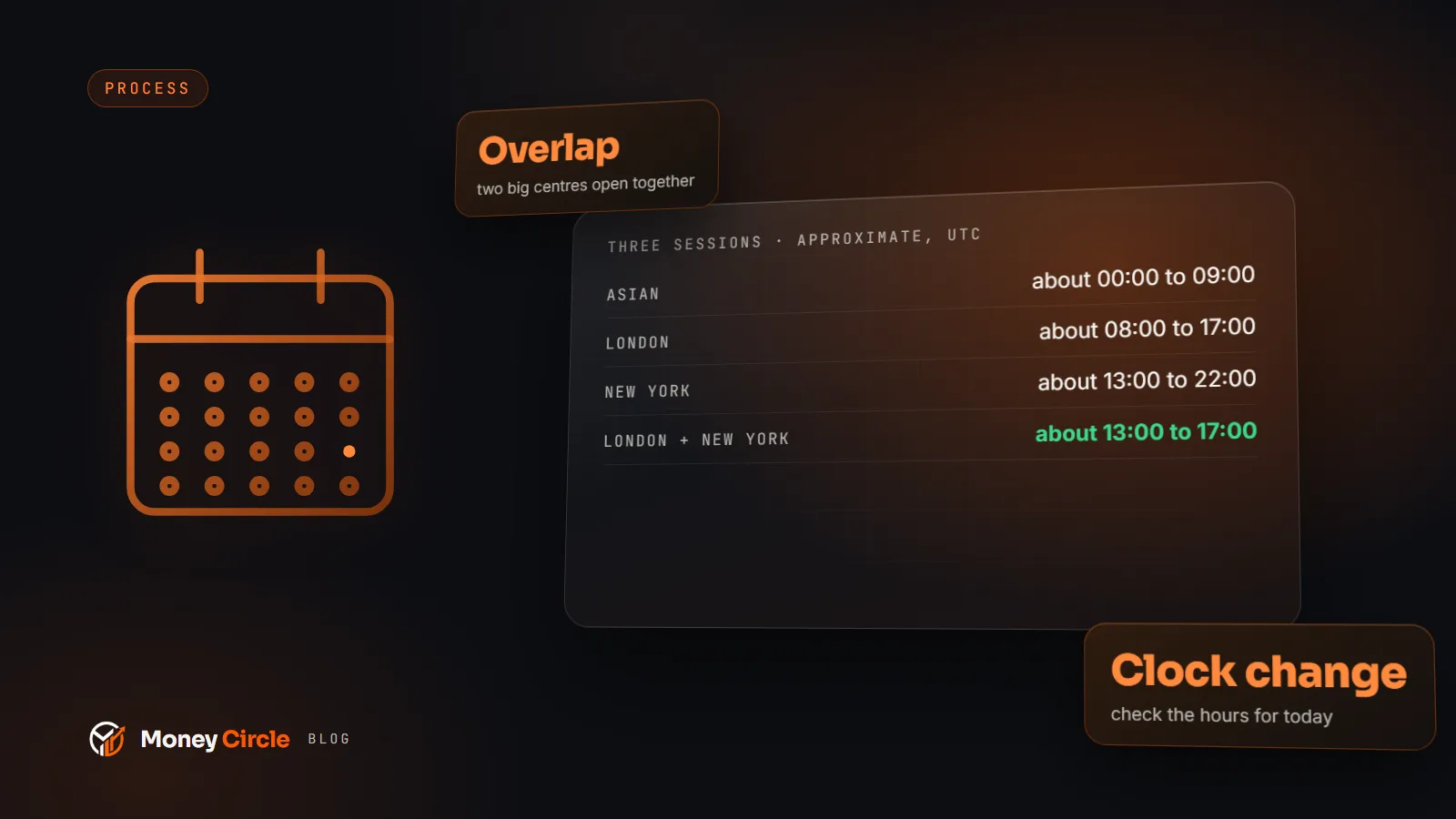
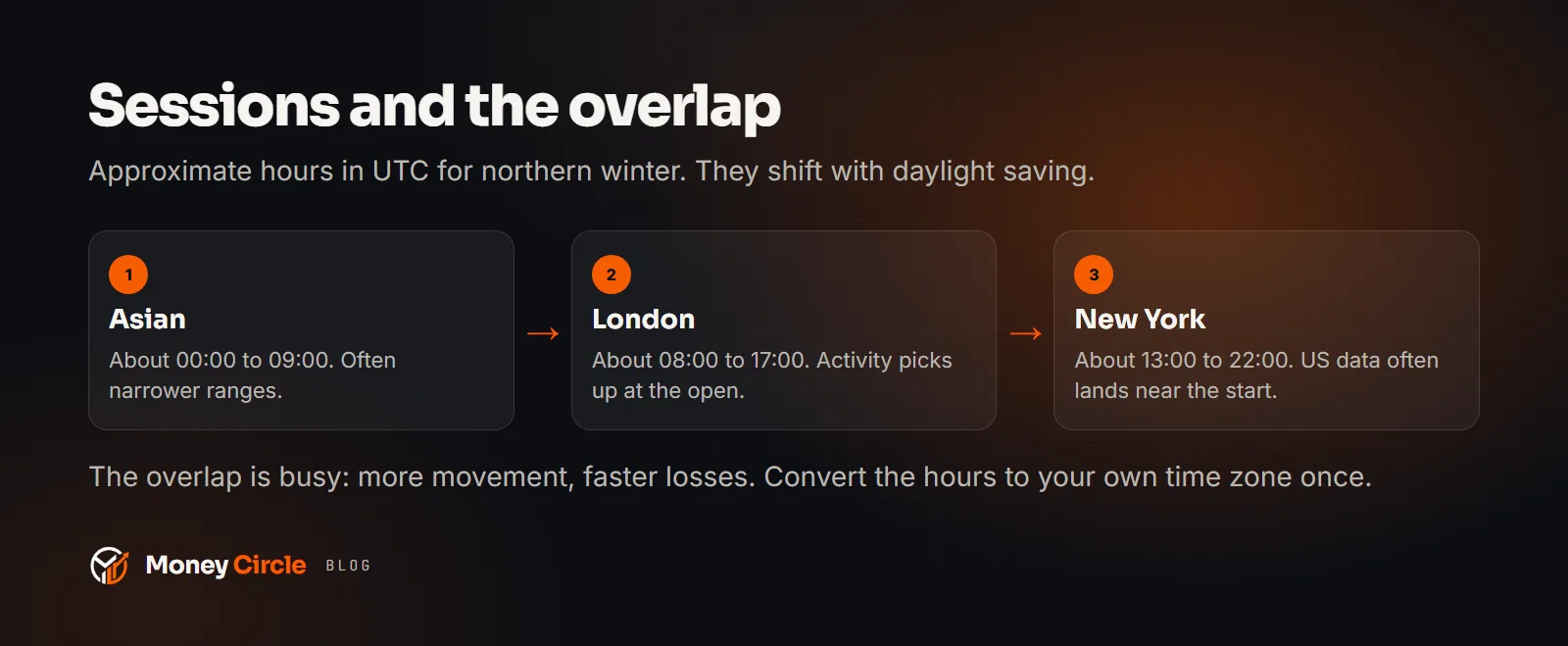
There are three sessions most traders talk about. The hours are approximate and given in UTC, and each one is named after the financial centre that dominates it.
- Asian session (Tokyo, Sydney, Singapore). It starts the trading day in the evening or night for Europeans and the Americas. Many currency pairs tend to move within narrower ranges here, though pairs involving the yen, the Australian dollar and the New Zealand dollar can be active.
- London session. It opens in the morning for Europe, at about 08:00 UTC in winter and one hour earlier in summer. London is a very large centre for currency trading, so activity usually picks up sharply at the open.
- New York session. It opens when the US morning starts, usually in the middle of the day UTC. US economic data is often released near its start, which can cause quick moves.
The London and New York overlap
During the overlap, two of the largest centres are open together. Many traders watch it because activity can be higher and moves can follow through more than in quieter hours. It also tends to include the release of important US data and the afternoon in Europe, so it is a busy time.
That does not make it a good time for you. More movement means more opportunity but also faster losses, larger swings against you and a greater chance of acting on impulse. Beginners often do better by learning a calmer window first.
A few cautions:
- Do not assume the overlap always produces a clean trend. Sometimes it produces a spike and a reversal.
- Check the economic calendar. Scheduled releases cluster here. See our upcoming guide to reading an economic calendar, or at least check it before the session starts.
- Expect wider swings, and size your trades accordingly. A stop that was reasonable in the Asian session may be too tight here.
How to convert sessions to your time zone
Session hours are quoted in many different time zones, which causes endless confusion. Do this once and write it down:
1. Find the opening and closing times of each session in UTC for the current season. 2. Convert them to your local time, remembering that your region and the financial centres may change clocks on different dates. For a few weeks in spring and autumn, the gap between your time and London time can differ from the rest of the year. 3. Mark the busiest window on a calendar or on your chart, and add the hour of any scheduled news. 4. Re-check after every clock change.
This sounds small, but a wrong conversion has put many people into a trade at the worst possible time. Put the local hours in your trading plan so you are not working them out in the middle of a session.
Match the session to your plan and your life
The best session is the one in which you can trade your plan without strain. Think about it from three angles.
Your availability. If you work during the day, the evening overlap may be the only time you can sit down. If you trade before work, the London open may suit you. A plan you can follow in the hours you actually have beats a perfect plan you cannot attend.
Your market. The pair or instrument you trade has its own busy hours. A European index tends to be most active when Europe is open. A currency pair built from the euro and the US dollar is usually most active when London and New York are open. Choose the session where your market is awake.
Your style. Breakout and momentum approaches need movement. Range-based approaches need calm. Look at your journal to see which sessions your trades have worked best in, and let your own record guide you.
Build a session rule into your plan
A session rule is short and checkable. For example: "I trade only during the first two hours of the London session. I do not open new trades after that. I do not trade in the minutes around scheduled high-impact news." Write the hours in your local time.
Then record the session in each journal entry. After a month or two, sort your trades by session. If most of your losses come from trades taken outside your chosen window, you have found a rule worth tightening. Our weekly trading review routine shows how to sort and review.
Common mistakes
- Trading every session. Being everywhere means being tired and unprepared. Pick one window.
- Holding a plan from one session into another without a rule. A trade that began in a quiet session may face a very different market after the next open. Decide in advance what you do with open trades when a new session starts.
- Forgetting weekends and holidays. Liquidity is thinner on bank holidays and around the end of the year. Check before assuming a normal day.
- Using hours from an old article. Times change with clocks and sometimes with how traders describe the sessions. Verify for the current date.
Where to go from here
Open your calendar, write the three sessions in your local time for this week, mark the overlap, and choose the window you can trade without rushing. Then add one line to your plan and one column to your journal. That is all it takes to make the clock work for you instead of against you.
Our pre-market routine fits neatly in the half hour before your window opens, and the Money Circle Academy has lessons on building a plan around a session.
Trading involves risk of loss; active sessions can bring faster losses as well as faster moves, and this is educational content, not financial advice.
Educational content, not financial advice. Trading involves risk of loss.
Learn it, log it, review it on Money Circle
Included with every paid Money Circle membership: Trader Reflect and 2 ChartViews AI analyses a day.
Guides
Continue in the ecosystem
 ChartViews AI
 Trader Reflect
More from the Money Circle Blog
Get the free Trading Plan Template
A printable plan with your rules, risk and review routine, plus the weekly market outlook by email. Unsubscribe anytime.