

A loss and the gain that undoes it are not the same size. Lose 20 percent of an account and you need a 25 percent gain to get back, because the gain is earned on a smaller balance. The calculator below turns any drawdown into the exact gain required, lists the figure for every loss from 5 to 90 percent, and adds an optional illustration of how many trades that could take. It is free with a Money Circle account and runs in your browser.
Create a free account to use the calculator
The explanation below is public. The drawdown recovery calculator comes with a free Money Circle account.
Free. No card needed.
 Sample data
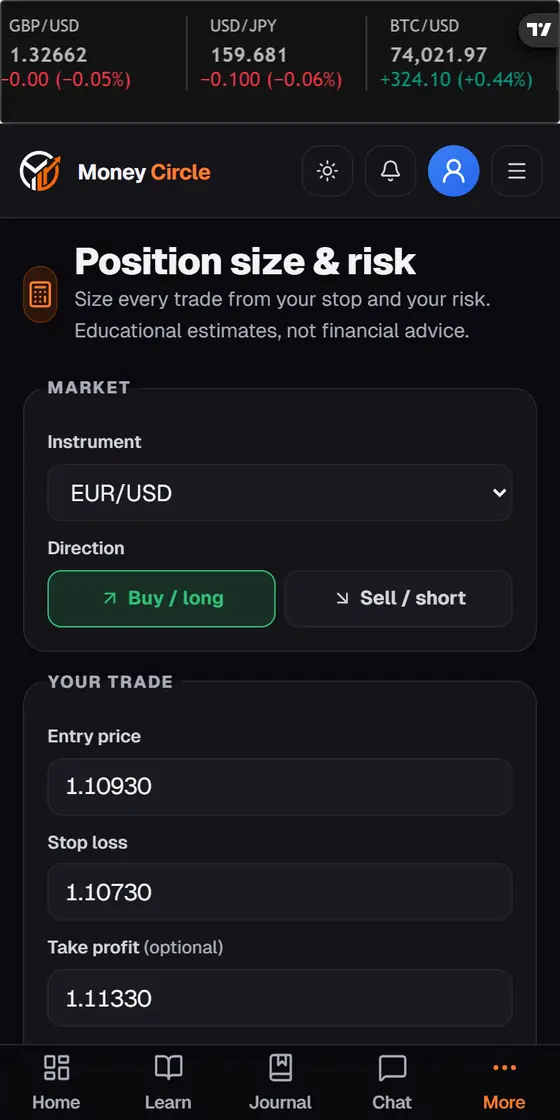
Screens from the website on a phone. Education, not financial advice. Trading involves substantial risk of loss.
Read the full guideEvery section of this page
Why recovering takes more than losing
A percentage is always a share of the balance at the moment you measure it. If a 10,000 account falls 20 percent, it is 8,000. A 20 percent gain on 8,000 is only 1,600, which gets you to 9,600, not 10,000. To return to 10,000 you need 2,000 on top of 8,000, which is 25 percent. The numbers in this example are made up for illustration only.
The rule behind it is short. If the loss is L (written as a fraction, so 20 percent is 0.2), the gain needed is L divided by (1 minus L). A 10 percent loss needs about 11.1 percent, a 33 percent loss needs 50 percent, a 50 percent loss needs 100 percent, and a 75 percent loss needs 300 percent. The curve gets steeper the deeper you fall, and a loss of 100 percent cannot be recovered at all.
What the calculator shows
Type the loss from your peak in percent. You read the balance that is left, the gain needed to get back to the peak, and how many times larger that gain is than the loss. A table below the tool lists every loss from 5 to 90 percent in steps of 5, with your own figure highlighted, so you can see where the curve bends.
- Gain needed to return to the previous peak, measured on the reduced balance.
- The balance left after the loss, as a share of the peak.
- A reference table for losses of 5 to 90 percent.
- An optional illustration of the number of trades needed, clearly marked as an illustration.
The trades-needed illustration
Beside the plain arithmetic, you can enter an invented trading profile: a win rate, a reward-to-risk ratio and the percentage of the account risked on each trade. The calculator works out the typical growth per trade, using the geometric average of a win and a loss, and divides the recovery you need by it. The result is the number of trades along the average path.
Treat that number as a teaching device. It assumes your win rate and ratio hold exactly, that every trade risks the same share of the balance, and that costs and slippage are zero. Real results arrive in streaks, so the actual path can be much shorter or much longer. If the numbers you enter have no positive expectancy, the tool says the balance does not recover on average, which is the honest answer.
What to do with the result
The practical lesson is to keep drawdowns shallow. Cutting size after a losing run, stopping for the day at a loss limit you set in advance, and risking a small share of the account per trade all keep you on the flat part of the curve, where recovery is cheap. Funded-account programmes use fixed drawdown limits for the same reason, and the prop firm lessons in the academy cover how those limits are measured.
Use your journal to see how deep your own drawdowns have been and how long each one lasted. Then check that your risk per trade would let you survive a streak that is worse than your worst so far. The position size calculator turns the risk percentage you choose into lots, and the risk of ruin calculator estimates how likely a deep drawdown is in the first place.
Limits
This is arithmetic on percentages. It does not know your costs, withdrawals, deposits or changes in position size, and it measures from a peak you choose. Results are educational estimates, not advice, and trading carries a high risk of loss.
Frequently asked questions
How much do I need to gain to recover a 50 percent loss?
You need a 100 percent gain. After a 50 percent loss you hold half of your peak balance, and only doubling it restores the peak.
What is the formula for recovering from a drawdown?
Gain needed equals the loss divided by (1 minus the loss), with the loss written as a fraction. For a 20 percent loss that is 0.2 divided by 0.8, which is 25 percent.
Why is the gain bigger than the loss?
Because the gain is earned on the smaller balance that is left after the loss. The deeper the loss, the smaller the base and the larger the gain required.
Does the trades-needed figure tell me how long recovery will take?
No. It is an illustration based on numbers you choose, with fixed risk and no costs. Real results are uneven, so the actual number of trades can be very different.
Can any strategy guarantee recovery?
No. A recovery is never guaranteed and trading carries a high risk of loss. Keeping losses small is the only reliable way to keep the climb back short.
Know the size of the hole before you dig
Register free to open the calculators and the journal in the member area.
Educational content, not financial advice. Trading foreign exchange, CFDs and cryptocurrencies carries a high level of risk and may not be suitable for everyone. You can lose more than you expect, and past performance does not guarantee future results. Only trade with capital you can afford to lose. Disclaimer.