Prop Firm Drawdown Rules Explained: Daily, Trailing, Static

Daily, trailing and static drawdown explained with hypothetical numbers, plus the questions to ask before you trade any evaluation.
When an evaluation ends early, the cause is often not the strategy or the profit target. It is a drawdown rule that was read too quickly. That rule that decides whether your account is closed is usually a sentence or two in the terms, and the difference between three similar-sounding versions of it can be the difference between passing and failing.
This guide explains the three types you will meet, with hypothetical numbers so you can see how each one works. It does not name any firm, because rules differ and change, and the only version that counts is the one in the terms you are agreeing to. It is educational content, not advice.
What a drawdown rule is for
A drawdown rule is a limit on how far your account may fall. The firm wants to cap its own exposure, so it draws a line under which your evaluation fails. Evaluations normally have two such lines: a limit on the loss in a single day and a limit on the loss overall. The words used for them vary. What matters is how the line is measured, what it is measured from, and whether it moves.
To keep the examples simple, we use a hypothetical account of 10,000 units. The numbers are not typical of any firm.
Static (fixed) drawdown
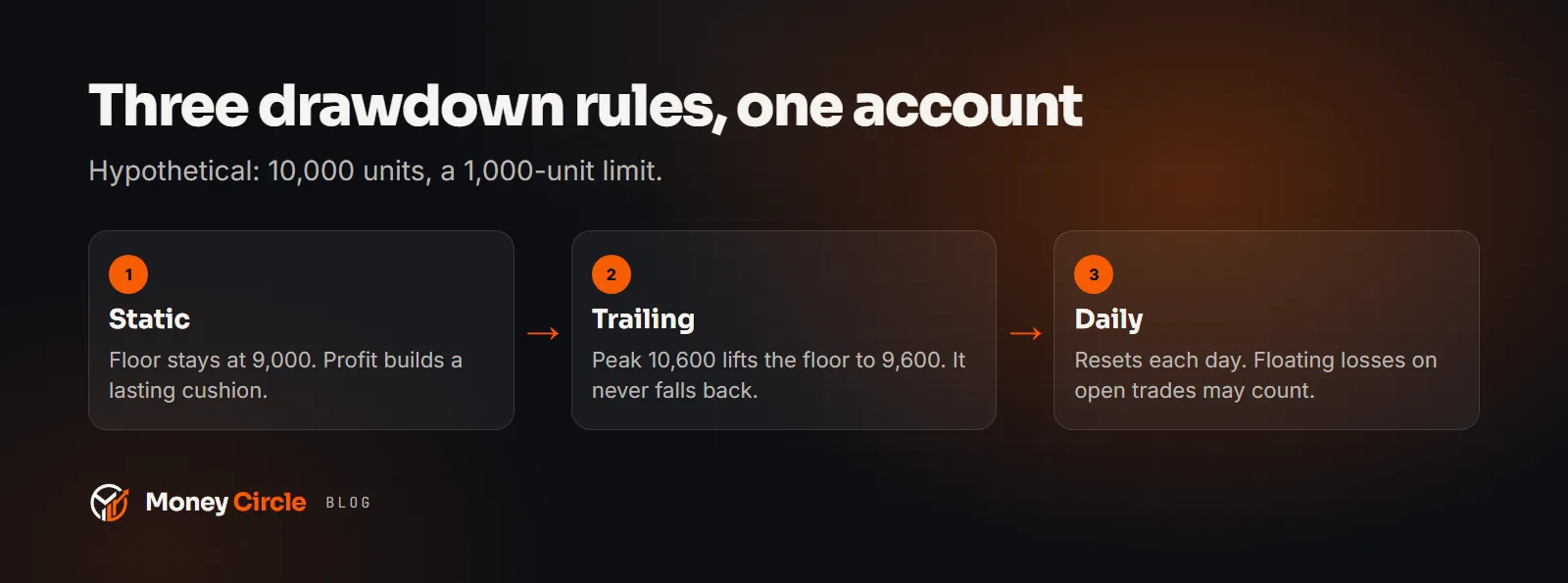
A static drawdown is a floor that never moves. If the maximum overall loss is 1,000 units on a 10,000 account, the floor is 9,000 units. It stays at 9,000 whether you earn 500 units or lose 500.
This is the easiest version to understand and the most forgiving, because profits give you a growing cushion. If you reach 10,800 units, you can lose 1,800 before you touch the floor. The distance to the line is always the current balance minus 9,000.
Trailing drawdown
A trailing drawdown moves up with your best result. The floor sits a fixed distance below the highest point your account has reached. With a 1,000-unit trailing rule, a start at 10,000 gives a floor of 9,000. If your account reaches 10,600, the floor rises to 9,600. If the account then falls back to 10,200, the floor stays at 9,600, because it only moves up.
Two consequences matter. First, profits do not build a lasting cushion in the way they do under a static rule: after a good run, your room to be wrong is still 1,000 units from the peak. Second, giving back gains can be dangerous. A trader who is up 600 and loses 450 on the next trade has a floor at 9,600 and a balance of 10,150, so the distance to failure is only 550.
Some trailing rules stop trailing once the floor reaches the starting balance, so it is locked from then on. Others never stop. This detail is worth finding out before you trade.
Equity-based or balance-based
A third question applies to both of the above: is the line measured against your closed balance or your equity, which includes open trades? If it uses equity, an open position that moves against you counts as a loss even if you would have recovered. It also means that a trailing floor can rise because of a profit you never banked.
Here is a hypothetical case. Your account is at 10,000 and a trade moves 400 units in your favour, then reverses and you close at breakeven. Under a balance-based trailing rule, nothing happened. Under an equity-based trailing rule, the high-water mark may now be 10,400, so your floor has risen to 9,400 for a trade that earned nothing. That is why you read the definition word for word.
Daily loss limits
The daily loss limit is separate. It caps how much you can lose within a single trading day, and it usually resets at a fixed time. Three details cause most of the confusion:
- What it is measured from. Some rules measure from the balance at the start of the day, some from the equity at that moment, some from the previous day's close. These can produce different floors on the same day.
- Whether open trades count. Often they do. A closed loss of 200 units plus a floating loss of 300 units on an open trade is a 500-unit loss for the purposes of the rule.
- When the day starts. The reset time is set by the firm and may not match your local midnight.
The danger zone between the rules
The overall limit and the daily limit interact. A large daily loss can also breach the overall limit if you are already below your starting balance. Trailing rules make this worse because a good day followed by a bad day raises the floor and then tests it.
A common mistake is to treat the firm's limits as a budget. They are not a target to spend down; they are the edge of a cliff. This is why a better plan is to set smaller personal limits inside them. Our guide on how to pass a prop firm challenge shows how: a personal daily stop at a fraction of the firm's, and a pause point well before the overall floor.
How to read the rule: a checklist
Before you pay for or start any evaluation, find the exact wording and answer these questions in writing:
- Is the overall drawdown static or trailing?
- If trailing, does it ever lock, and at what level?
- Is it measured on balance or equity?
- Is the daily limit measured from the start-of-day balance, equity or previous close?
- At what exact time does the trading day start and end?
- Do open trades count towards the daily and overall limits?
- Do fees, swaps and commissions count as losses?
- What happens on a breach: is the account closed at once, or can you continue?
Sizing around the rules
Position size is how you stay away from the lines. If your daily limit is 500 units and your risk per trade is 100, three consecutive stop-outs use most of it and leave little room for slippage, a widened spread or a gap. A smaller risk per trade, a limit on the number of trades a day and a personal stop that is lower than the firm's give you a buffer. Our guide to how much to risk per trade explains how to choose the amount, and position sizing gives the formula.
Also remember that the drawdown does not care about your reasons. If an event moves the market against you faster than your stop can fill, the loss counts. Consider whether to trade through major scheduled news at all, and whether you hold positions over weekends.
Which type is "better"?
There is no universal answer. A static rule is simpler and more forgiving, but a firm may offset that elsewhere, for example with a smaller allowance or a higher target. A trailing rule can look generous in the headline number and be strict in practice. Compare the whole package: the size of the limit, how it is measured, the profit target read against the drawdown, and the minimum trading days. Our explainer on what a prop firm challenge is covers the other rules and the fee.
If you want a second pair of eyes on a particular rule set, the prop firm challenge help page is a good place to start, and the glossary defines the terms used here.
Trading involves risk of loss, evaluation fees can be lost in full, and nothing here is financial advice.
Educational content, not financial advice. Trading involves risk of loss.
Learn it, log it, review it on Money Circle
Included with every paid Money Circle membership: Trader Reflect and 2 ChartViews AI analyses a day.
Guides
Continue in the ecosystem
 ChartViews AI
 Trader Reflect
More from the Money Circle Blog



Get the free Trading Plan Template
A printable plan with your rules, risk and review routine, plus the weekly market outlook by email. Unsubscribe anytime.