

Compounding means each month's return is earned on a balance that already includes earlier returns. The calculator below applies a monthly percentage to a starting balance for the number of months you choose, with an optional deposit each month, and shows the balance at the end and by year. It is arithmetic on numbers you type, not a prediction. Real trading returns are not steady, and the page keeps that in front of you. It is free with a Money Circle account and runs in your browser.
Create a free account to use the calculator
The explanation below is public. The compounding calculator comes with a free Money Circle account.
Free. No card needed.
 Sample data
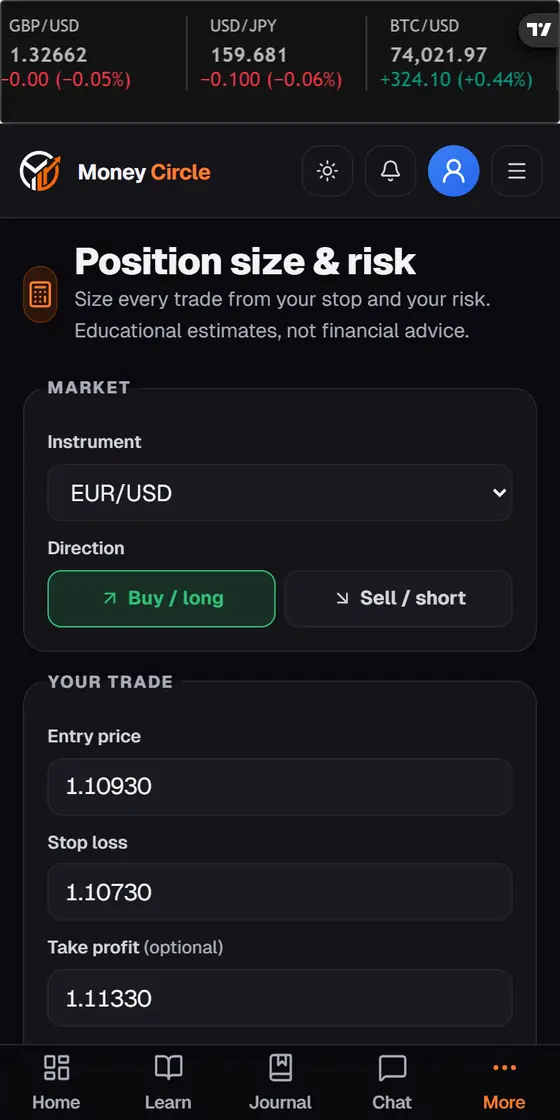
Screens from the website on a phone. Education, not financial advice. Trading involves substantial risk of loss.
Read the full guideEvery section of this page
How the calculation works
Each month the balance is multiplied by one plus the monthly return, and then any deposit is added at the end of the month. With a 5,000 balance and a steady 3 percent a month, the first month ends at 5,150, the second at 5,304.50, and so on. After 24 months the balance is about 10,164, of which 5,000 was yours at the start. The figures in this example are made up for illustration only.
Without deposits the closed form is the start multiplied by (1 plus the return) to the power of the months. With a deposit D the extra part is D multiplied by ((1 plus the return) to the power of the months, minus 1) divided by the return. The calculator uses a monthly loop and the tests check it against that formula.
Why steady returns are a poor assumption
A fixed monthly return is a convenient way to see how growth builds on itself, and it is also the reason compounding tables look so attractive. Trading does not work like a savings account. Returns arrive unevenly, some months lose money, and a few large losses can undo many small gains. A month of plus 10 percent followed by a month of minus 10 percent leaves you 1 percent below where you started, not at zero, and the effect grows with the size of the swings.
Pushing the return up in the calculator to see an impressive end figure says nothing about what is achievable. Very high monthly returns are usually paired with very high risk, and the risk of ruin calculator shows how quickly aggressive sizing can end an account. If a result looks too good to be true, treat it as a reminder of what the assumption is, not as a plan.
What you can use it for
It is useful for understanding the shape of growth rather than predicting your balance. You can see how much of a future balance comes from your own deposits and how much from the return, how a longer horizon matters more than a slightly higher rate, and how small the difference between plans is in the first few months.
- The balance at the end, the total you put in and the growth from the return.
- A table with the balance after every 12 months and at the final month.
- An optional monthly deposit, added at the end of each month.
- Negative monthly returns, from minus 50 percent, to see how a losing run compounds the other way.
Inputs and limits
Months run from 1 to 600, the monthly return from minus 50 to plus 50 percent and the deposit from zero up. Taxes, fees, withdrawals, changes in position size and the cost of trading are not included. Compounding in a real account also depends on how much you risk per trade, and position sizing, not a headline percentage, decides how a balance behaves.
Results are educational estimates, not advice. No monthly return is guaranteed, and trading carries a high risk of loss.
Frequently asked questions
How do I calculate compound growth on a trading account?
Multiply the balance by one plus the monthly return for every month, adding any deposit at the end of the month. The calculator does this for you and shows the balance by year.
Is the result a forecast of my account?
No. It is arithmetic on numbers you entered, with a return that never changes. Real trading returns vary from month to month and can be negative.
What monthly return should I enter?
Nothing here is a recommendation. Use your own journal figures if you have a long record, or try a low number to see the shape of the growth. High numbers do not show what is achievable.
Why does plus 10 percent then minus 10 percent not return to zero?
Because the second percentage is applied to a changed balance. One hundred becomes 110, and 10 percent of 110 is 11, which leaves 99.
Does compounding reduce risk?
No. Compounding describes how returns build on a balance. It does not make a strategy safer, and trading carries a high risk of loss.
Plan the risk before the percentage
Register free to open the calculators and the journal in the member area.
Educational content, not financial advice. Trading foreign exchange, CFDs and cryptocurrencies carries a high level of risk and may not be suitable for everyone. You can lose more than you expect, and past performance does not guarantee future results. Only trade with capital you can afford to lose. Disclaimer.