

Demo Account vs Live Account: What Changes and How to Move Over
A demo account teaches the mechanics but not the emotions. See what differs on a live account and how to make the move in careful steps.
Almost every broker offers a demo account: a practice account funded with pretend money. It is one of the best tools a beginner has, and it is also one of the most misunderstood. Some people spend a week on it, feel brilliant, and go live too fast. Others stay on it for a year, never feeling ready, and learn little after the first month.
This guide explains what a demo account is good for, what it cannot teach, what changes when real money is involved, and how to move over in careful steps. It does not recommend any broker or account type, and it is educational only.
What a demo account is good for
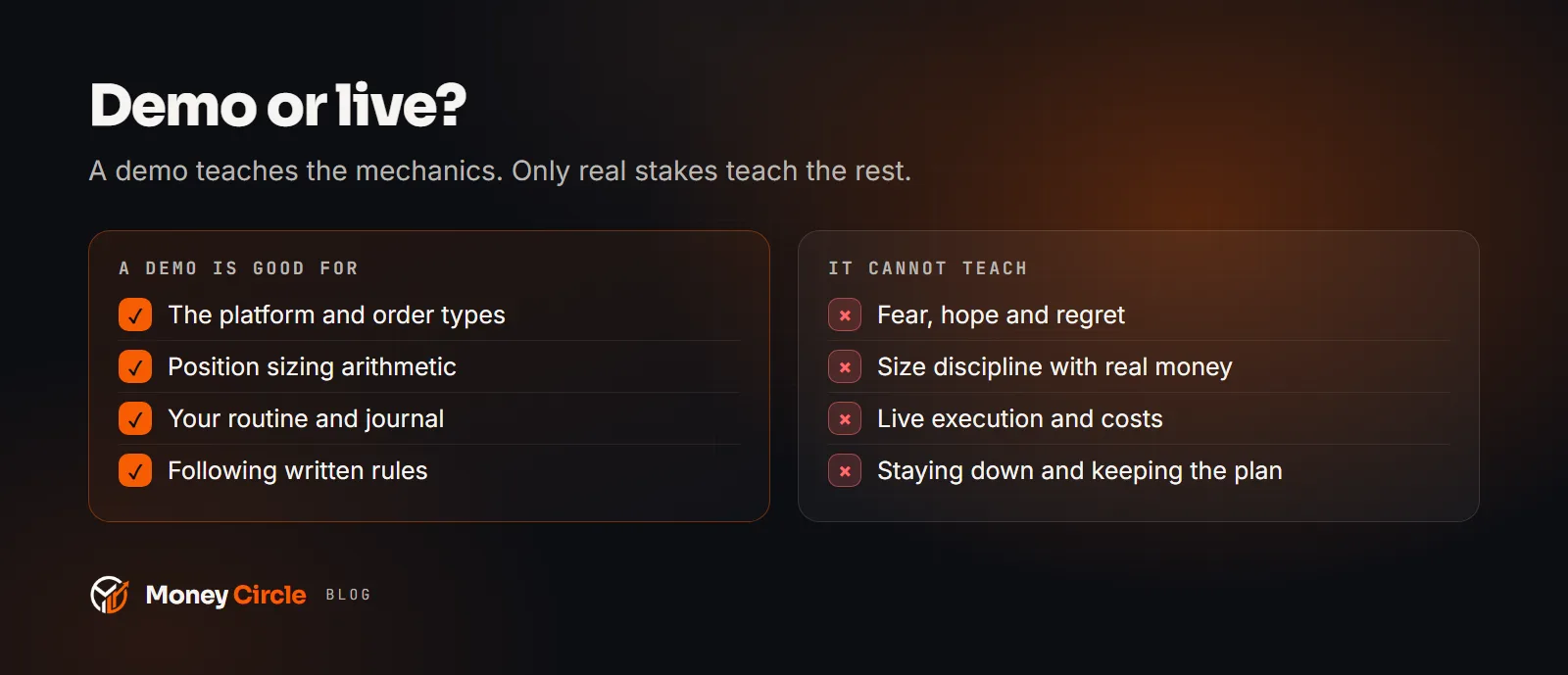
A demo account lets you practise the mechanics without risking money. Use it to learn:
- The platform. Where the buttons are, how to place, change and cancel orders, how to set a stop and a target, how to read the position window.
- Order types. The difference between a market order and a pending order, and what happens when each fills.
- Position sizing. How a change in lot size or contract size changes the amount at risk. Our position size calculator helps you check the arithmetic.
- Your routine. Whether you can run a pre-market check, follow your rules and journal each trade.
- Your strategy, roughly. Whether your written rules produce trades you can follow in real time, which complements backtesting by hand.
What a demo account cannot teach
Pretend money changes how you act. Several things are different in a way you cannot copy:
- Emotion. Fear, hope and regret are weak when nothing is at stake. A loss that means nothing does not tempt you to move a stop, to revenge-trade or to freeze. Those reactions only appear when the money is yours.
- Size discipline. On a demo account, people often use positions they would never use with real money, because losing is cheap. Their results then say nothing about their real behaviour.
- Execution quality. A demo environment may fill orders more smoothly than real markets do. In live trading, you may meet slippage, requotes or wider spreads, especially around news. How much differs by provider, so check rather than assume.
- Consequence. Nothing in a demo teaches you what it feels like to be down on a month and still follow the plan.
What changes on a live account
When you go live, expect these differences:
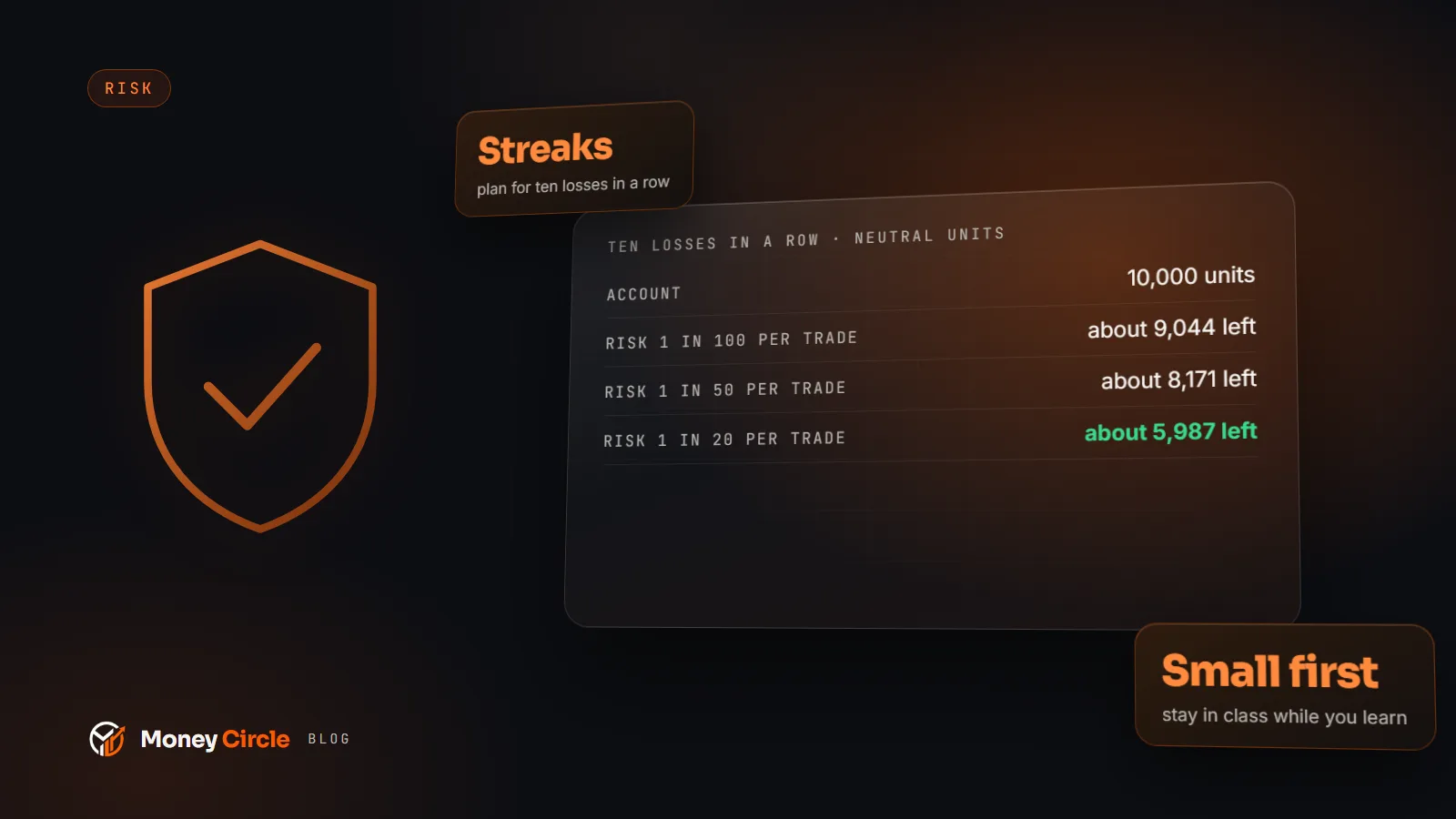
1. Every decision feels heavier. The same chart will look different once real money rides on it. Be ready to feel it, and do not take it as a sign that something is wrong. 2. Costs are real. Spread and commission now come out of an actual balance. A strategy that looked fine on a free demo may look different after costs. 3. Account rules matter. Leverage limits, margin requirements and stop-out levels become real. Read your account's own documents so you know when positions would be closed automatically. 4. You can lose more than you planned if you size badly. This is why the first live weeks should use very small size.
How long should you stay on a demo?
There is no honest fixed number. Think in terms of what you have demonstrated instead of time spent. A reasonable set of requirements:
- You have a written plan with checkable rules.
- You have followed it on the demo for a set number of trades or weeks, and your journal shows that you followed it, not just that you won.
- You have survived at least one losing stretch on the demo without breaking your rules.
- You can explain every trade you took.
- You know exactly how much you will risk per trade and why.
Moving across in steps
The safest way to move over is gradually. Here is a simple structure:
- Step 1: a small live account. Fund it only with an amount you can afford to lose entirely, and treat it as the price of learning. Never fund it with money you need for living costs or debts.
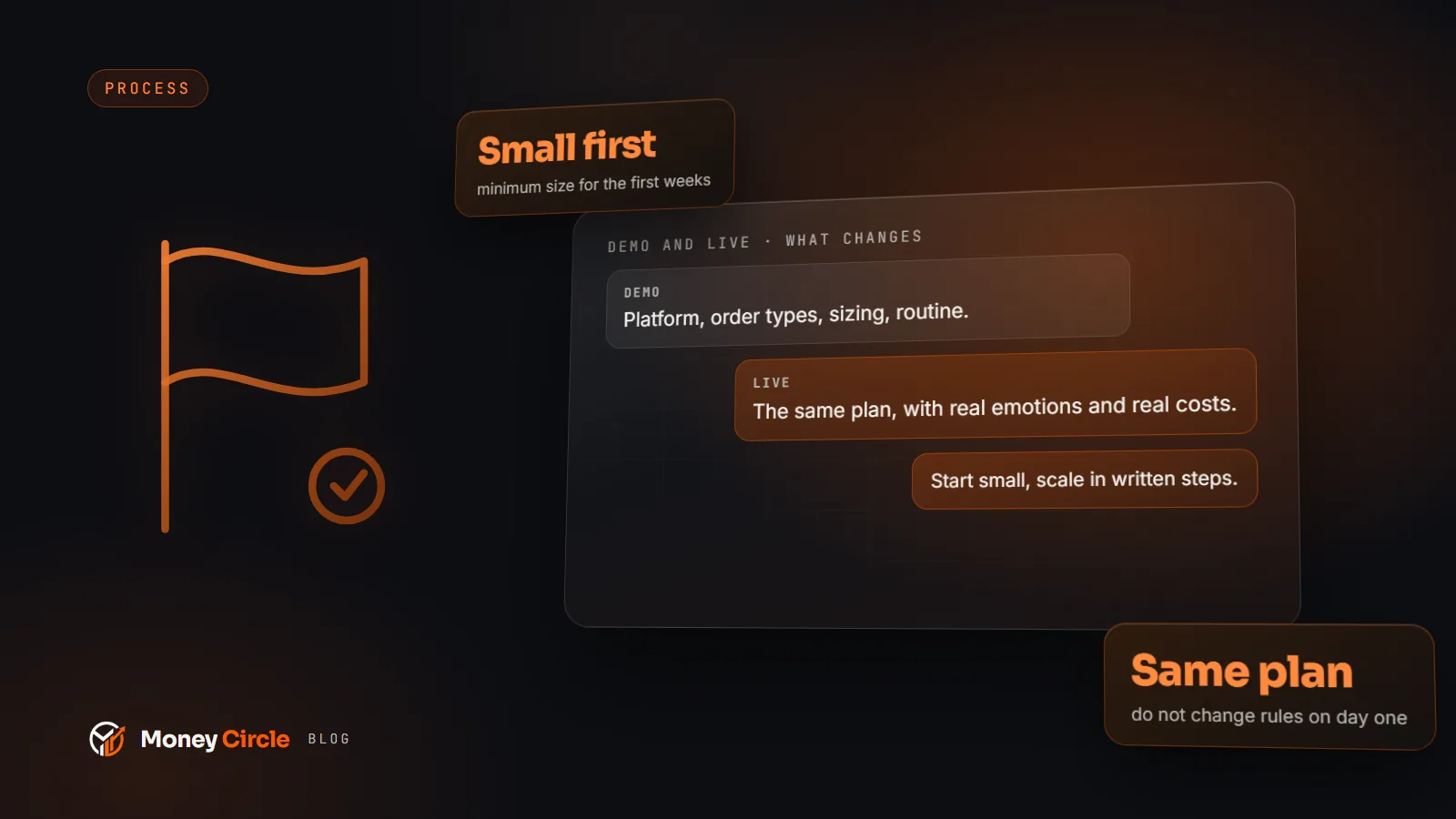
- Step 2: minimum size. Trade the smallest size your account allows for the first weeks. The goal is to experience real emotions with a loss small enough to learn from.
- Step 3: the same plan. Do not change your rules on the day you go live. Use the same plan, the same journal and the same limits. If the live results differ from the demo, you learn something real about costs or behaviour.
- Step 4: scale slowly. Increase size only after you have kept to your rules for a set period, and only by small steps that you wrote down in advance.
- Step 5: keep a stop condition. Decide what would send you back to the demo, for example breaking your daily loss rule several times in a row. Going back is not failure. It is a rule doing its job.
Mistakes to avoid
- Skipping the demo. Learning platform mistakes with real money is expensive.
- Staying forever. If you have met your standards, more demo time adds little. Delay can become a way to avoid the discomfort of real stakes.
- Treating the demo as a game. If you take trades you would never take live, the record is meaningless. Trade it with the size and attitude you plan to use later.
- Chasing the account size. A bigger account is not the aim of the first months. Process is.
- Ignoring the broker's terms. Read the live account's costs, leverage rules and margin conditions yourself, from the provider's own documents. Our article on how to choose a CFD broker gives a checklist.
A final check before you go live
Ask yourself plainly: could I lose the whole of this deposit and still be fine? Do I have a written daily loss limit? Have I tested my rules? Will I journal from the first trade?
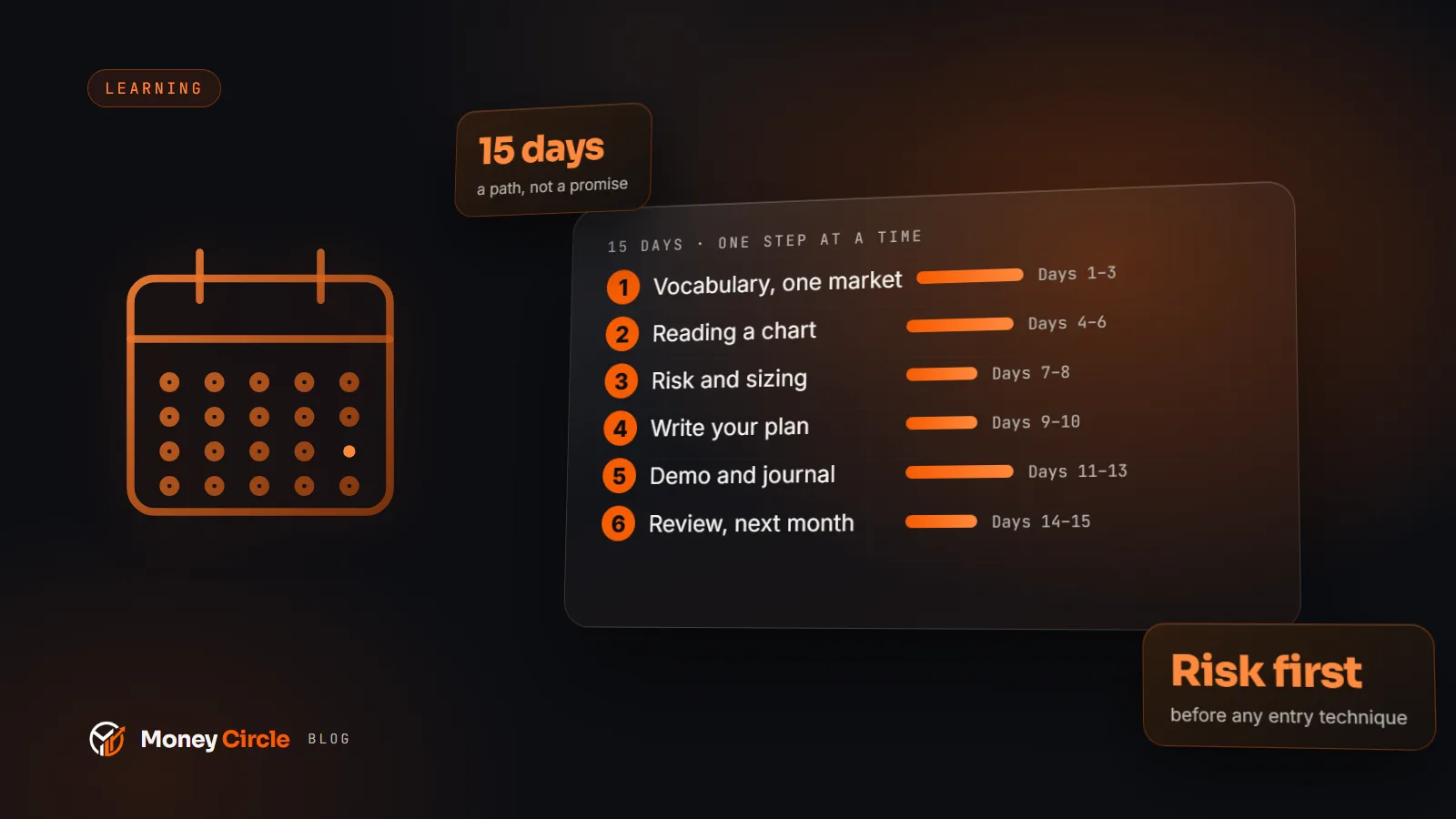
If the answers are yes, start small and let the experience teach you. If not, stay on the demo a little longer and fix the gap that stopped you. The Money Circle Academy has a lesson path that mirrors these steps, and sharing your progress in a community helps you stay honest.
Trading involves risk of loss and you can lose your entire deposit, and this is educational content, not financial advice.
Educational content, not financial advice. Trading involves risk of loss.
Learn it, log it, review it on Money Circle
Included with every paid Money Circle membership: Trader Reflect and 2 ChartViews AI analyses a day.
Guides
Continue in the ecosystem
 ChartViews AI
 Trader Reflect
More from the Money Circle Blog
Get the free Trading Plan Template
A printable plan with your rules, risk and review routine, plus the weekly market outlook by email. Unsubscribe anytime.